The field of Agent AI is defined by its ability to execute complex tasks autonomously. This autonomy isn't a single feature, but rather a progression of technical mechanisms that grant the AI greater reach, intelligence, and collaborative power. At its heart, this evolution can be broken down into three main stages: Function Calling, Multi-step Complex Planning (MCP), and Agent-to-Agent (A2A) communication.
The Three Pillars of Agent Evolution
The single slide below visualizes the difference in complexity and scope offered by these three architectural approaches. Understanding their distinct roles is crucial for designing effective AI solutions.
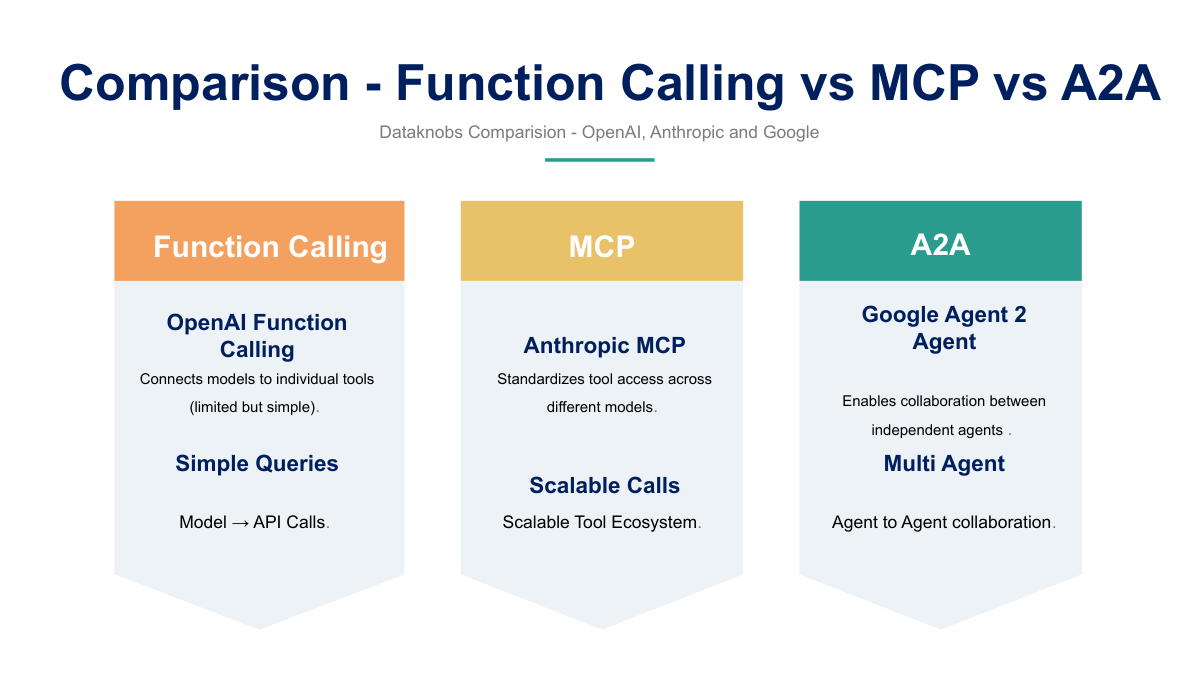
This slide provides a comparative framework, illustrating a clear progression: Function Calling (simple tool integration) serves as the foundation, leading to MCP (reasoning and sequencing for complex tasks), which finally scales up to A2A (distributed, collaborative intelligence among specialized agents). This shows how AI capabilities move from single-turn action to collaborative autonomy.
1. Function Calling (Tool Use)
Definition: Function Calling is the foundational mechanism where a Large Language Model (LLM) is trained to determine when it needs to call an external function or API based on a user's prompt, and to generate the required arguments for that call.
- Role: It allows the AI to perform single-step actions in the real world (e.g., retrieving real-time weather data, sending an email, or running a code snippet).
- Scope: Limited to the immediate response and the capabilities of the single tool provided. It lacks inherent planning or memory across multiple user interactions.
- Analogy: It’s like a smart assistant who knows exactly which button to push to fulfill an immediate, straightforward request.
2. Multi-step Complex Planning (MCP)
Definition: MCP refers to an agent's ability to break down a high-level, complex goal into a detailed, sequential series of sub-tasks. It involves iterative planning, reflection, and continuous execution.
- Role: Enables multi-turn, goal-oriented autonomy. The agent maintains memory, revises its plan based on feedback from executed steps, and uses multiple tools/functions sequentially.
- Scope: Handles complex projects requiring planning and problem-solving, such as researching a topic, drafting a report, and summarizing the result—all in one session.
- Analogy: It’s like a project manager who can devise a detailed schedule, monitor progress, and adjust the plan when faced with unexpected roadblocks.
3. Agent-to-Agent Communication (A2A)
Definition: A2A, or Multi-Agent Systems, is an architecture where multiple specialized AI agents communicate, delegate tasks, and collaborate to achieve a single collective goal.
- Role: Achieves distributed intelligence and parallel processing. Tasks are broken down and handed off to agents with specialized knowledge (e.g., a "Researcher Agent" talking to an "Analyst Agent").
- Scope: Solves the most complex, large-scale problems that benefit from specialization and parallel execution, such as simulating market behavior or managing an entire IT infrastructure.
- Analogy: It’s like a specialized corporate team—the marketing agent works with the sales agent, and the IT agent—all coordinating on a new product launch.
Conclusion: The Path to Full Autonomy
The progression from Function Calling to A2A represents the maturation of AI agent design:
- Function Calling provides the interface to the world.
- MCP provides the brain to sequence and execute.
- A2A provides the team to scale and specialize.
While Function Calling is essential, modern enterprise solutions increasingly rely on the advanced reasoning of MCP and the collaborative power of A2A systems to deliver genuine, high-value business outcomes.