EKIP Knobs: the control plane for AI-ready enterprise intelligence.
EKIP turns raw enterprise data into governed, measurable, and production-ready intelligence assets. KNOBS are the tunable decision variables that decide what data is valuable, trusted, compliant, cost-effective, and ready for data products, APIs, agents, and workflows.
signal strength, completeness, freshness
privacy, compliance, drift, misuse
business impact and reuse potential
production speed and serving SLA
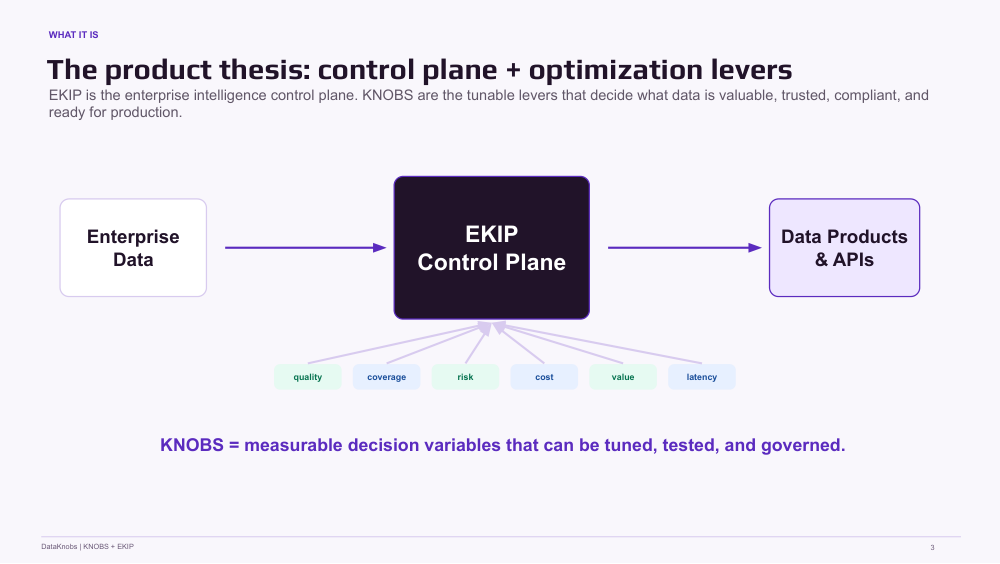
Control plane + optimization levers.
Most enterprises have data lakes, dashboards, catalogs, policies, and AI pilots. What they lack is a measurable layer that decides which data should be promoted into intelligence products and how those products should be tuned over time.
KNOBS = measurable decision variables that can be tuned, tested, and governed.
EKIP creates a repeatable path from enterprise data to trusted data products: evaluate the signal, attach controls, create semantic meaning, expose APIs, and monitor performance in production.
The core EKIP knobs.
Each knob represents a decision that can be scored, tested, versioned, governed, and optimized. Together they create a control surface for data products, RAG systems, AI agents, regulatory intelligence, and enterprise APIs.
| Knob | What it controls | Example decision | Production output |
|---|---|---|---|
| Quality | Accuracy, completeness, freshness, deduplication, source reliability. | Should this source be promoted into the trusted corpus? | Quality score, trust tier, refresh rule. |
| Coverage | Entity, product, region, customer segment, language, time-period coverage. | Is the dataset representative enough for the use case? | Coverage map, gap report, acquisition priority. |
| Risk | Privacy, compliance, regulatory sensitivity, brand risk, security exposure. | Can this data be used by an agent or only by an internal analyst? | Access policy, masking rule, review requirement. |
| Cost | Storage, labeling, embedding, model inference, API serving, human review cost. | Should we enrich every record or only high-impact records? | Cost model, budget guardrail, routing policy. |
| Value | Business impact, revenue potential, operational savings, reuse across products. | Which signal should become a paid data product? | Value score, product candidate, ROI view. |
| Latency | Batch vs real-time needs, refresh frequency, SLA, time-to-decision. | Does this signal need hourly updates or monthly refresh? | Serving SLA, pipeline schedule, cache policy. |
| Explainability | Traceability, citations, lineage, model reasoning support, auditability. | Can a user see why an answer, score, or recommendation was produced? | Evidence bundle, lineage graph, audit log. |
| Experimentation | Prompt versions, retrieval rules, model choices, scoring thresholds, agent behavior. | Which configuration produces the best trusted outcome? | Experiment report, winning config, rollback point. |
From enterprise data to governed data products.
Ingest
Bring in enterprise data, documents, transcripts, logs, APIs, public datasets, and partner feeds.
Score
Apply quality, coverage, risk, value, latency, and cost knobs to rank high-impact signals.
Semantics
Attach entities, ontology, relationships, definitions, business rules, and policy context.
Package
Publish reusable datasets, APIs, RAG corpora, agent tools, dashboards, and decision workflows.
Optimize
Continuously test prompts, models, thresholds, retrieval strategy, governance rules, and ROI.
For data leaders
Create a measurable portfolio of reusable intelligence assets instead of disconnected AI experiments.
For AI teams
Know which data, prompt, model, and retrieval configuration is production-ready before scaling agents.
For risk teams
Control sensitive content, regulated language, data usage, evidence, explainability, and review workflows.
Where EKIP knobs create leverage.
Complaints intelligence
Detect complaints, themes, regulatory risk, escalation patterns, and customer harm signals from calls, chats, emails, and reviews.
Financial signals
Turn earnings calls, fundamentals, options activity, momentum, and market events into governed data products and APIs.
Compliance for web and agents
Evaluate public pages, location pages, chatbots, and agent responses against policy and regulatory controls.
Supply chain risk
Combine vendor, geography, disruption, commodity, logistics, and news signals into supplier risk intelligence.
Enterprise knowledge graph
Connect people, projects, products, documents, decisions, metrics, risks, and policies into semantic memory.
Evaluation datasets
Build high-impact test sets for prompts, models, RAG pipelines, agents, workflows, and business decisions.
What EKIP produces
- Trusted datasets with quality, lineage, and coverage metadata.
- High-impact signals scored by value, cost, risk, and production readiness.
- Governed APIs for products, agents, dashboards, and customer workflows.
- Evaluation datasets for continuous testing across models and prompts.
- Audit evidence for decisions, policy application, and regulatory review.
Why it matters
- AI systems are only as reliable as the data and controls behind them.
- Enterprise teams need knobs they can measure, tune, and defend.
- Data products need reusable intelligence, not one-off pipelines.
- Agents need trusted memory, policies, evidence, and feedback loops.
- Leaders need a control plane that connects data value to business outcomes.
Build the control plane for your enterprise intelligence.
Start with one high-value domain: complaints, compliance, stocks, supply chain, customer calls, tax, legal, or enterprise knowledge. EKIP turns the domain into a measurable data product portfolio.
Recommended first workshop
Identify the top 10 enterprise intelligence signals, define the initial knobs, score production readiness, and create the first data product roadmap.