Governance is embedded, not bolted on.
EKIP turns governance into executable product logic. Every AI data product carries validity checks, risk constraints, quality thresholds, operational SLAs, lineage, approvals, monitoring rules, and evidence trails.
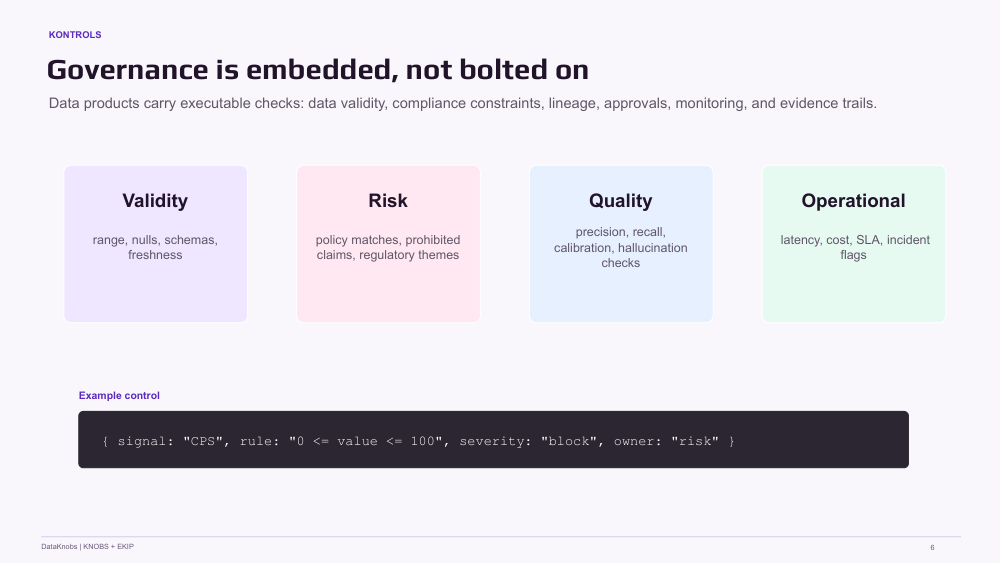
Four families of executable controls.
Instead of writing governance after the model is already in production, EKIP packages controls with the data product itself. Controls run during ingestion, labeling, evaluation, publishing, serving, and monitoring.
Validity
Range, nulls, schema, freshness, source completeness, distribution shifts, duplicates, and required metadata.
- Block bad inputs
- Quarantine incomplete records
- Track schema drift
Risk
Policy matches, prohibited claims, regulated themes, privacy flags, jurisdiction constraints, and escalation triggers.
- Detect compliance exposure
- Route for review
- Preserve decision evidence
Quality
Precision, recall, calibration, hallucination checks, citation quality, reviewer agreement, and confidence thresholds.
- Measure model reliability
- Compare prompt variants
- Promote only trusted outputs
Operational
Latency, cost, SLA, incident flags, retry behavior, throughput, version compatibility, and release readiness.
- Control cost and speed
- Detect service degradation
- Support rollback
Controls are machine-readable, owned, and enforceable.
A control can be simple enough to understand and structured enough to run automatically inside the product pipeline.
"signal": "CPS",
"rule": "0 <= value <= 100",
"severity": "block",
"owner": "risk",
"evidence_required": true,
"on_fail": "quarantine_and_create_review_task"
}
Stop unsafe or invalid data from entering production.
Allow usage with visible risk and review signals.
Send borderline cases to product, risk, or compliance owners.
Attach evidence, lineage, and reviewer decisions.
The same controls follow the data product across its lifecycle.
Validate source data
Check schema, freshness, completeness, sensitivity, and source lineage before the data enters EKIP.
Create signals
Generate labels, scores, embeddings, summaries, themes, and derived data products with traceable versions.
Run quality gates
Test precision, recall, calibration, citation accuracy, bias slices, policy coverage, and regression impact.
Apply governance gates
Require sign-off by business owner, data steward, risk reviewer, or compliance owner before publishing.
Watch production
Track drift, incidents, SLA, cost, hallucination, complaints, overrides, and real-world feedback.
AI governance cannot live in a separate document.
Policies, review checklists, and model cards are useful, but they do not enforce behavior by themselves. EKIP moves governance closer to the data, prompts, evaluations, agents, and production signals that determine actual outcomes.
- Controls execute where work happens
- Failures create workflow tasks, not just reports
- Approvals are tied to versions and evidence
- Monitoring continuously updates trust status
Every data product has a governance contract.
The governance contract defines owners, checks, thresholds, release rules, monitoring obligations, and what happens when a control fails.
How teams operationalize EKIP KONTROLS.
Define
Document the product purpose, expected users, data sources, output signals, risk classes, and business owners.
Encode
Convert policies and quality expectations into executable controls, thresholds, rules, tests, and review routing.
Attach
Package controls with the data product, signal schema, evaluation set, model version, prompt version, and lineage.
Operate
Run gates continuously, capture evidence, publish dashboards, open review tasks, and improve the controls over time.
Governance patterns for real enterprise AI products.
| Use case | Embedded controls | Business outcome |
|---|---|---|
| Complaint intelligence | Complaint score thresholds, UDAAP theme detection, product-specific escalation, reviewer evidence, accuracy gates. | Consistent complaint identification with auditable regulatory risk handling. |
| Website and chatbot compliance | Prohibited claims, missing disclosures, stale content, unsafe chatbot answers, citation and approval checks. | Continuous monitoring of company-controlled and customer-facing content. |
| Stocks intelligence signals | Signal range checks, freshness, data source lineage, calculation version, anomalous movement, confidence bands. | Reusable financial data products with explainable signal quality. |
| Knowledge assistants | Retrieval grounding, citation presence, hallucination tests, restricted topic rules, answer confidence, source freshness. | Safer enterprise copilots that can be measured and governed. |
| Agentic workflows | Tool permission checks, action approval gates, cost limits, latency SLA, rollback triggers, human-in-the-loop routing. | Agents that act within enterprise policy instead of bypassing it. |
Governance should generate proof automatically.
When an auditor, executive, product owner, or customer asks why an AI system behaved a certain way, EKIP can show the data product version, controls that ran, evidence used, approvals granted, and incidents detected.
Lineage
Source data, transformations, model version, prompt version, evaluator version, and generated output.
Approvals
Business owner, compliance owner, reviewer decisions, exception handling, and release status.
Monitoring
Drift, quality, cost, latency, incidents, policy hits, user feedback, and remediation status.
Make every AI data product govern itself.
Embed validity, risk, quality, and operational controls directly into your data products, evaluation sets, and agentic workflows.