Slide 12 Concept · Executive Intelligence Layer

Turn AI activity into executive operating intelligence.

KNOBS EKIP gives leadership a single view of AI value, risk, adoption, evaluation quality, data readiness, and optimization progress. It connects datasets, prompts, models, agents, workflows, experiments, and controls into measurable business outcomes.
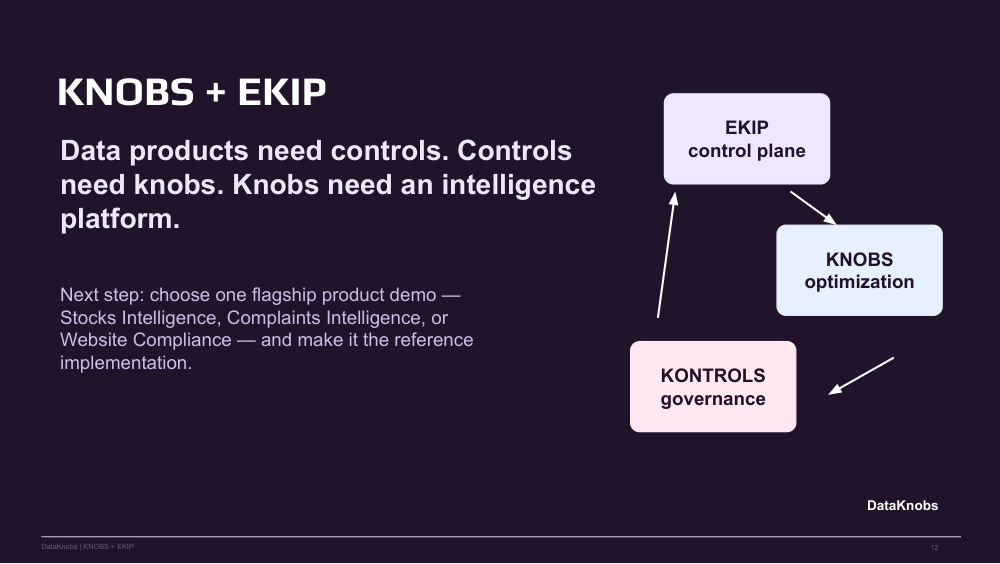
KNOBS EKIP slide 12 concept
Source concept image expanded into an enterprise product webpage.

The executive dashboard for enterprise AI performance

Most AI programs report activity: number of pilots, number of models, number of users, number of tokens. EKIP shifts the conversation to outcomes: value created, risk reduced, quality improved, cost optimized, and knobs that actually moved the business.

87%
High-impact knobs identified
42
Datasets needing quality action
19%
Cost reduction opportunity
7
Risk controls requiring review

Business Value View

Track revenue lift, productivity, complaint reduction, cycle-time improvement, and decision quality by initiative, domain, team, and use case.

AI Quality View

Monitor evaluation scores, prompt regression, model drift, hallucination risk, dataset coverage, edge cases, and human review outcomes.

Governance View

Show control status across policy, privacy, compliance, audit evidence, approvals, experiments, and production deployment readiness.

Portfolio View

Prioritize AI investments across stocks intelligence, complaints intelligence, compliance, tax, supply chain, ecommerce, and operations.

Knobs View

See which levers are driving performance: data filters, thresholds, scoring weights, prompts, retrieval strategy, routing, and automation rules.

Consumption View

Connect APIs, assistants, websites, mobile apps, dashboards, batch jobs, and agent workflows to measurable downstream consumption.

From AI pilots to an AI operating model

EKIP creates a repeatable system for deciding what to build, what to test, what to govern, what to scale, and what to retire.

1. InventoryMap AI use cases, datasets, prompts, models, workflows, owners, and business goals.
2. EvaluateMeasure quality, coverage, bias, risk, stability, cost, latency, and human acceptance.
3. OptimizeIdentify high-impact knobs and run controlled experiments before production changes.
4. GovernAttach controls, approval checkpoints, audit evidence, and monitoring to each AI asset.
5. ScalePromote proven patterns into reusable products, APIs, templates, and enterprise playbooks.

What leaders can ask EKIP

  • Where is AI creating measurable value? Compare initiatives by ROI, adoption, and outcome improvement.
  • Which AI systems are risky? Surface weak controls, low evaluation coverage, unresolved policy gaps, and drift.
  • Which knobs should we tune next? Rank opportunities by expected lift, cost reduction, risk reduction, and implementation effort.
  • What should move from pilot to production? Use evidence instead of intuition to scale enterprise AI.

What teams can manage

  • Datasets: source, lineage, coverage, freshness, schema, quality, sensitivity, labels, and gaps.
  • Prompts and agents: versions, experiments, evaluation results, fallback paths, and approval status.
  • Controls: policies, constraints, thresholds, human review, logs, red-team tests, and compliance evidence.
  • Consumption: APIs, apps, dashboards, workflows, customer journeys, and operational handoffs.

KNOBS EKIP becomes the management layer for enterprise AI.

It does not replace your models, data platforms, BI tools, or applications. It connects them into an operating system for AI decisions, evaluation, governance, and continuous improvement.

Back to Blueprint