From raw data to high-value intelligence products.
EKIP turns scattered enterprise data into reusable intelligence assets. Each layer increases quality, reuse, auditability, and business value: raw data becomes gold datasets, gold datasets become features, features become signals, and signals become data products used by APIs, agents, dashboards, alerts, and decision workflows.
value layers from raw data to product
lineage from source to decision
productized signals for reuse
impact tracked across the chain
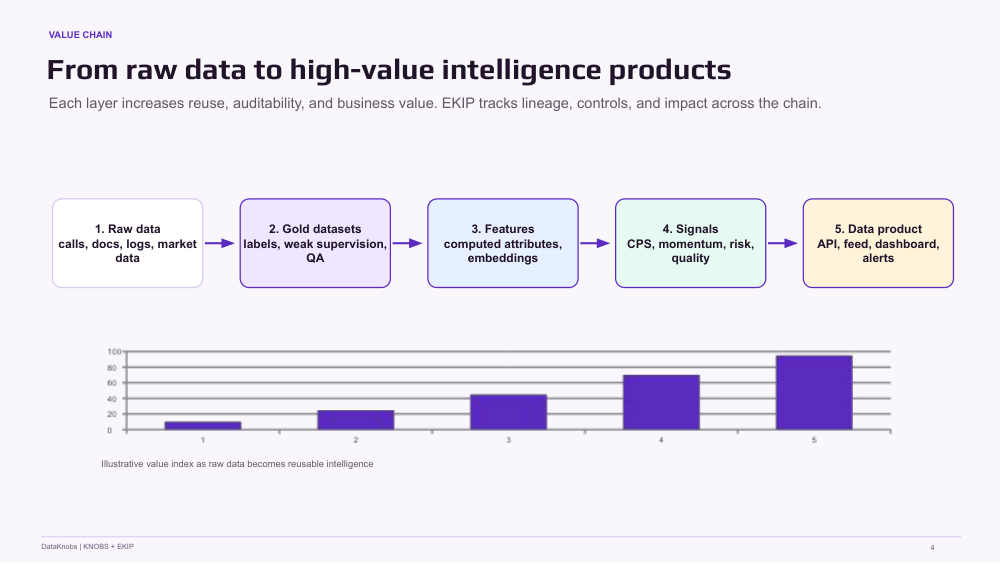
Every step adds structure, trust, and monetizable intelligence.
The value chain is not just a pipeline. It is a governed product lifecycle where every artifact has lineage, quality metadata, controls, owners, consumers, and measurable business impact.
Raw data
Calls, documents, logs, market data, claims, chats, reviews, CRM data, transactions, PDFs, events, and public sources.
Gold datasets
Cleaned, deduplicated, labeled, supervised, quality-checked, permissioned, and ready for reuse.
Features
Computed attributes, entities, embeddings, categories, summaries, taxonomies, and semantic relationships.
Signals
Scores such as CPS, momentum, complaint risk, regulatory risk, supply risk, opportunity, confidence, and quality.
Data products
APIs, feeds, dashboards, agent tools, alerts, workflows, reports, and customer-facing intelligence products.
Raw data has potential. Intelligence products have compounding business value.
EKIP makes that compounding value visible by tracking how each source, feature, signal, and product contributes to decisions, revenue, risk reduction, and operational leverage.
EKIP tracks lineage, controls, and impact at every layer.
Each layer has different risks and optimization knobs. EKIP keeps the chain auditable from source ingestion to customer-facing intelligence.
| Layer | Primary EKIP questions | Controls and knobs | Evidence captured |
|---|---|---|---|
| Raw data | Can we use it? Who owns it? Is it sensitive? Is it current? | Access policy, source trust, privacy classification, ingestion SLA, retention rule. | Source registry, permissions, timestamps, data contracts, usage restrictions. |
| Gold datasets | Is it clean, labeled, complete, representative, and reusable? | Quality threshold, labeling guidelines, dedupe rule, validation tests, coverage targets. | QA score, label audit, coverage report, exception log, dataset version. |
| Features | Which attributes explain the business outcome? Which semantic relationships matter? | Feature importance, embedding model, taxonomy, ontology, entity resolution, freshness. | Feature lineage, entity map, semantic definitions, model/prompt version. |
| Signals | Which computed signals are predictive, explainable, stable, and valuable? | Signal formula, threshold, confidence, drift, calibration, false-positive cost. | Score card, backtest, threshold rationale, validation examples, drift history. |
| Data products | Who consumes it? What decision does it support? What is the ROI? | API SLA, product packaging, pricing, consumer access, dashboard UX, alert rules. | Usage logs, decision outcomes, revenue attribution, audit trail, customer feedback. |
One chain, many product outputs.
The same EKIP value chain can power internal decision systems and external data products.
Signal API
Expose CPS, momentum, risk, quality, complaint, supply-chain, or regulatory signals as secured APIs.
Agent tool
Let enterprise agents call trusted signals instead of guessing from ungoverned documents or ad hoc prompts.
Dashboard
Give executives and operators a productized view of trends, exceptions, impact, and opportunities.
Alert engine
Trigger alerts when risk increases, momentum changes, quality degrades, or an opportunity crosses a threshold.
Evaluation set
Use gold examples and high-impact edge cases to continuously evaluate models, prompts, RAG, and agents.
Customer product
Package domain intelligence into a paid data product, application module, marketplace feed, or embedded feature.
Example: complaints intelligence chain
- Raw data: call transcripts, chats, emails, product metadata, agent notes.
- Gold datasets: labeled complaint/non-complaint examples and regulatory categories.
- Features: customer harm terms, escalation phrases, product references, intent, sentiment, entities.
- Signals: complaint probability, UDAAP risk, root cause, severity, trend, repeat issue.
- Products: audit dashboard, regulatory risk API, branch/product alerts, executive reporting.
Example: market intelligence chain
- Raw data: earnings calls, fundamentals, prices, analyst notes, options, news.
- Gold datasets: normalized company-quarter records and labeled events.
- Features: revenue surprise, EPS surprise, moving averages, options OI, sector context.
- Signals: CPS, earnings momentum, demand/supply zones, resistance/support, risk score.
- Products: stock signal API, watchlist alerts, dashboard, mobile assistant, portfolio workflows.
Map your data value chain into intelligence products.
Start with one domain: complaints, compliance, stocks, supply chain, legal, customer calls, tax, operations, or enterprise knowledge. EKIP identifies which raw data can become gold datasets, features, signals, and productized intelligence.
Workshop output
Value-chain map, signal inventory, controls matrix, data product candidates, API/dashboard roadmap, and ROI model.