Agent AI represents the next leap in artificial intelligence, moving beyond simple tools to **autonomous, goal-oriented systems**. These agents are digital workers capable of making decisions and executing complex tasks without constant human input. Their core strength lies in combining **autonomy, continuous learning, and purposeful action**.
Agents come in different forms from **Reactive** (immediate response) to **Deliberative** (long-term planning) and **Hybrid** (combining both). They are not just enhancing productivity through **Task Automation**, but are also transforming business outcomes by offering highly **Tailored Experiences** and extracting critical **Data-Driven Insights** from vast, unstructured datasets. Agent AI is defining the future of digital efficiency and personalization.
--- ## 🖼️ Slides: Visual Overview of Agent AI Concepts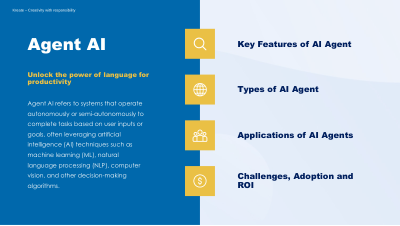


Artificial Intelligence is advancing rapidly, and the concept of a self-sufficient AI **Agent** is leading the charge. An AI agent is more than a tool; it's a software system capable of sensing its environment and acting upon it to achieve specific objectives. These agents are built on a set of critical characteristics that enable their powerful performance.
### Core Features Defining Agent AIThe functionality of an AI agent stems from its sophisticated design:
- Autonomy: The ability to make independent choices and execute complex workflows. This can range from autonomously managing a project schedule to executing complex financial trading strategies.
- Learning Capabilities: Agents leverage machine learning to continuously adapt. They learn from new data, past outcomes, and user feedback, ensuring their effectiveness improves over time.
- Goal-Oriented Behavior: Every action an agent takes is directed toward achieving a predefined goal, making them highly efficient at problem-solving, optimization, and task completion.
- Interaction with the Environment: Agents perceive their operational domain whether it's the physical world (via sensors) or a digital landscape (via APIs and data streams) and interact with it dynamically.
- Reactivity and Proactiveness: Agents can be **reactive**, responding instantly to market changes or alerts, or **proactive**, anticipating needs, like a predictive maintenance system flagging equipment failure before it happens.
Agents are categorized by their complexity and how they process information to act:
- **Reactive Agents:** Simple agents that act solely on the current perceived state. They have no internal memory or complex reasoning.
- **Deliberative Agents:** These agents maintain a model of the world and use **reasoning and planning** to predict the future outcomes of their actions before choosing a step.
- **Hybrid Agents:** They combine the speed of reactive systems with the foresight of deliberative systems, offering the best of both worlds for nuanced tasks.
- **Utility-Based Agents:** These agents calculate the "utility" or value of each potential action, choosing the one that will maximize their performance measure or reward.
The deployment of AI Agents is creating real-world business impact:
- **Task Automation:** By handling routine, repetitive tasks from data entry and report generation to initial customer support triage agents drastically increase human productivity.
- **Tailored Experiences:** Agents analyze individual user preferences and historical behavior to deliver **hyper-personalized** outcomes, such as custom marketing messages or specialized financial advisory.
- **Data-Driven Insights:** Agents excel at sifting through vast quantities of **unstructured data** (often called 'dark data'), uncovering patterns and insights that humans would likely miss, thereby improving the quality and speed of strategic decision-making.
- **Instant Responses:** In fast-moving sectors like algorithmic trading or cybersecurity, agents can process and react to events in real-time, delivering immediate value where speed is critical.
As AI Agents become more sophisticated, they will continue to redefine the boundaries of what automated digital work can achieve.