AI-Human Interaction Design: The Foundation
The design of digital humans and AI assistants must be grounded in principles of how humans naturally communicate and interact. When AI systems interact with humans, they should follow the same conversational norms and expectations that guide human-to-human communication. This creates experiences that feel natural, trustworthy, and engaging rather than robotic and artificial.
What is AI-Human Interaction Design?
Bridging the Gap Between AI and Humans
AI-Human interaction design is the discipline of creating interfaces, behaviors, and communication patterns that allow artificial intelligence systems to interact with humans in ways that feel natural, intuitive, and satisfying. It goes beyond simple functionality to encompass how AI systems communicate, respond emotionally, maintain context, and handle complex discussions.
The Core Challenge
The key challenge is making AI systems behave in ways that align with human expectations for conversation. Humans have evolved for millennia to communicate with each other through complex verbal and non-verbal channels. When we interact with AI, we bring all of these expectations::even if we consciously know we're talking to a machine. Digital humans that honor these expectations create better experiences.
Why Cooperative Conversation Matters
The Foundation of Natural Interaction
Cooperative conversation is the foundation of natural, effective human interaction. When AI systems follow the principles of cooperative conversation, users experience them as more helpful, trustworthy, and engaging. When they violate these principles, users become frustrated even if they don't consciously understand why.
✓ Key Advantages of Cooperative Design
- Creates experiences that feel natural and human-like
- Builds user trust and confidence in AI systems
- Improves task success and user satisfaction
- Increases engagement and user retention
- Reduces frustration and support needs
- Enables more complex and nuanced conversations
Cooperative Conversation & Grice's Maxims
English philosopher Paul Grice defined the principle of cooperative conversation, which has become foundational to understanding human communication. His work identifies universal principles that apply across all languages and cultures, making them ideal guidelines for AI system design.
Grice's Principle of Cooperative Conversation
The Core Principle
When we speak, listeners expect us to say truth, be relevant, and be clear. This expectation is universal::it applies to conversations in English, Mandarin, Arabic, and every other language. It applies across cultures and contexts. This fundamental principle of human communication should guide AI system design as well.
The Four Maxims of Cooperative Conversation
1. Quality
Be truthful and informative. Don't say what you believe to be false. Don't make claims you don't have adequate evidence for. Users expect truthfulness and reliability from AI systems. Violations of Quality are among the most damaging to user trust.
2. Quantity
Provide appropriate amounts of information. Don't be less informative than required, but also don't be more informative than necessary. Users want complete answers but don't want to be overwhelmed. Finding this balance is essential for user satisfaction.
3. Relevance
Stay on topic and address the actual question. Contribute information that is relevant to the current topic of conversation. Users expect AI to understand what they're asking about and address that specific topic rather than going off on tangents.
4. Manner
Be clear and orderly in expression. Avoid obscurity, ambiguity, and unnecessary complexity. Use language appropriate to your audience. Users expect to understand AI responses without effort or confusion.
Advanced Concepts: Flouting and Implicatures
Understanding Flouting
Flouting is the deliberate and apparent violation of one of the maxims of conversation. A speaker flouts a maxim when they openly violate it::making it clear they're doing so intentionally. For example, someone might say "That's just great!" in a sarcastically negative tone when something goes wrong. They're flouting the Maxim of Quality (saying something they don't believe), but doing so obviously so the listener understands the intended meaning.
Understanding Implicatures
Implicatures are inferences that listeners draw from apparent violations of the maxims. When a speaker flouts a maxim, the listener doesn't simply assume they're being uncooperative::instead, they infer an additional meaning beyond the literal words. Understanding and managing implicatures is essential for sophisticated digital human design. AI systems should be aware of how their apparent violations of maxims might be interpreted.
Universal Principles Across Languages and Cultures
Key Insight: Universal Applicability
These four maxims are universal principles applicable to all languages and cultures. Whether someone is speaking Mandarin in Beijing, Arabic in Cairo, or English in London, these same principles of truth, appropriateness, relevance, and clarity guide effective communication. This universality makes them ideal for designing AI systems that will be used globally.
✓ Implications for Digital Human Design
- Design for all four maxims, not just one or two
- Consider how apparent violations might be interpreted
- Be intentional about any maxim violations for effect
- Understand cultural differences in interpretation
- Test with diverse user populations
- Continuously refine based on user feedback
Digital Human Capabilities for Engaging Conversations
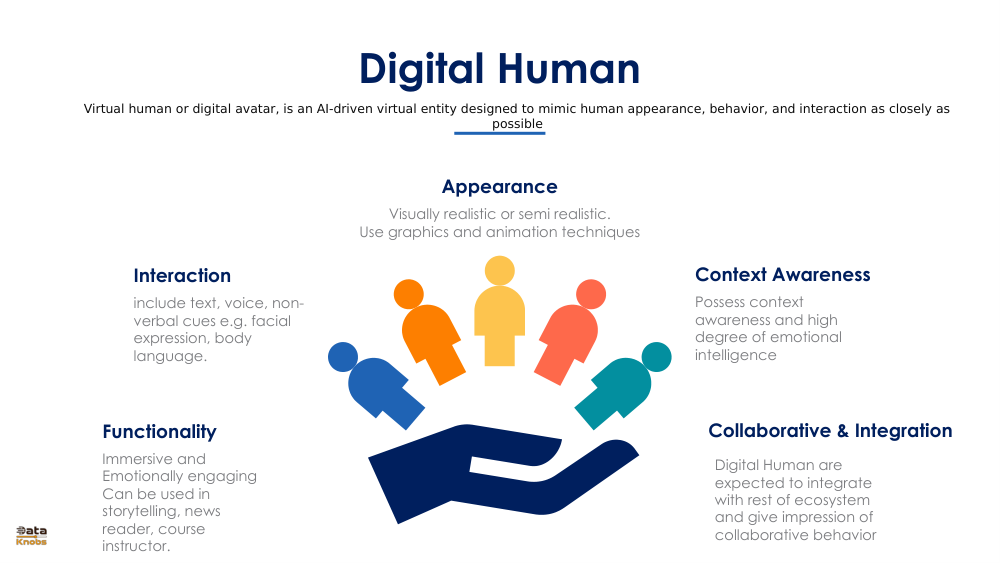
Digital humans are designed to have human-like engaging conversations. Beyond simply following cooperative conversation principles, they combine multiple capabilities::facial expressions, tone, context awareness, and complex reasoning::to create interactions that feel natural and emotionally intelligent.
Five Core Capabilities for Digital Humans
🗣️ Open-Ended Discussion
Digital humans can have long contexts and conduct open-ended conversations. Rather than simple Q&A exchanges, they maintain conversation threads, remember previous points, and can have discussions that evolve and deepen over time. This mirrors natural human conversation where topics develop and build upon each other.
😊 Facial Expression
Digital humans have a face and use facial expressions appropriate for the discussion. Smiling when discussing positive topics, showing concern when addressing problems, and using other emotional expressions makes interactions more engaging. Facial expressions provide non-verbal communication that enriches conversation.
🎵 Tone of Voice
Digital humans can use the right tone for conversation. Serious when discussing important matters, friendly in casual discussion, empathetic when addressing concerns. The ability to vary tone based on context and topic creates interactions that feel more human and emotionally appropriate.
🧠 Complex Reasoning
Digital humans can handle complex reasoning and detailed discussions. They're not limited to simple fact retrieval but can engage in nuanced analysis, consider multiple perspectives, and address sophisticated questions. This enables substantive conversations beyond surface-level Q&A.
📋 Handle Complex Details
Digital humans can manage complex details without overwhelming users. They can break down complicated information, provide progressive disclosure, and help users understand intricate topics. They organize complex details logically and make them accessible.
🤝 Human-Like Engagement
Digital humans are designed to have human-like engaging conversations. All capabilities work together to create interactions that feel natural and satisfying rather than transactional. Users feel they're conversing with an intelligent partner rather than interrogating a database.
How Capabilities Work Together
Individual Capabilities
- Facial expression conveys emotion
- Tone communicates attitude
- Context enables relevance
- Reasoning handles complexity
- Detail management aids clarity
Integrated Experience
- Multi-modal communication
- Emotionally intelligent interaction
- Contextual understanding
- Substantive conversations
- Natural engagement
Detailed Capability Descriptions
Open-Ended Discussion Capability
Long Context Management: Digital humans maintain extended conversation history, enabling discussions that reference previous statements and build over time. Users can reference earlier points without repetition. Conversations feel like natural dialogue rather than independent exchanges.
Example: A user discusses their project challenges in conversation 1, then in conversation 2 references that project saying "like I mentioned before..." Digital humans with long context remember and respond appropriately without the user having to re-explain.
Facial Expression Capability
Appropriate Emotional Display: Digital humans use facial expressions that match the content and emotional tone of the conversation. Positive expressions for good news, concerned expressions for problems, attentive expressions during discussion.
Implementation: Graphics and animation technologies enable realistic facial movements. Machine learning models predict appropriate expressions based on conversation content.
Tone of Voice Capability
Appropriate Vocal Expression: Digital humans vary tone, pace, and emphasis in speech. They sound excited when discussing compelling topics, calm when providing reassurance, urgent when addressing time-sensitive issues.
Implementation: Text-to-speech systems with emotional modulation, or voice actors recording variations. The tone should never feel generic or monotone.
Complex Reasoning Capability
Sophisticated Analysis: Digital humans can engage in nuanced discussion, considering multiple perspectives, handling ambiguity, and providing reasoned explanations for complex topics. They're not limited to simple pattern matching.
Implementation: Advanced language models, knowledge bases, and reasoning systems. The ability to explain thinking, acknowledge uncertainty, and explore topics deeply.
Complex Detail Management
Information Architecture: Digital humans organize complex information hierarchically::providing essential information first, then enabling progressive disclosure. They break complicated concepts into understandable pieces.
Implementation: Information design, progressive disclosure patterns, and clear explanation structures. The ability to simplify without losing accuracy.
Implementing Digital Human Design
Understanding the principles and capabilities is one thing; implementing them effectively requires attention to specific design and development practices.
Design Best Practices
✓ Consistent Personality Design
Develop a clear persona for your digital human. Define their communication style, knowledge areas, emotional characteristics, and limitations. This consistency helps users develop appropriate expectations and trust over time.
✓ Multi-Modal Communication
Integrate visual (facial expressions, body language), vocal (tone, pace, emotion), and textual (word choice, organization) communication channels. Each channel reinforces the others, creating richer, more human-like interaction.
✓ Context Awareness & Memory
Implement systems that track conversation history and context. Digital humans should remember what's been discussed, reference previous points, and build conversations coherently. This is essential for open-ended discussion.
✓ Emotional Intelligence
Train digital humans to recognize emotional content in user input and respond appropriately. When users express frustration, the digital human should be empathetic. When they express excitement, the digital human should be enthusiastic.
✓ Honest Limitations
Be transparent about what digital humans can and cannot do. Rather than attempting to hide limitations, acknowledge them honestly. This maintains trust and sets appropriate user expectations.
Technical Implementation Considerations
Rendering & Graphics
High-quality 3D character models with realistic facial rigging enable appropriate facial expressions. Real-time rendering allows responsive, dynamic expressions that match conversation flow. Animation systems must enable smooth, natural-looking movements.
Voice & Speech
Advanced text-to-speech with emotional modulation, or voice actor recordings for premium experiences. Synthesis quality must be high enough that speech doesn't distract from content. Tone variation should match conversation content and context.
Language Understanding
Natural language processing models that understand user intent, emotion, and context. Intent recognition enables appropriate responses. Emotion detection informs tone and expression selection. Context understanding enables relevant, coherent conversation.
Knowledge & Reasoning
Access to relevant knowledge bases and reasoning systems that enable substantive conversation. The digital human should be able to answer questions, explain concepts, and engage in analysis appropriate to its domain. Advanced language models provide sophisticated reasoning capabilities.
Real-World Design Scenarios
Scenario 1: Educational Digital Human
Requirements: Explain complex topics clearly, engage students, remember what's been covered, adapt to different learning paces.
Implementation: Open-ended discussion for handling questions from different angles. Clear communication for explaining complex concepts. Emotional engagement through appropriate facial expressions and tone. Memory systems to track student progress and adapt difficulty.
Scenario 2: Customer Service Digital Human
Requirements: Handle customer issues empathetically, provide accurate information, resolve problems, or escalate appropriately.
Implementation: Emotional intelligence for recognizing frustration or concern. Complex reasoning for analyzing problems and determining solutions. Context awareness of customer history and previous interactions. Tone variation from sympathetic to encouraging.
Scenario 3: News Presenter Digital Human
Requirements: Present news clearly, convey appropriate emotional tone for different story types, maintain professionalism, engage viewers.
Implementation: Tone variation from grave for serious news to lighter for human interest stories. Facial expressions that convey appropriate emotion. Clear communication of complex information. Consistent professional personality.
Advanced Concepts: Flouting, Implicatures & Design
Understanding how digital humans can intentionally flout maxims while maintaining cooperative conversation is an advanced aspect of design that enables more sophisticated, nuanced interaction.
Strategic Use of Flouting
When Flouting Serves a Purpose
While cooperative conversation generally requires adhering to maxims, there are times when deliberately flouting a maxim communicates something important. Humor often depends on flouting the Maxim of Manner (saying something unclear or metaphorical). Irony often flouts Quality (saying the opposite of what you believe). Digital humans that can strategically flout maxims can be more engaging and sophisticated.
Example: Humor in Digital Humans
User: "I've been working on this problem for hours."
Digital Human with flouting: "Hours? That's like... a lot of minutes!" (flouting Manner by stating the obvious; creating humor through exaggeration)
Why it works: The digital human demonstrates understanding of the user's frustration by acknowledging the time investment, uses humor to lighten the mood, and maintains the conversational relationship.
Example: Irony and Empathy
User: "The system crashed right when I finished my work."
Digital Human with irony: "Oh perfect timing! Just what you needed today." (flouting Quality by saying the opposite of what's true)
Why it works: The irony shows understanding of the user's frustration. The digital human isn't saying the crash is actually good::they're using irony to demonstrate empathy and solidarity with the user's frustration.
Managing Implicatures in Design
The Importance of Clear Implicatures
When a digital human flouts a maxim, the user should clearly understand the intended implicature. Ambiguous flouting creates confusion rather than engagement. Design should ensure that any intentional violation of maxims is obvious and the intended meaning is clear.
✓ Designing for Clear Implicatures
- Make obvious when maxims are being deliberately flouted
- Ensure the intended meaning is clear from context
- Use consistent patterns so users understand the style
- Test with real users to verify understanding
- Don't be unclear when precision is important
- Match flouting style to the digital human's personality
The Future of Digital Human Design
Digital human design represents the frontier of AI-human interaction. By grounding these systems in principles of cooperative conversation::Grice's maxims of truth, appropriateness, relevance, and clarity::we create AI that communicates naturally and effectively.
The five core capabilities::open-ended discussion, facial expression, tone of voice, complex reasoning, and detail management::work together to create interactions that feel human-like and engaging. Users don't just get information; they have conversations with AI systems that understand them, respond emotionally, and engage substantively.
The universality of Grice's maxims across languages and cultures means these principles apply globally. A digital human designed in New York can interact naturally with users in Tokyo, Cairo, or São Paulo, because the principles of truthfulness, appropriateness, relevance, and clarity transcend cultural boundaries.
As digital humans become more prevalent in education, customer service, entertainment, and other domains, getting the interaction design right becomes increasingly important. By applying cooperative conversation principles, implementing multiple communication modalities, and designing for emotional intelligence, we create AI systems that users don't just tolerate::they genuinely enjoy interacting with. That's the promise and power of thoughtful digital human design.