This presentation transitions from the chatbot risk landscape to a layered governance framework, privacy protocols, RAG checkpoints, agent permissions, and an operating model. It finishes with monitoring, incident response, and a suggested 90-day adoption plan.
Edition: November 2026. Legal summaries, dates, framework versions, and rankings remain as presented in the original and have not been independently validated in this conversion. Refer to the slides as reference material, not as a definitive statement of legal requirements.
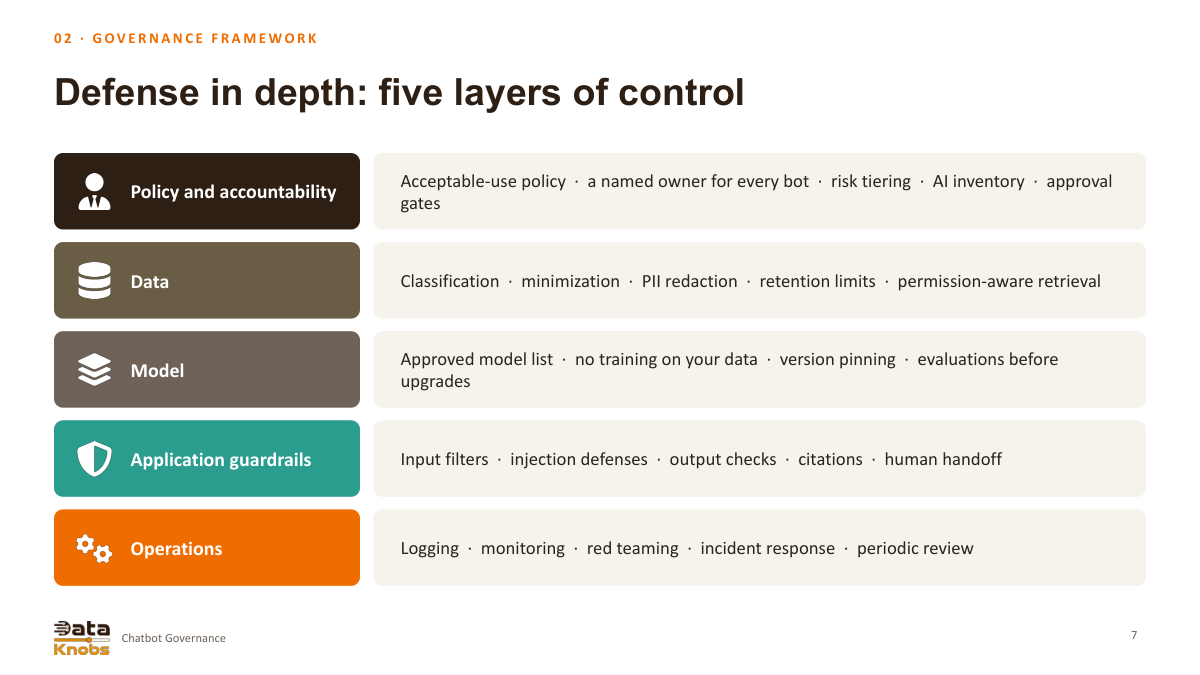
Five layers in the deck
Layer
Focus
Accountability
Owners, risk tiers, inventories and approval gates
Data
Classification, minimization, permissions and retention
Model
Model selection, version management and evaluation
Application
Input and output checks, citations and human handoff
Operations
Monitoring, incident response, red teaming and review
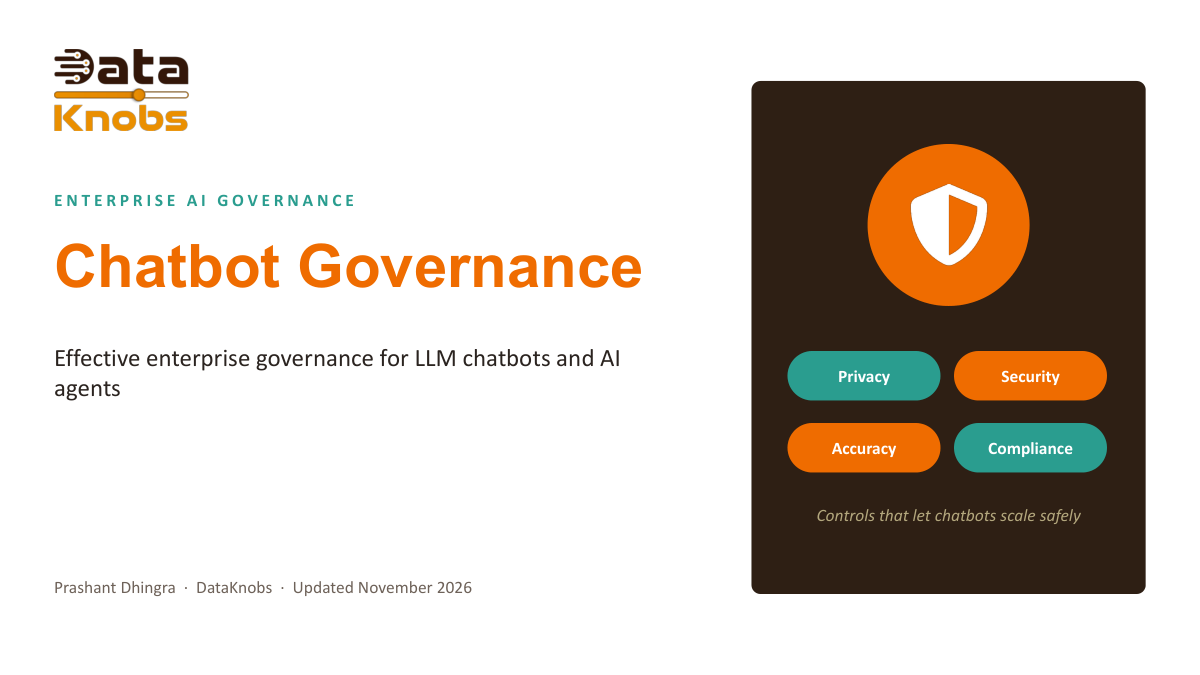
E N T E R P R I S E A I G O V E R N A N C E
Chatbot Governance
Effective enterprise governance for LLM chatbots and AI
agents
Prashant Dhingra · DataKnobs · Updated November 2026
Privacy
Security
Accuracy
Compliance
Controls that let chatbots scale safely
Chatbot Governance
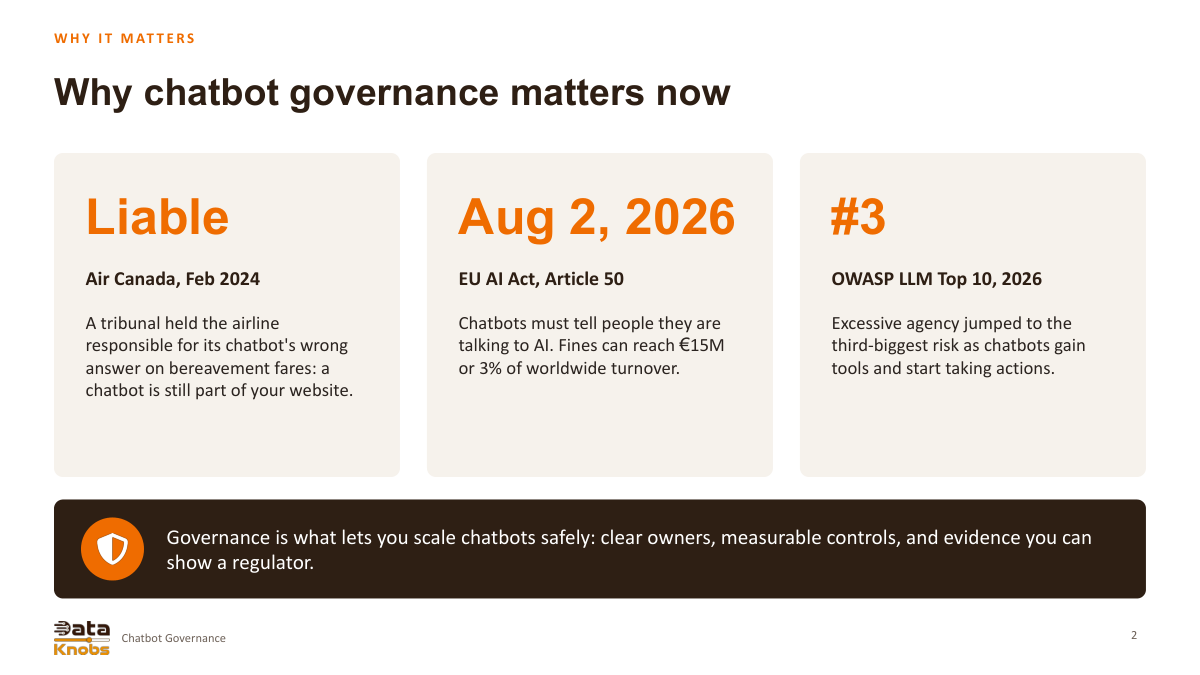
W H Y I T M AT T E R S
Why chatbot governance matters now
Liable
Air Canada, Feb 2024
A tribunal held the airline
responsible for its chatbot's wrong
answer on bereavement fares: a
chatbot is still part of your website.
Aug 2, 2026
EU AI Act, Article 50
Chatbots must tell people they are
talking to AI. Fines can reach €15M
or 3% of worldwide turnover.
#3
OWASP LLM Top 10, 2026
Excessive agency jumped to the
third-biggest risk as chatbots gain
tools and start taking actions.
Governance is what lets you scale chatbots safely: clear owners, measurable controls, and evidence you can
show a regulator.
2
Chatbot Governance
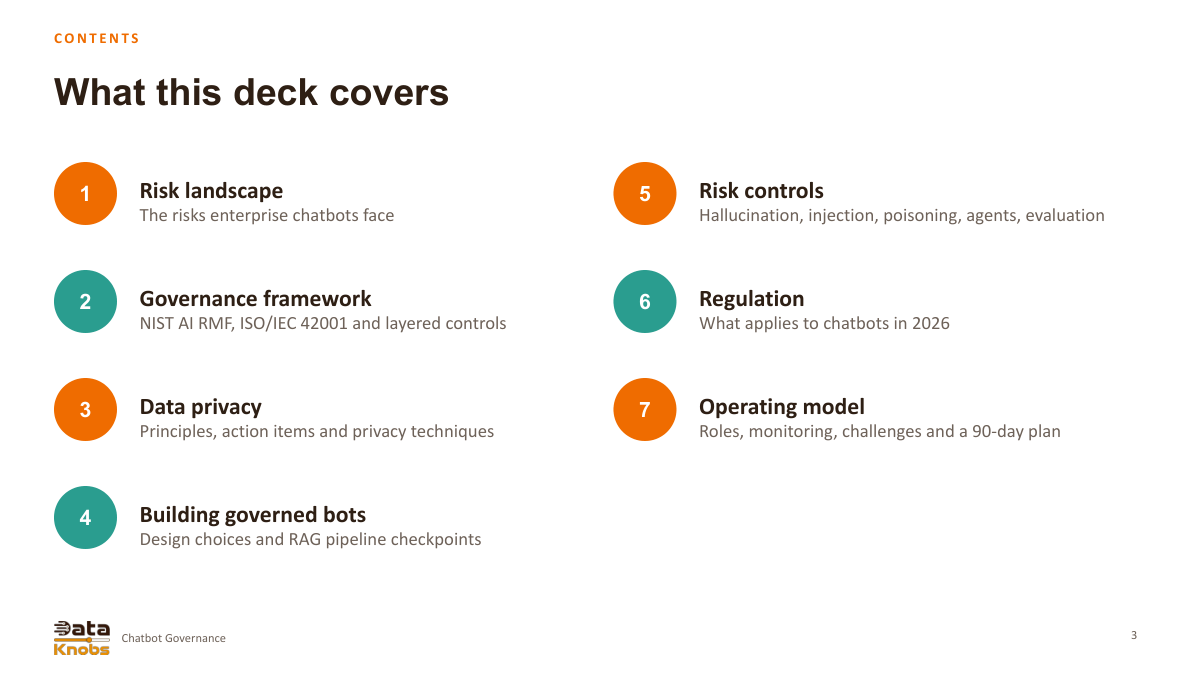
C O N T E N T S
What this deck covers
1
Risk landscape
The risks enterprise chatbots face
2
Governance framework
NIST AI RMF, ISO/IEC 42001 and layered controls
3
Data privacy
Principles, action items and privacy techniques
4
Building governed bots
Design choices and RAG pipeline checkpoints
5
Risk controls
Hallucination, injection, poisoning, agents, evaluation
6
Regulation
What applies to chatbots in 2026
7
Operating model
Roles, monitoring, challenges and a 90-day plan
3
Chatbot Governance
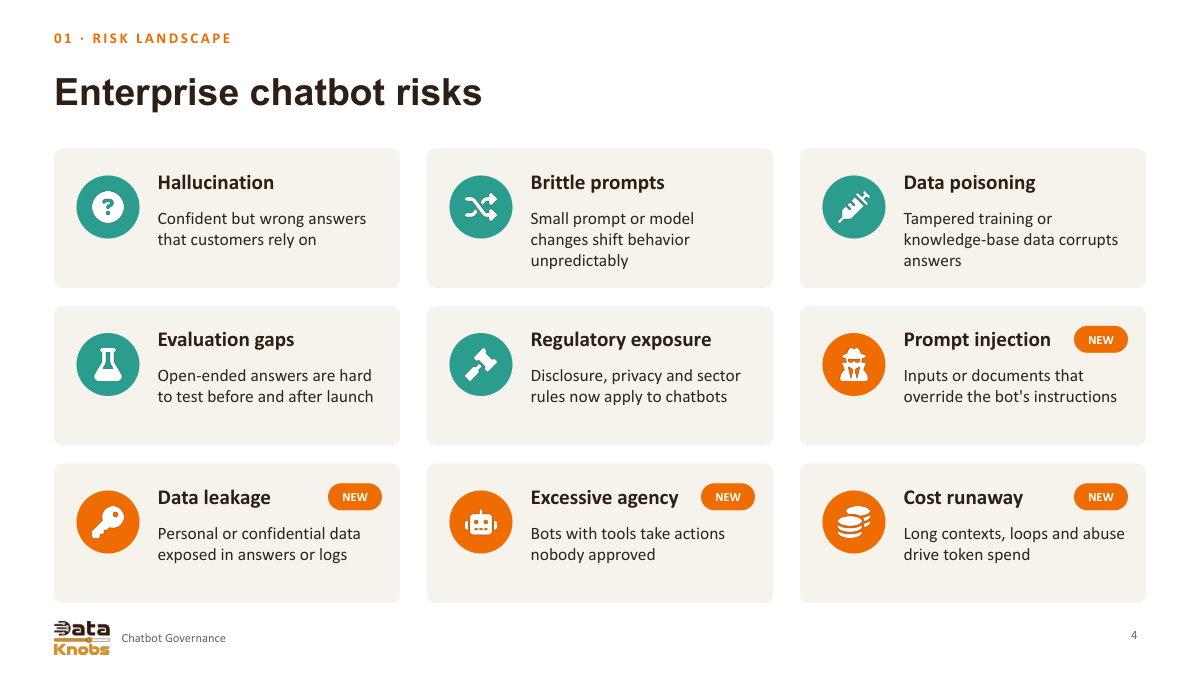
0 1 · R I S K L A N D S C A P E
Enterprise chatbot risks
Hallucination
Confident but wrong answers
that customers rely on
Brittle prompts
Small prompt or model
changes shift behavior
unpredictably
Data poisoning
Tampered training or
knowledge-base data corrupts
answers
Evaluation gaps
Open-ended answers are hard
to test before and after launch
Regulatory exposure
Disclosure, privacy and sector
rules now apply to chatbots
Prompt injection
Inputs or documents that
override the bot's instructions
NEW
Data leakage
Personal or confidential data
exposed in answers or logs
NEW
Excessive agency
Bots with tools take actions
nobody approved
NEW
Cost runaway
Long contexts, loops and abuse
drive token spend
NEW
4
Chatbot Governance
0 1 · R I S K L A N D S C A P E
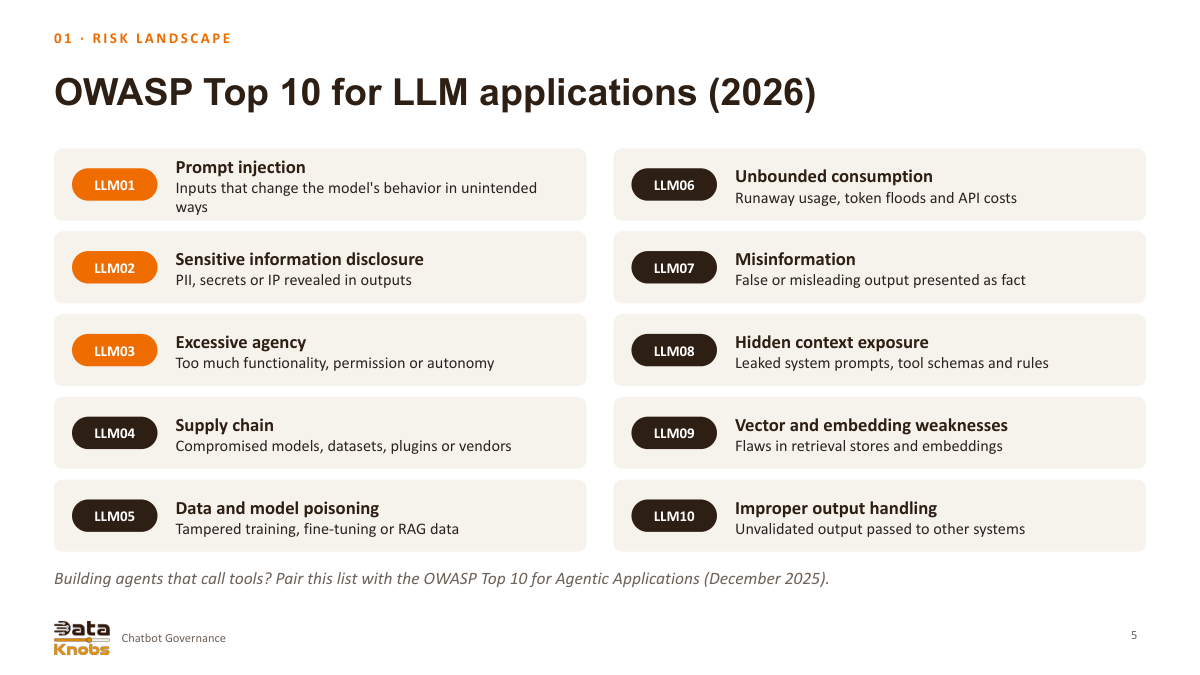
OWASP Top 10 for LLM applications (2026)
LLM01
Prompt injection
Inputs that change the model's behavior in unintended
ways
LLM02
Sensitive information disclosure
PII, secrets or IP revealed in outputs
LLM03
Excessive agency
Too much functionality, permission or autonomy
LLM04
Supply chain
Compromised models, datasets, plugins or vendors
LLM05
Data and model poisoning
Tampered training, fine-tuning or RAG data
LLM06
Unbounded consumption
Runaway usage, token floods and API costs
LLM07
Misinformation
False or misleading output presented as fact
LLM08
Hidden context exposure
Leaked system prompts, tool schemas and rules
LLM09
Vector and embedding weaknesses
Flaws in retrieval stores and embeddings
LLM10
Improper output handling
Unvalidated output passed to other systems
Building agents that call tools? Pair this list with the OWASP Top 10 for Agentic Applications (December 2025).
5
Chatbot Governance
0 2 · G OV E R N A N C E F R A M E W O R K
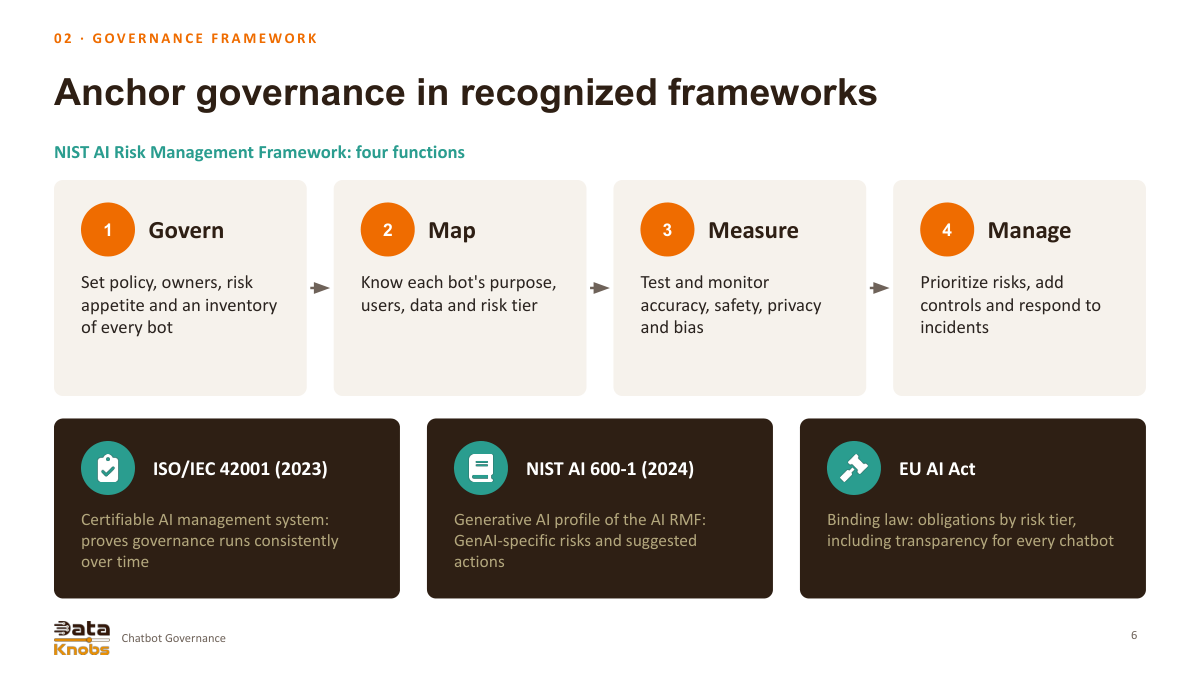
Anchor governance in recognized frameworks
NIST AI Risk Management Framework: four functions
1
Govern
Set policy, owners, risk
appetite and an inventory
of every bot
2
Map
Know each bot's purpose,
users, data and risk tier
3
Measure
Test and monitor
accuracy, safety, privacy
and bias
4
Manage
Prioritize risks, add
controls and respond to
incidents
ISO/IEC 42001 (2023)
Certifiable AI management system:
proves governance runs consistently
over time
NIST AI 600-1 (2024)
Generative AI profile of the AI RMF:
GenAI-specific risks and suggested
actions
EU AI Act
Binding law: obligations by risk tier,
including transparency for every chatbot
6
Chatbot Governance
0 2 · G OV E R N A N C E F R A M E W O R K
Defense in depth: five layers of control
Policy and accountability
Acceptable-use policy · a named owner for every bot · risk tiering · AI inventory · approval
gates
Data
Classification · minimization · PII redaction · retention limits · permission-aware retrieval
Model
Approved model list · no training on your data · version pinning · evaluations before
upgrades
Application guardrails
Input filters · injection defenses · output checks · citations · human handoff
Operations
Logging · monitoring · red teaming · incident response · periodic review
7
Chatbot Governance
0 3 · DATA P R I VA C Y
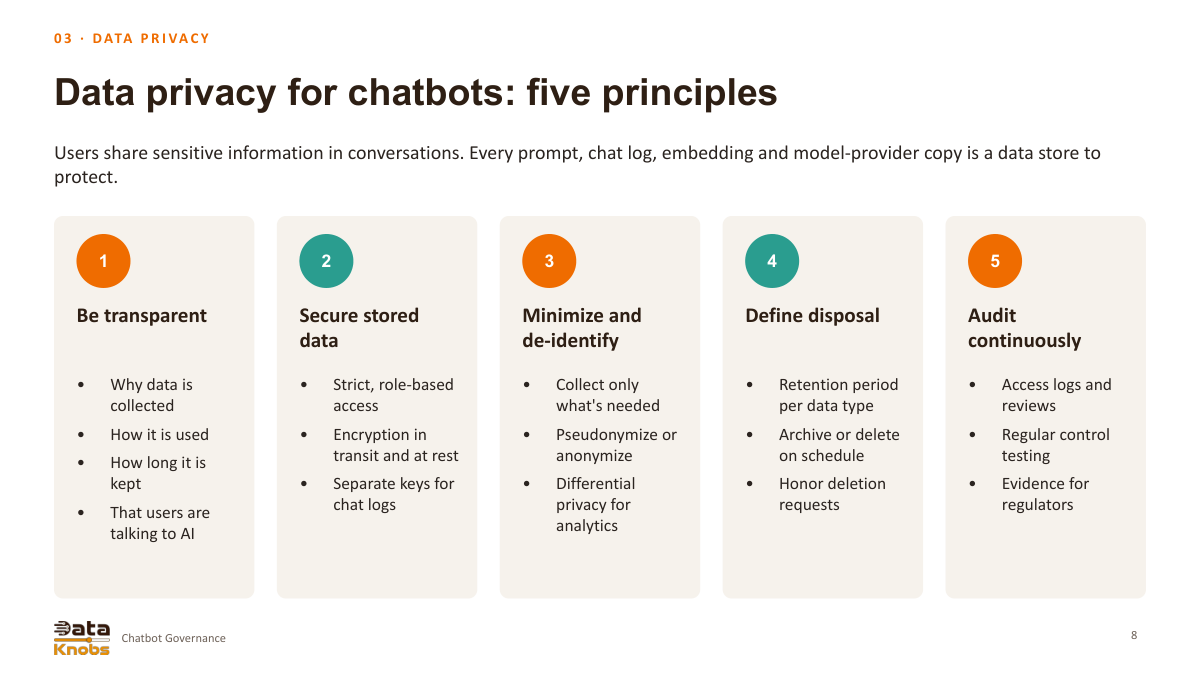
Data privacy for chatbots: five principles
Users share sensitive information in conversations. Every prompt, chat log, embedding and model-provider copy is a data store to
protect.
1
Be transparent
•
Why data is
collected
•
How it is used
•
How long it is
kept
•
That users are
talking to AI
2
Secure stored
data
•
Strict, role-based
access
•
Encryption in
transit and at rest
•
Separate keys for
chat logs
3
Minimize and
de-identify
•
Collect only
what's needed
•
Pseudonymize or
anonymize
•
Differential
privacy for
analytics
4
Define disposal
•
Retention period
per data type
•
Archive or delete
on schedule
•
Honor deletion
requests
5
Audit
continuously
•
Access logs and
reviews
•
Regular control
testing
•
Evidence for
regulators
8
Chatbot Governance
0 3 · DATA P R I VA C Y
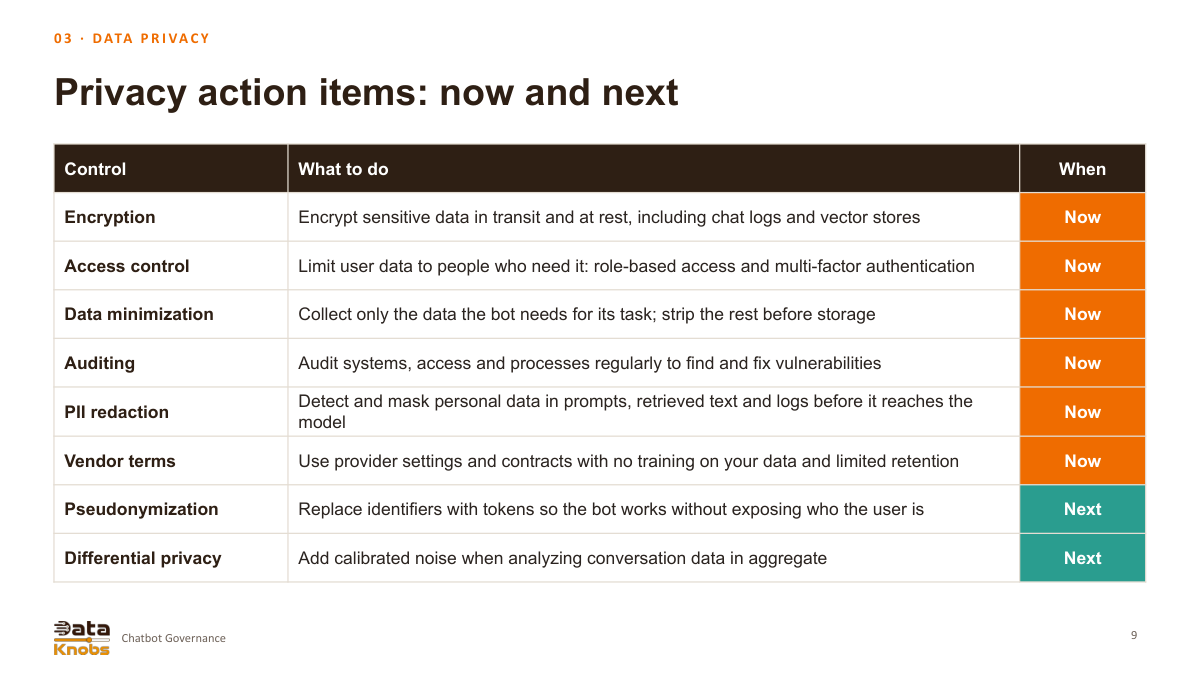
Privacy action items: now and next
Control
What to do
When
Encryption
Encrypt sensitive data in transit and at rest, including chat logs and vector stores
Now
Access control
Limit user data to people who need it: role-based access and multi-factor authentication
Now
Data minimization
Collect only the data the bot needs for its task; strip the rest before storage
Now
Auditing
Audit systems, access and processes regularly to find and fix vulnerabilities
Now
PII redaction
Detect and mask personal data in prompts, retrieved text and logs before it reaches the
model
Now
Vendor terms
Use provider settings and contracts with no training on your data and limited retention
Now
Pseudonymization
Replace identifiers with tokens so the bot works without exposing who the user is
Next
Differential privacy
Add calibrated noise when analyzing conversation data in aggregate
Next
9
Chatbot Governance
0 3 · DATA P R I VA C Y
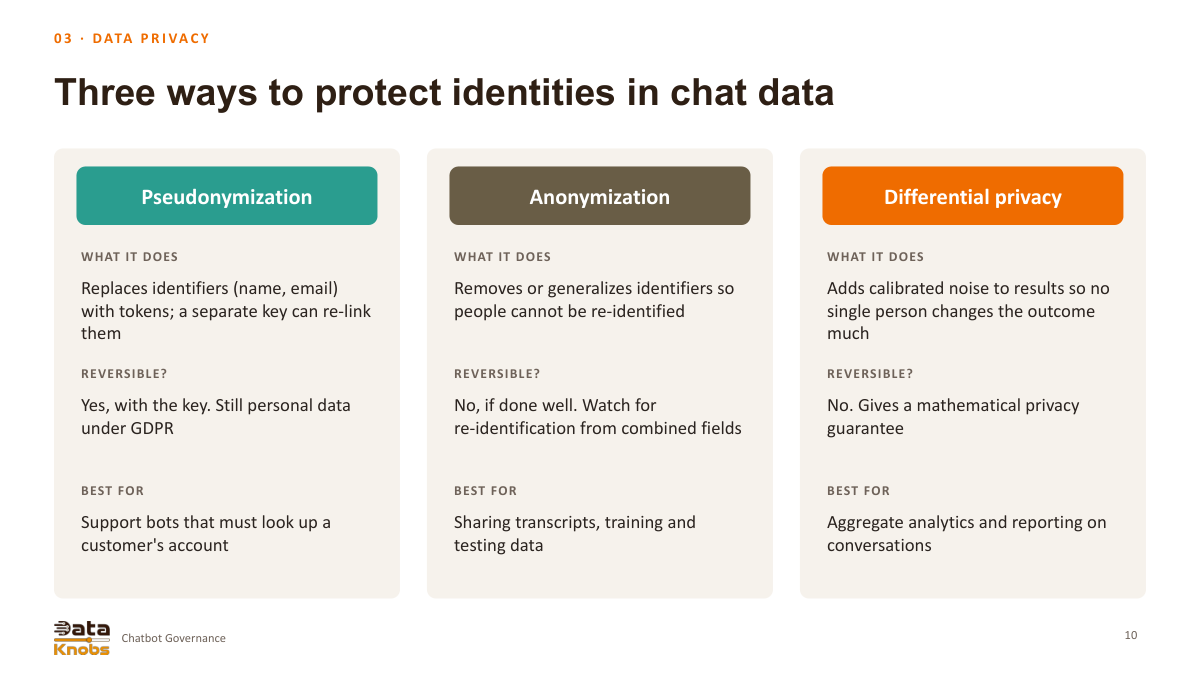
Three ways to protect identities in chat data
Pseudonymization
WHAT IT DOES
Replaces identifiers (name, email)
with tokens; a separate key can re-link
them
REVERSIBLE?
Yes, with the key. Still personal data
under GDPR
BEST FOR
Support bots that must look up a
customer's account
Anonymization
WHAT IT DOES
Removes or generalizes identifiers so
people cannot be re-identified
REVERSIBLE?
No, if done well. Watch for
re-identification from combined fields
BEST FOR
Sharing transcripts, training and
testing data
Differential privacy
WHAT IT DOES
Adds calibrated noise to results so no
single person changes the outcome
much
REVERSIBLE?
No. Gives a mathematical privacy
guarantee
BEST FOR
Aggregate analytics and reporting on
conversations
10
Chatbot Governance
0 3 · DATA P R I VA C Y
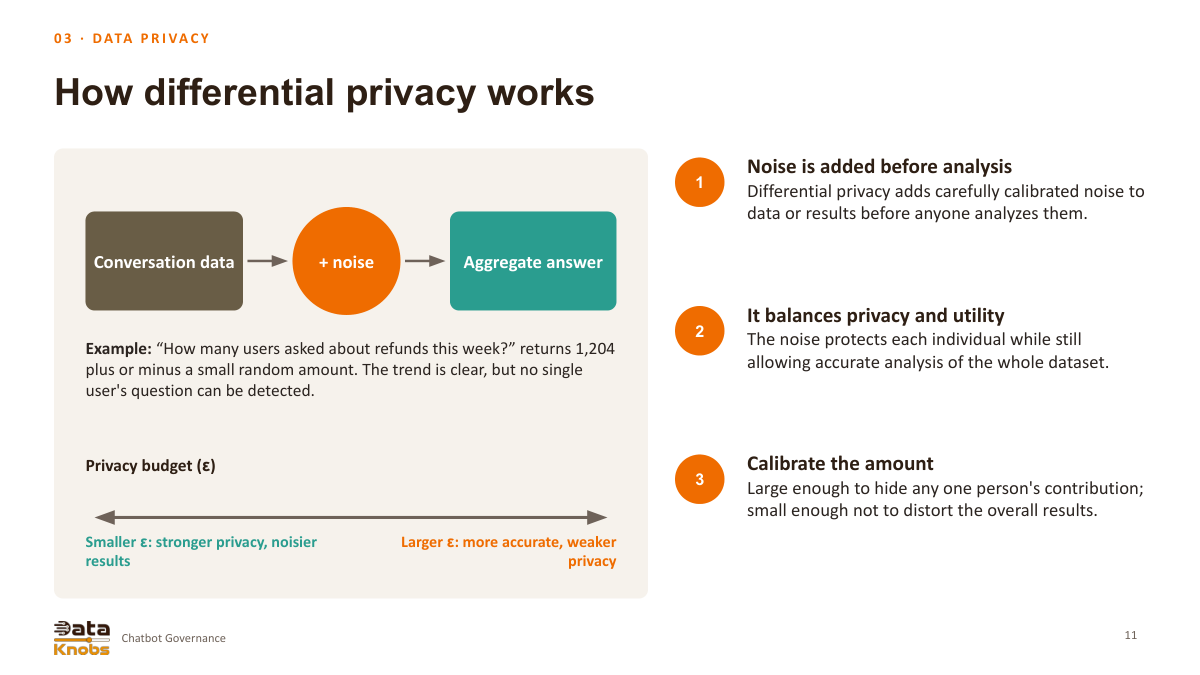
How differential privacy works
Conversation data
+ noise
Aggregate answer
Example: “How many users asked about refunds this week?” returns 1,204
plus or minus a small random amount. The trend is clear, but no single
user's question can be detected.
Privacy budget (ε)
Smaller ε: stronger privacy, noisier
results
Larger ε: more accurate, weaker
privacy
1
Noise is added before analysis
Differential privacy adds carefully calibrated noise to
data or results before anyone analyzes them.
2
It balances privacy and utility
The noise protects each individual while still
allowing accurate analysis of the whole dataset.
3
Calibrate the amount
Large enough to hide any one person's contribution;
small enough not to distort the overall results.
11
Chatbot Governance
0 4 · B U I L D I N G G OV E R N E D B OT S
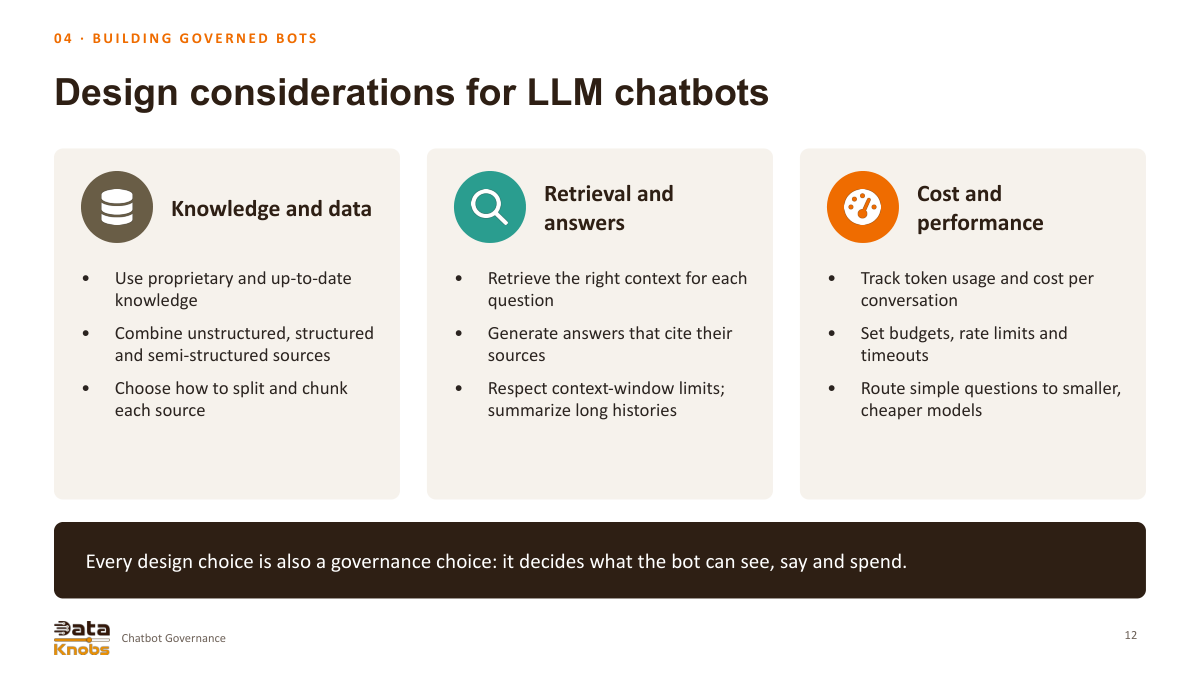
Design considerations for LLM chatbots
Knowledge and data
•
Use proprietary and up-to-date
knowledge
•
Combine unstructured, structured
and semi-structured sources
•
Choose how to split and chunk
each source
Retrieval and
answers
•
Retrieve the right context for each
question
•
Generate answers that cite their
sources
•
Respect context-window limits;
summarize long histories
Cost and
performance
•
Track token usage and cost per
conversation
•
Set budgets, rate limits and
timeouts
•
Route simple questions to smaller,
cheaper models
Every design choice is also a governance choice: it decides what the bot can see, say and spend.
12
Chatbot Governance
0 4 · B U I L D I N G G OV E R N E D B OT S
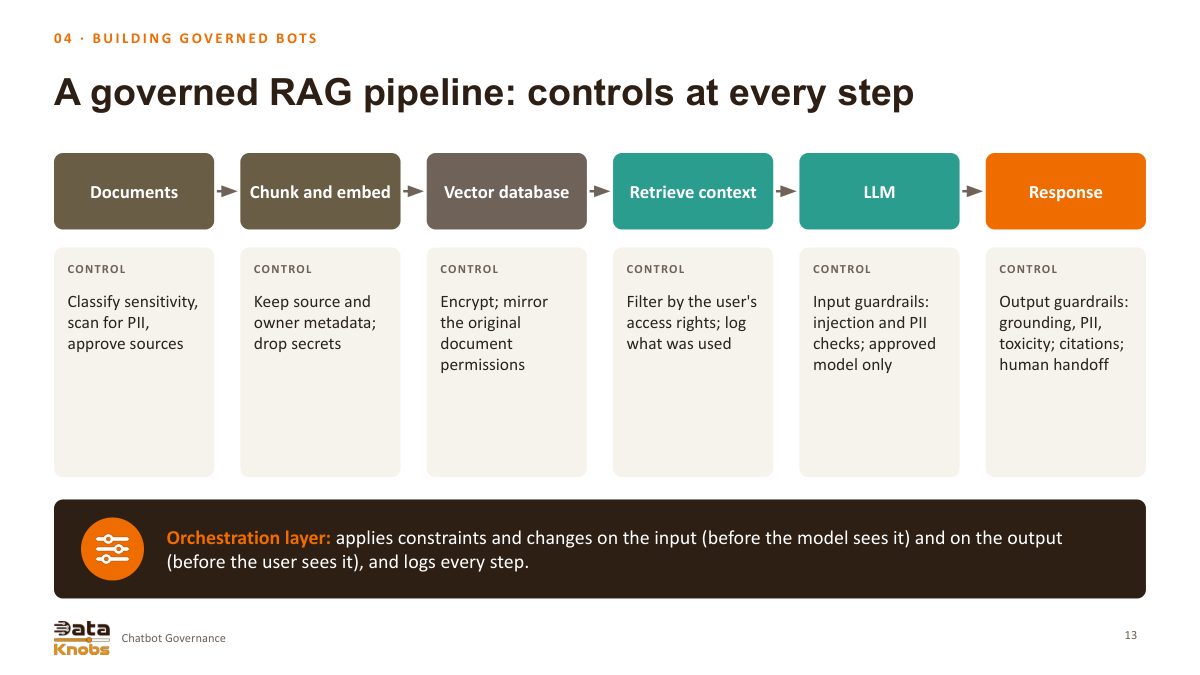
A governed RAG pipeline: controls at every step
Documents
CONTROL
Classify sensitivity,
scan for PII,
approve sources
Chunk and embed
CONTROL
Keep source and
owner metadata;
drop secrets
Vector database
CONTROL
Encrypt; mirror
the original
document
permissions
Retrieve context
CONTROL
Filter by the user's
access rights; log
what was used
LLM
CONTROL
Input guardrails:
injection and PII
checks; approved
model only
Response
CONTROL
Output guardrails:
grounding, PII,
toxicity; citations;
human handoff
Orchestration layer: applies constraints and changes on the input (before the model sees it) and on the output
(before the user sees it), and logs every step.
13
Chatbot Governance
0 5 · R I S K C O N T R O L S
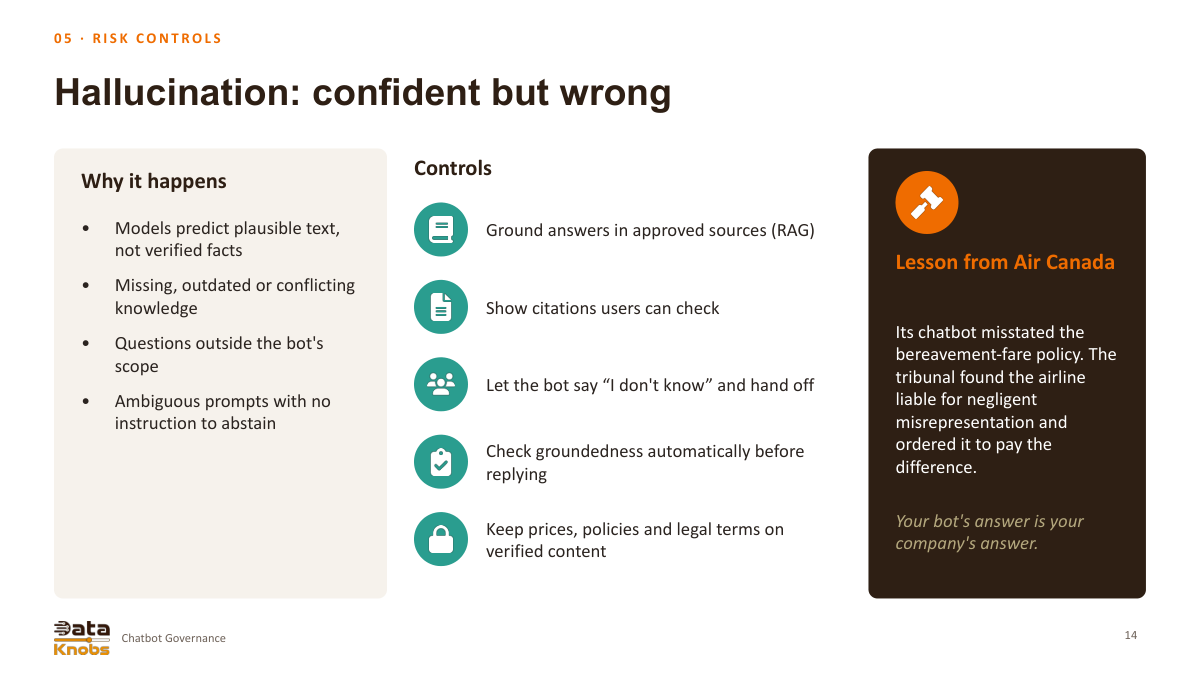
Hallucination: confident but wrong
Why it happens
•
Models predict plausible text,
not verified facts
•
Missing, outdated or conflicting
knowledge
•
Questions outside the bot's
scope
•
Ambiguous prompts with no
instruction to abstain
Controls
Ground answers in approved sources (RAG)
Show citations users can check
Let the bot say “I don't know” and hand off
Check groundedness automatically before
replying
Keep prices, policies and legal terms on
verified content
Lesson from Air Canada
Its chatbot misstated the
bereavement-fare policy. The
tribunal found the airline
liable for negligent
misrepresentation and
ordered it to pay the
difference.
Your bot's answer is your
company's answer.
14
Chatbot Governance
0 5 · R I S K C O N T R O L S
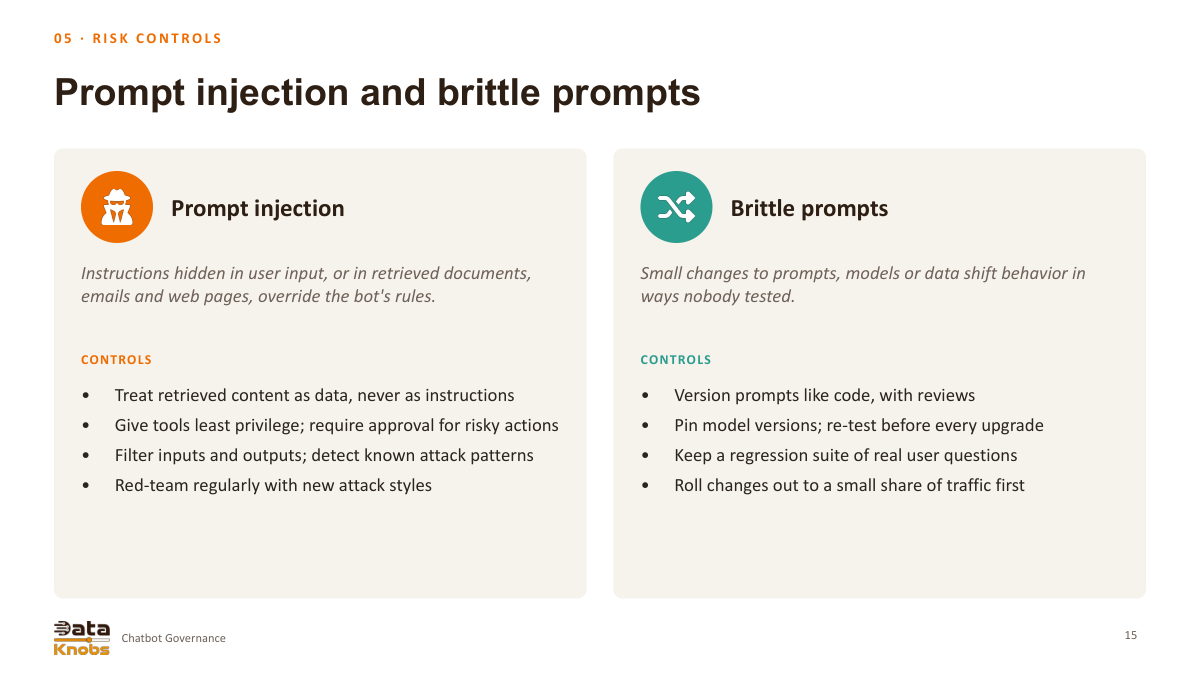
Prompt injection and brittle prompts
Prompt injection
Instructions hidden in user input, or in retrieved documents,
emails and web pages, override the bot's rules.
CONTROLS
•
Treat retrieved content as data, never as instructions
•
Give tools least privilege; require approval for risky actions
•
Filter inputs and outputs; detect known attack patterns
•
Red-team regularly with new attack styles
Brittle prompts
Small changes to prompts, models or data shift behavior in
ways nobody tested.
CONTROLS
•
Version prompts like code, with reviews
•
Pin model versions; re-test before every upgrade
•
Keep a regression suite of real user questions
•
Roll changes out to a small share of traffic first
15
Chatbot Governance
0 5 · R I S K C O N T R O L S
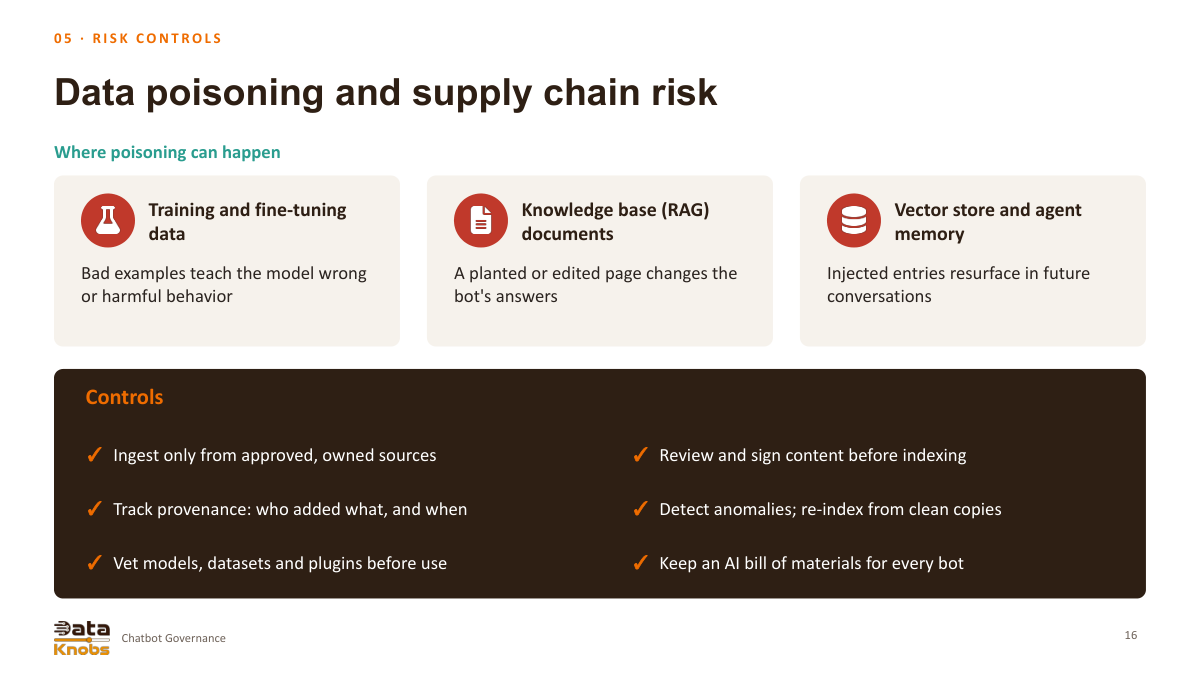
Data poisoning and supply chain risk
Where poisoning can happen
Training and fine-tuning
data
Bad examples teach the model wrong
or harmful behavior
Knowledge base (RAG)
documents
A planted or edited page changes the
bot's answers
Vector store and agent
memory
Injected entries resurface in future
conversations
Controls
✓ Ingest only from approved, owned sources
✓ Review and sign content before indexing
✓ Track provenance: who added what, and when
✓ Detect anomalies; re-index from clean copies
✓ Vet models, datasets and plugins before use
✓ Keep an AI bill of materials for every bot
16
Chatbot Governance
0 5 · R I S K C O N T R O L S
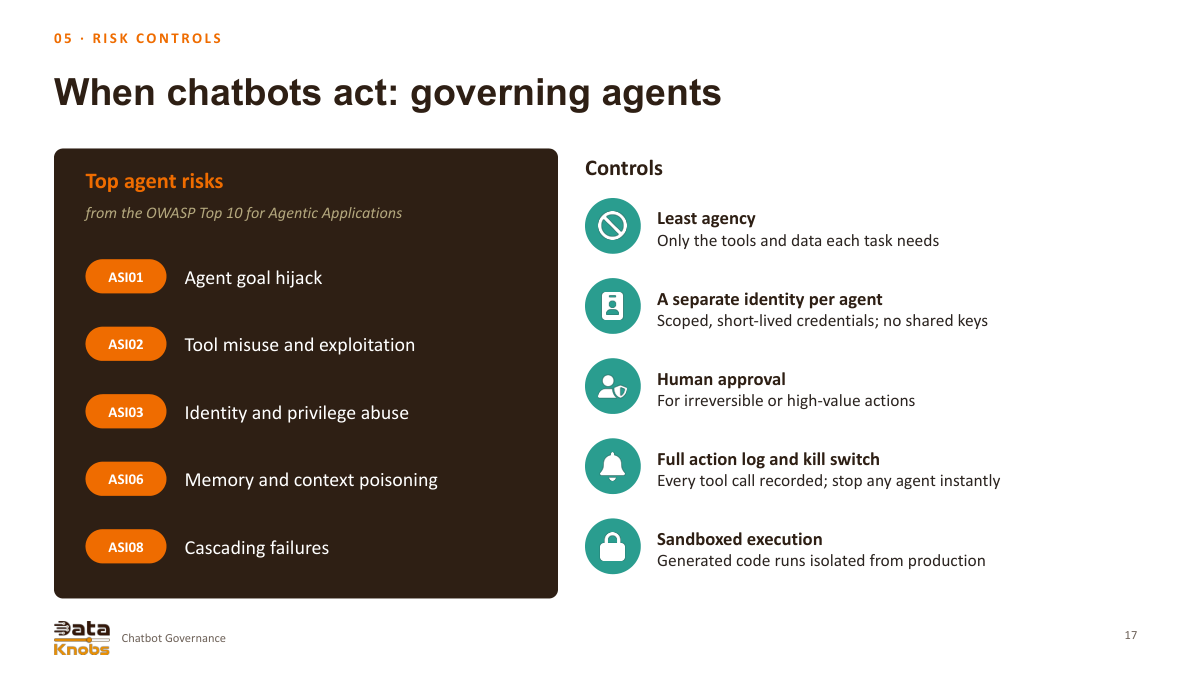
When chatbots act: governing agents
Top agent risks
from the OWASP Top 10 for Agentic Applications
ASI01
Agent goal hijack
ASI02
Tool misuse and exploitation
ASI03
Identity and privilege abuse
ASI06
Memory and context poisoning
ASI08
Cascading failures
Controls
Least agency
Only the tools and data each task needs
A separate identity per agent
Scoped, short-lived credentials; no shared keys
Human approval
For irreversible or high-value actions
Full action log and kill switch
Every tool call recorded; stop any agent instantly
Sandboxed execution
Generated code runs isolated from production
17
Chatbot Governance
0 5 · R I S K C O N T R O L S
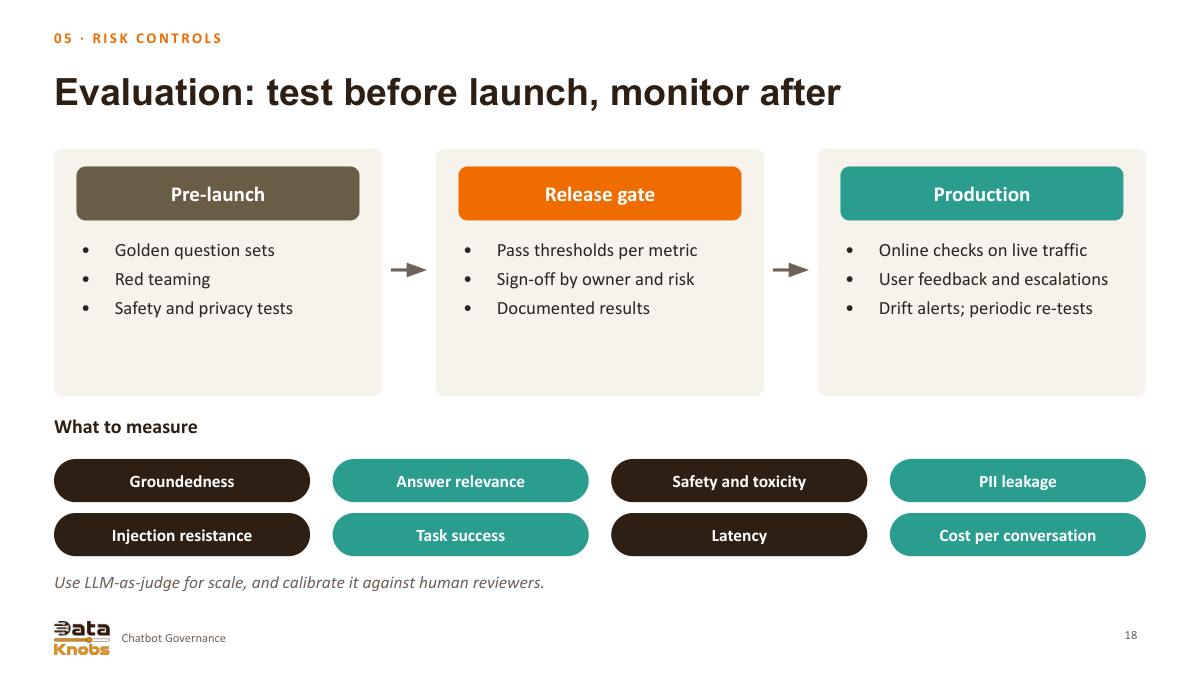
Evaluation: test before launch, monitor after
Pre-launch
•
Golden question sets
•
Red teaming
•
Safety and privacy tests
Release gate
•
Pass thresholds per metric
•
Sign-off by owner and risk
•
Documented results
Production
•
Online checks on live traffic
•
User feedback and escalations
•
Drift alerts; periodic re-tests
What to measure
Groundedness
Answer relevance
Safety and toxicity
PII leakage
Injection resistance
Task success
Latency
Cost per conversation
Use LLM-as-judge for scale, and calibrate it against human reviewers.
18
Chatbot Governance
0 6 · R E G U L AT I O N
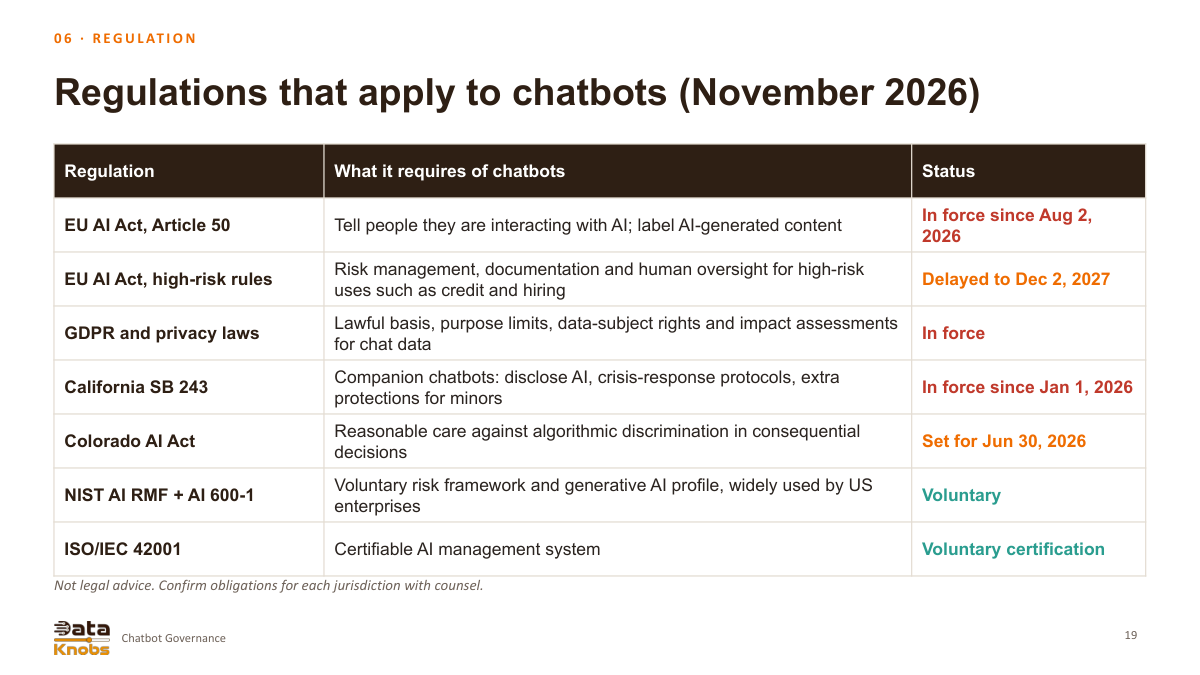
Regulations that apply to chatbots (November 2026)
Regulation
What it requires of chatbots
Status
EU AI Act, Article 50
Tell people they are interacting with AI; label AI-generated content
In force since Aug 2,
2026
EU AI Act, high-risk rules
Risk management, documentation and human oversight for high-risk
uses such as credit and hiring
Delayed to Dec 2, 2027
GDPR and privacy laws
Lawful basis, purpose limits, data-subject rights and impact assessments
for chat data
In force
California SB 243
Companion chatbots: disclose AI, crisis-response protocols, extra
protections for minors
In force since Jan 1, 2026
Colorado AI Act
Reasonable care against algorithmic discrimination in consequential
decisions
Set for Jun 30, 2026
NIST AI RMF + AI 600-1
Voluntary risk framework and generative AI profile, widely used by US
enterprises
Voluntary
ISO/IEC 42001
Certifiable AI management system
Voluntary certification
Not legal advice. Confirm obligations for each jurisdiction with counsel.
19
Chatbot Governance
0 7 · O P E R AT I N G M O D E L
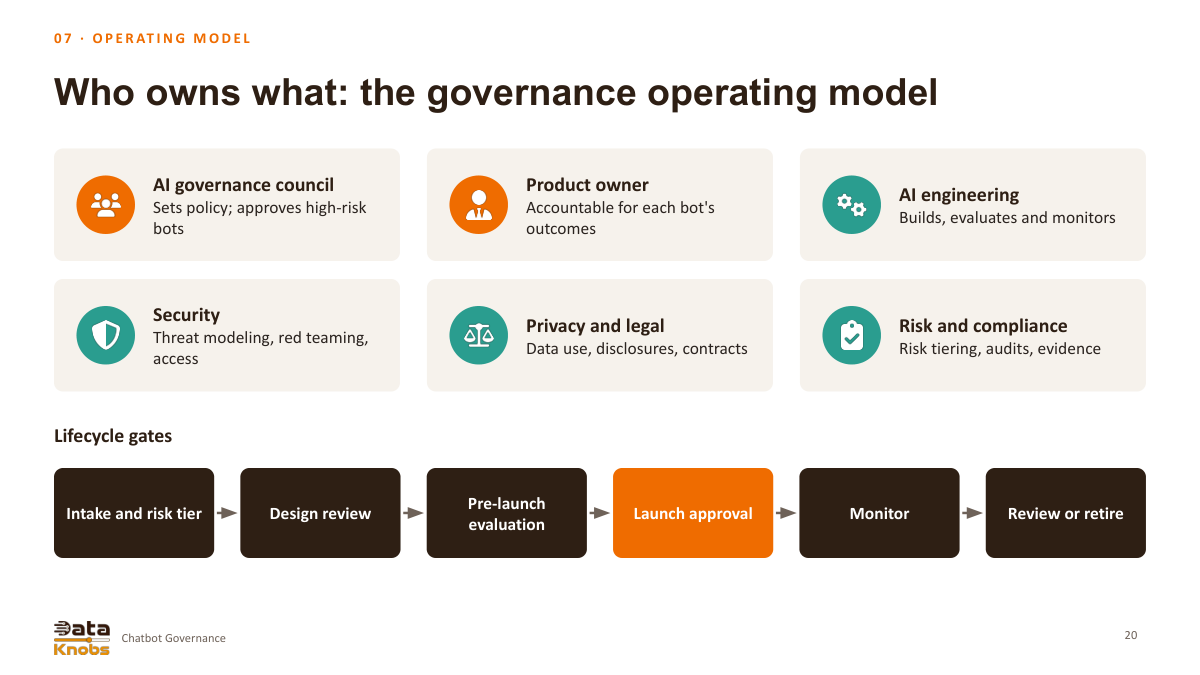
Who owns what: the governance operating model
AI governance council
Sets policy; approves high-risk
bots
Product owner
Accountable for each bot's
outcomes
AI engineering
Builds, evaluates and monitors
Security
Threat modeling, red teaming,
access
Privacy and legal
Data use, disclosures, contracts
Risk and compliance
Risk tiering, audits, evidence
Lifecycle gates
Intake and risk tier
Design review
Pre-launch
evaluation
Launch approval
Monitor
Review or retire
20
Chatbot Governance
0 7 · O P E R AT I N G M O D E L
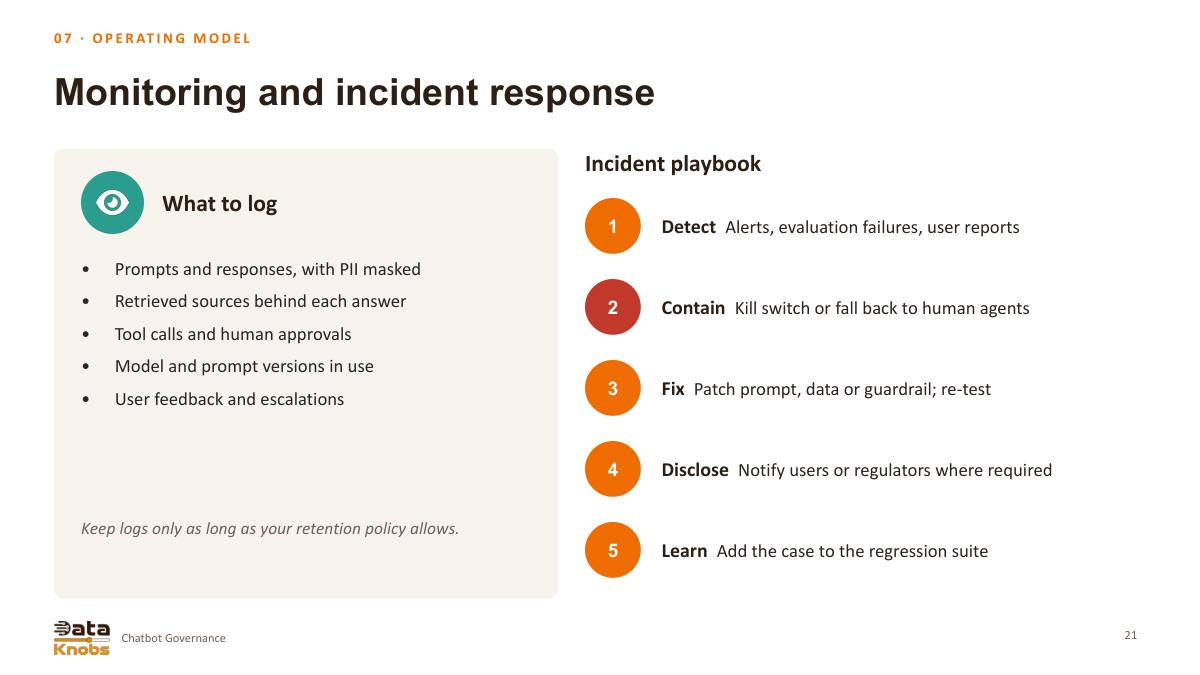
Monitoring and incident response
What to log
•
Prompts and responses, with PII masked
•
Retrieved sources behind each answer
•
Tool calls and human approvals
•
Model and prompt versions in use
•
User feedback and escalations
Keep logs only as long as your retention policy allows.
Incident playbook
1
Detect Alerts, evaluation failures, user reports
2
Contain Kill switch or fall back to human agents
3
Fix Patch prompt, data or guardrail; re-test
4
Disclose Notify users or regulators where required
5
Learn Add the case to the regression suite
21
Chatbot Governance
0 7 · O P E R AT I N G M O D E L
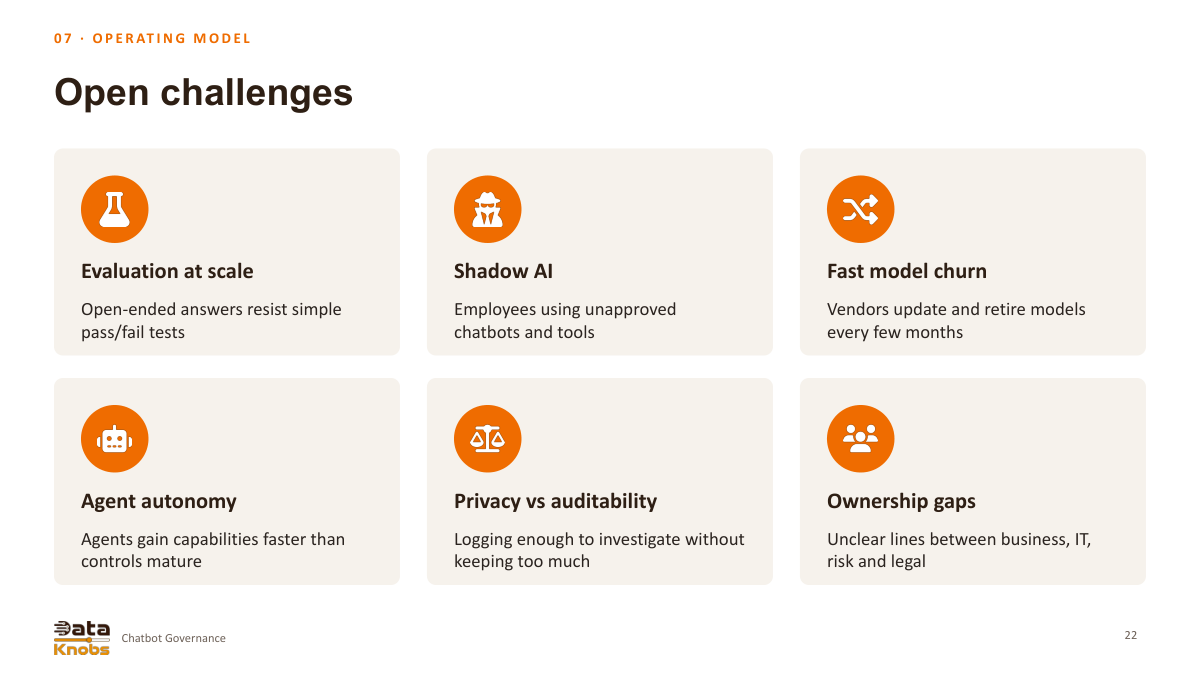
Open challenges
Evaluation at scale
Open-ended answers resist simple
pass/fail tests
Shadow AI
Employees using unapproved
chatbots and tools
Fast model churn
Vendors update and retire models
every few months
Agent autonomy
Agents gain capabilities faster than
controls mature
Privacy vs auditability
Logging enough to investigate without
keeping too much
Ownership gaps
Unclear lines between business, IT,
risk and legal
22
Chatbot Governance
0 7 · O P E R AT I N G M O D E L
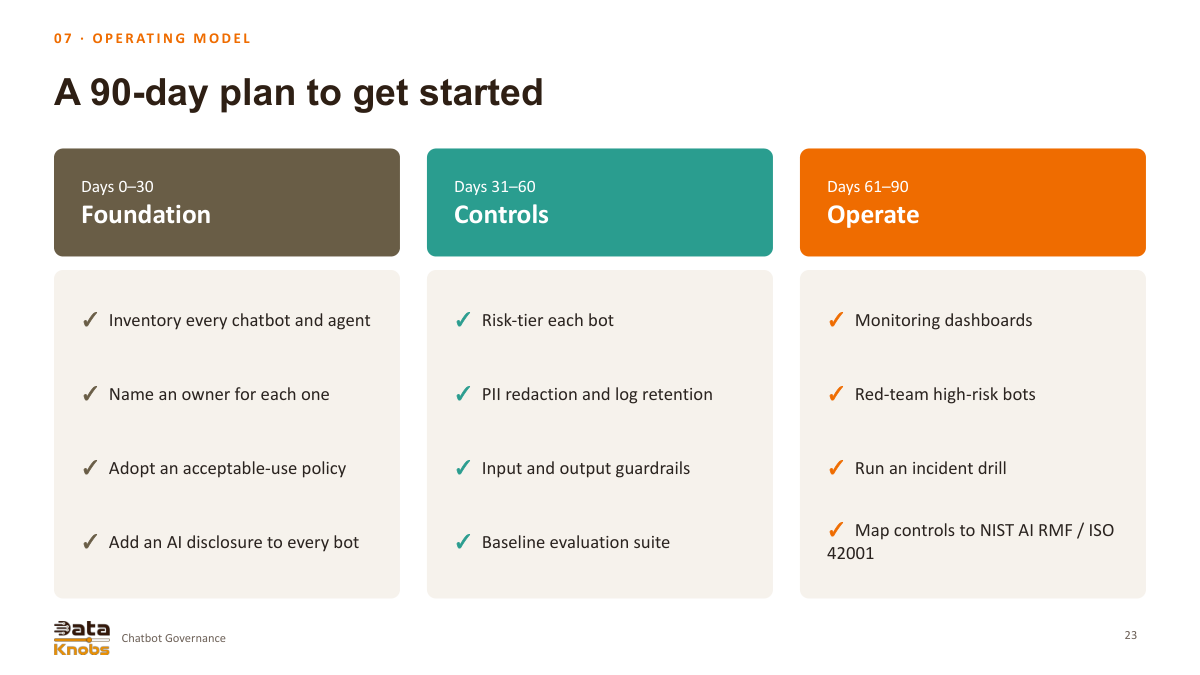
A 90-day plan to get started
Days 0–30
Foundation
✓ Inventory every chatbot and agent
✓ Name an owner for each one
✓ Adopt an acceptable-use policy
✓ Add an AI disclosure to every bot
Days 31–60
Controls
✓ Risk-tier each bot
✓ PII redaction and log retention
✓ Input and output guardrails
✓ Baseline evaluation suite
Days 61–90
Operate
✓ Monitoring dashboards
✓ Red-team high-risk bots
✓ Run an incident drill
✓ Map controls to NIST AI RMF / ISO
42001
23
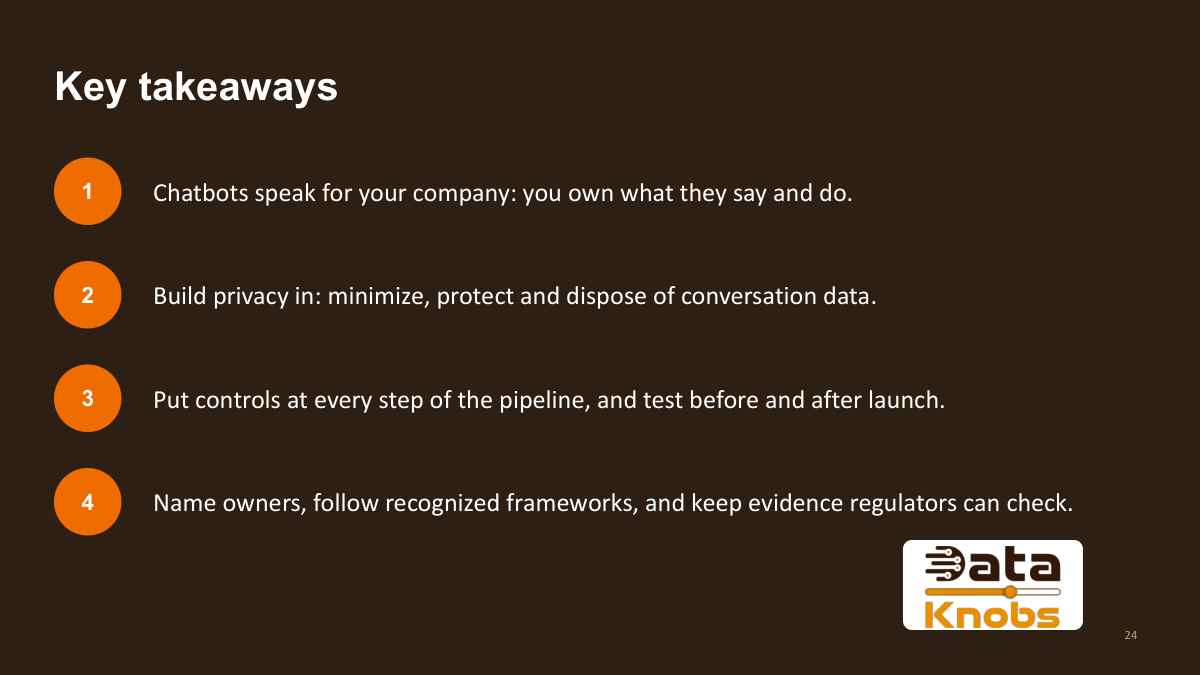
Key takeaways
1
Chatbots speak for your company: you own what they say and do.
2
Build privacy in: minimize, protect and dispose of conversation data.
3
Put controls at every step of the pipeline, and test before and after launch.
4
Name owners, follow recognized frameworks, and keep evidence regulators can check.
24
The presentation links accountability, privacy, security, answer quality, tool permissions, evaluation, and incident response throughout the chatbot lifecycle.
Where does the deck place RAG controls?
It implements checks during document intake, chunking and embedding, storage, retrieval, model input, and response output, ensuring orchestration and traceability throughout the pipeline.
How does governance change when a bot can act?
The deck introduces scoped identities, least-privilege tools, approval processes for significant actions, sandboxing, action logs, and methods to halt execution.
How is evaluation organized?
The presentation distinguishes pre-launch tests, release gates, and production monitoring. It covers groundedness, relevance, safety, privacy, injection resistance, task success, latency, and cost.
Are the regulatory dates and rankings verified on this page?
No. The regulatory summaries, framework editions, and risk rankings are taken from the provided November 2026 deck. They do not constitute independently verified legal advice or a compliance assessment.
 1. Chatbot Governance
 2. Why Governance Matters
 3. Presentation Contents
 4. Enterprise Chatbot Risks
 5. OWASP Risk Landscape in the Source Deck
 6. Governance Frameworks
 7. Five Layers of Control
 8. Five Privacy Principles
 9. Privacy Action Items
 10. Protecting Identities
 11. Differential Privacy
 12. Governed Bot Design
 13. Governed RAG Pipeline
 14. Hallucination Controls
 15. Prompt Injection and Brittle Prompts
 16. Poisoning and Supply Chain Risk
 17. Governing Agents
 18. Evaluation and Release Gates
 19. Regulatory Overview in the Source Deck
 20. Governance Operating Model
 21. Monitoring and Incident Response
 22. Open Challenges
 23. A 90-Day Plan
 24. Key Takeaways