AI data products in legal
Regulatory compliance intelligence: transforming evolving legal texts into assessed obligations and scheduled tasks.
Make legal knowledge reusable, reviewable and actionable.
A regulatory compliance data product organizes structured, source-referenced obligations and links them to internal policies, controls, and authorized activities. LLMs assist in classifying, extracting, matching, and interpreting; product ownership, review, and assessment ensure these outputs are valuable for various teams.
This guide follows the provided presentation from source monitoring to extraction, gap assessment, and delivery. It retains all slides and includes brief explanations for readers seeking the concepts without depending on text within images.
From source to decision
| Stage | Reusable output | Review focus |
|---|---|---|
| Fetch & track | Versioned source documents | Coverage, status and freshness |
| Filter | Potentially relevant changes | Applicability and missed changes |
| Extract | Atomic obligation records | Definitions, citations and omissions |
| Map & assess | Control links and proposed gaps | Scope and effectiveness evidence |
| Plan | Approved backlog with owners | Priority, dates and traceability |
Browse all 26 slides
01 · AI data products in legal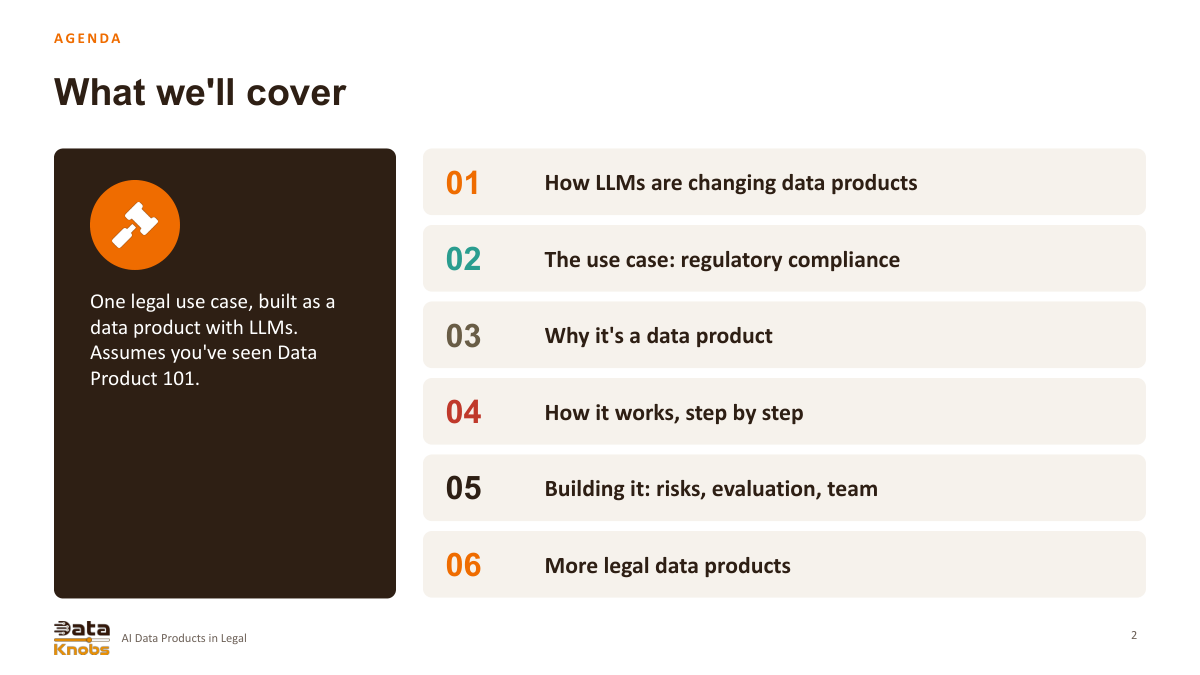 02 · One use case, a reusable pattern
 03 · From reporting to agentic products
 04 · What LLMs change
 05 · Five roles for LLMs
 06 · Upgrade the product contract
 07 · The compliance-intelligence use case
 08 · Start with objectives and decisions
 09 · A product rather than a one-off summary
 10 · DATSIS applied to obligations
 11 · The data product canvas
 12 · An end-to-end pipeline
 13 · External sources and internal knowledge
 14 · Track status, versions and applicability
 15 · Extract atomic obligations
 16 · Design reliable extraction
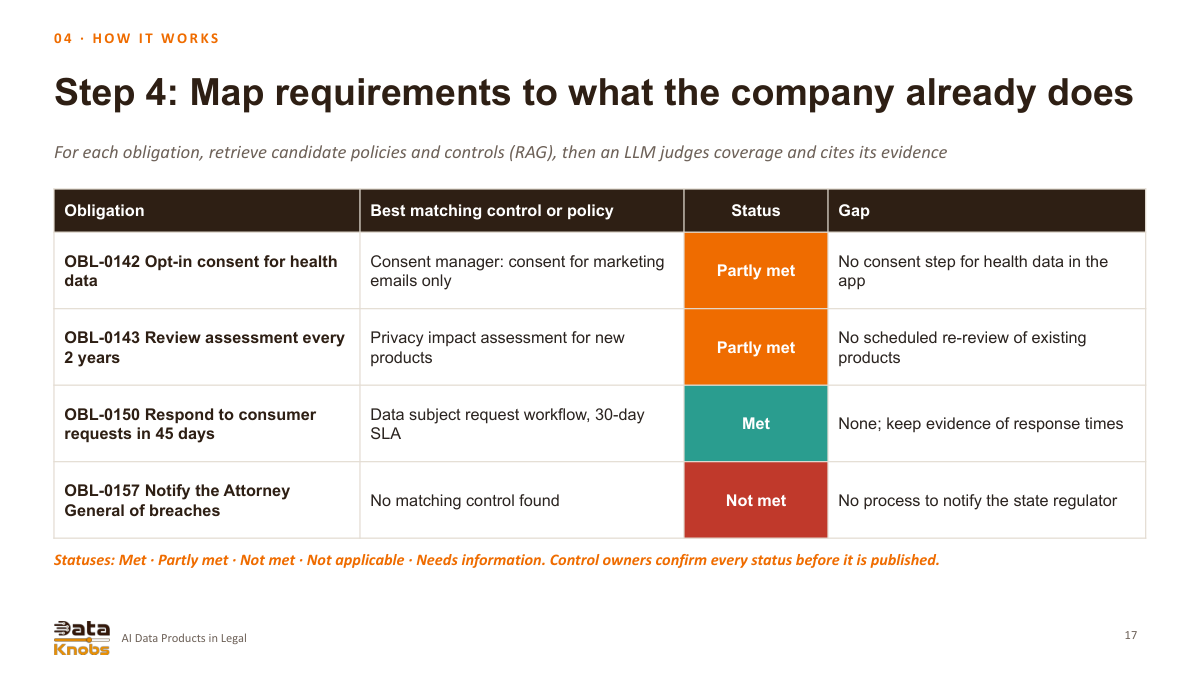 17 · Map to policies and controls
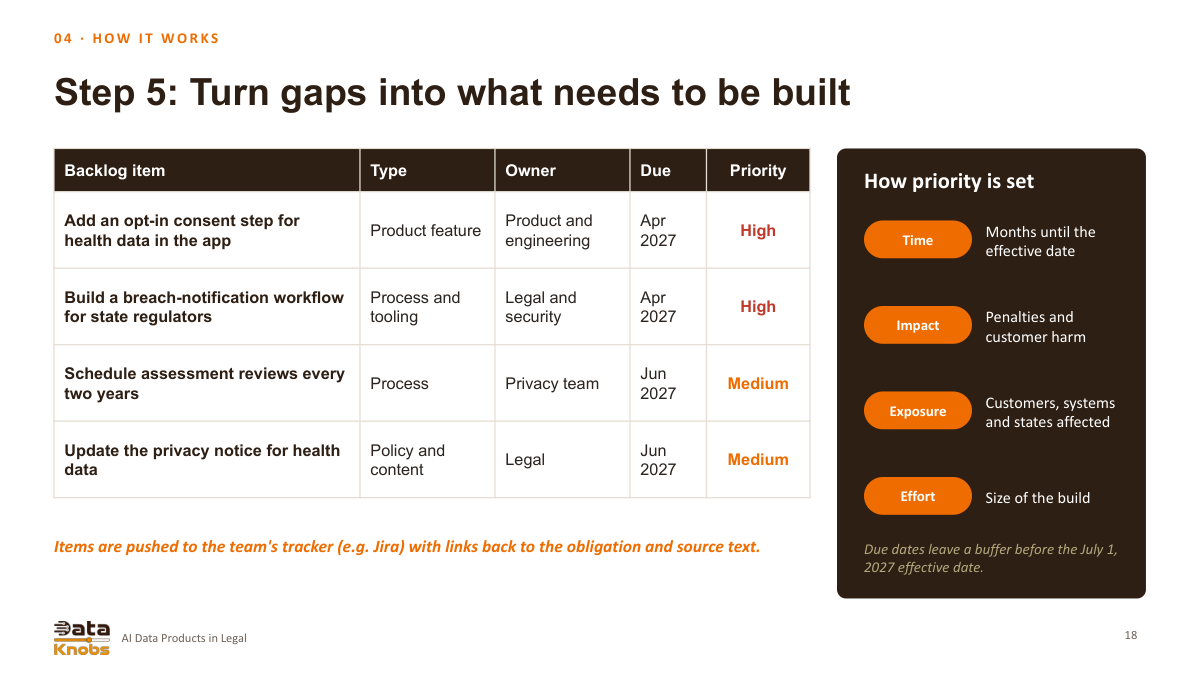 18 · Turn reviewed gaps into planned work
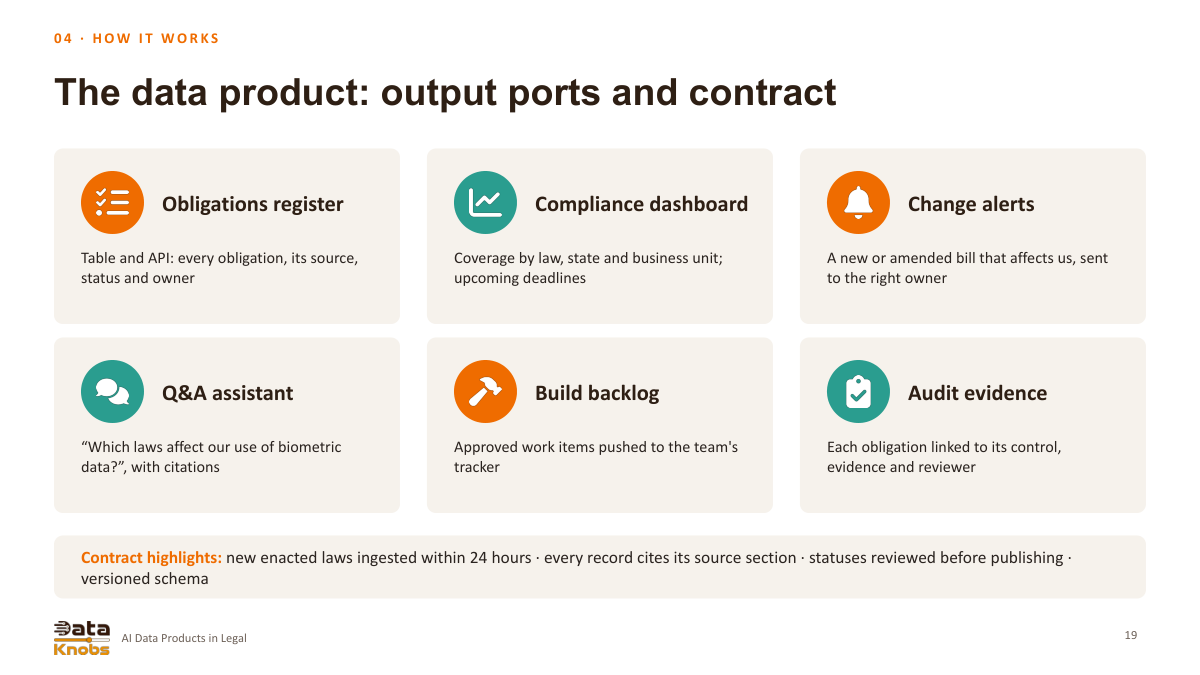 19 · Publish reusable output ports
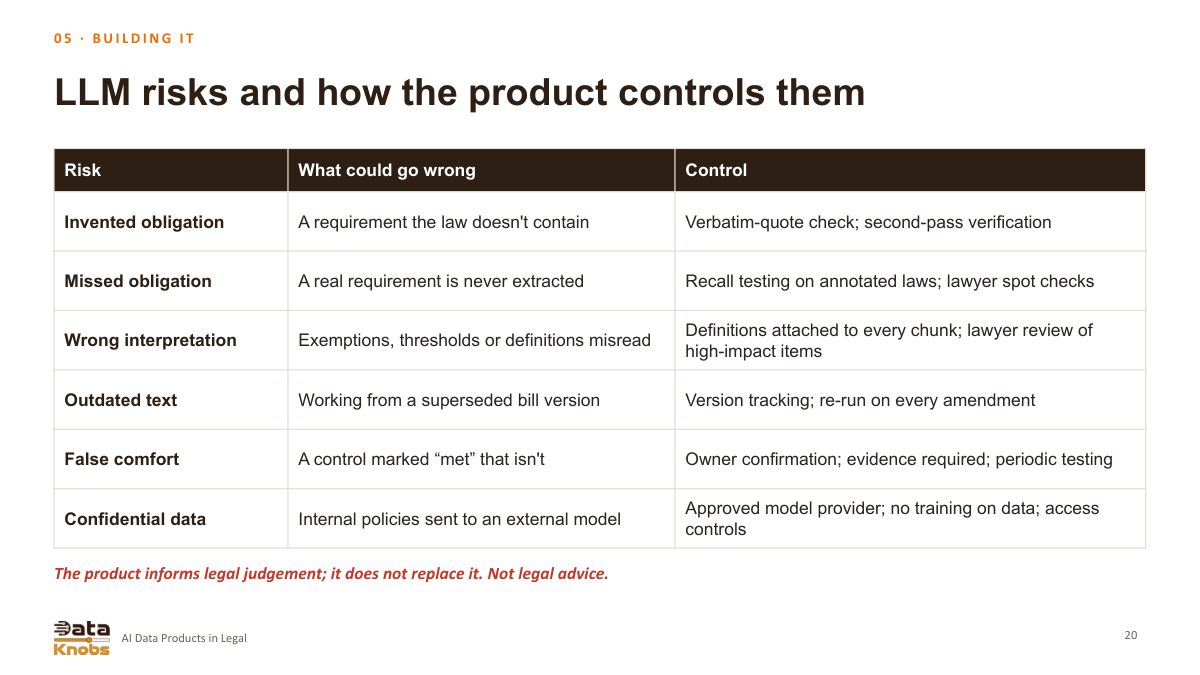 20 · Control the failure modes
 21 · Evaluate each pipeline stage
 22 · Measure product value
 23 · Components to build
 24 · A staged roadmap and team
 25 · Reuse the pattern across legal products
 26 · The product discipline is the differentiator
LLMs inside governed data products
AI data products in legal
Regulatory compliance intelligence transforms evolving legal text into a reusable repository of obligations, evidence, control mappings, and authorized work. This presentation utilizes data-product principles to guide the process from a source document to the deliverables a team may require.
One use case, a reusable pattern
The guide outlines the function of LLMs, the compliance-intelligence use case, the reasons it qualifies as a data product, the processing pipeline, delivery controls, and related legal applications. It serves as a companion to the deck’s Data Product 101 framework.
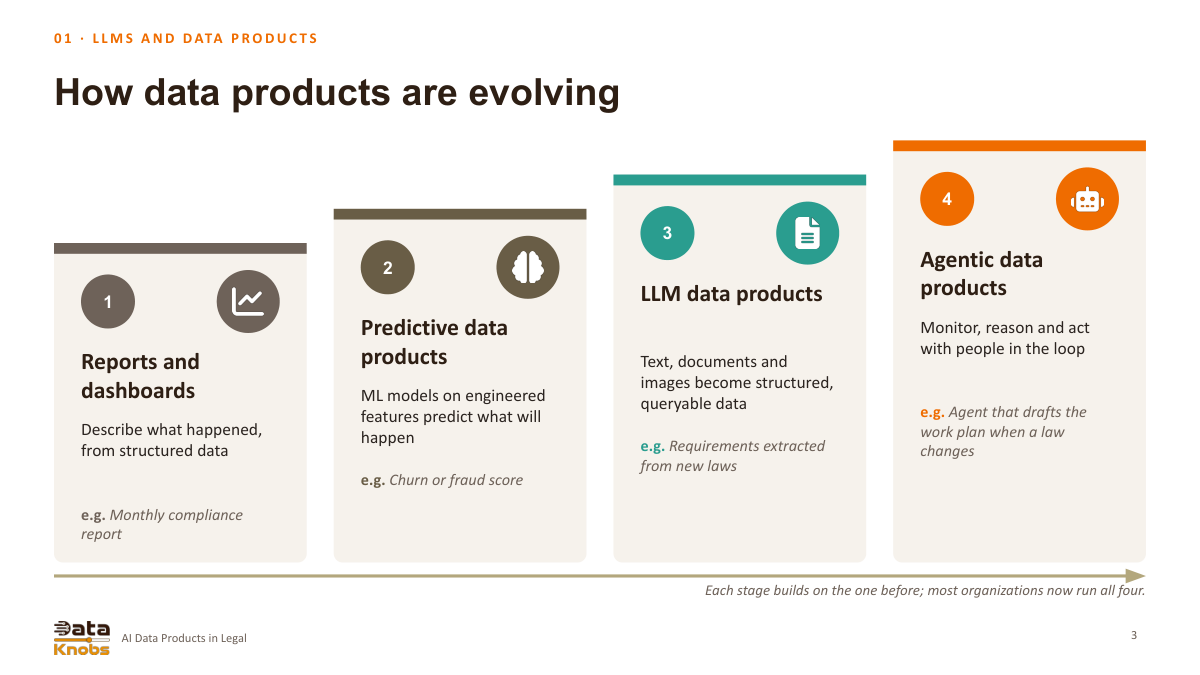
From reporting to agentic products
Reports document observed activity, predictive tools forecast results, LLM-based solutions organize unstructured information, and agents manage coordinated workflows. These methods can operate together; incorporating autonomy does not eliminate the necessity for regulated inputs, outputs, and accountability.
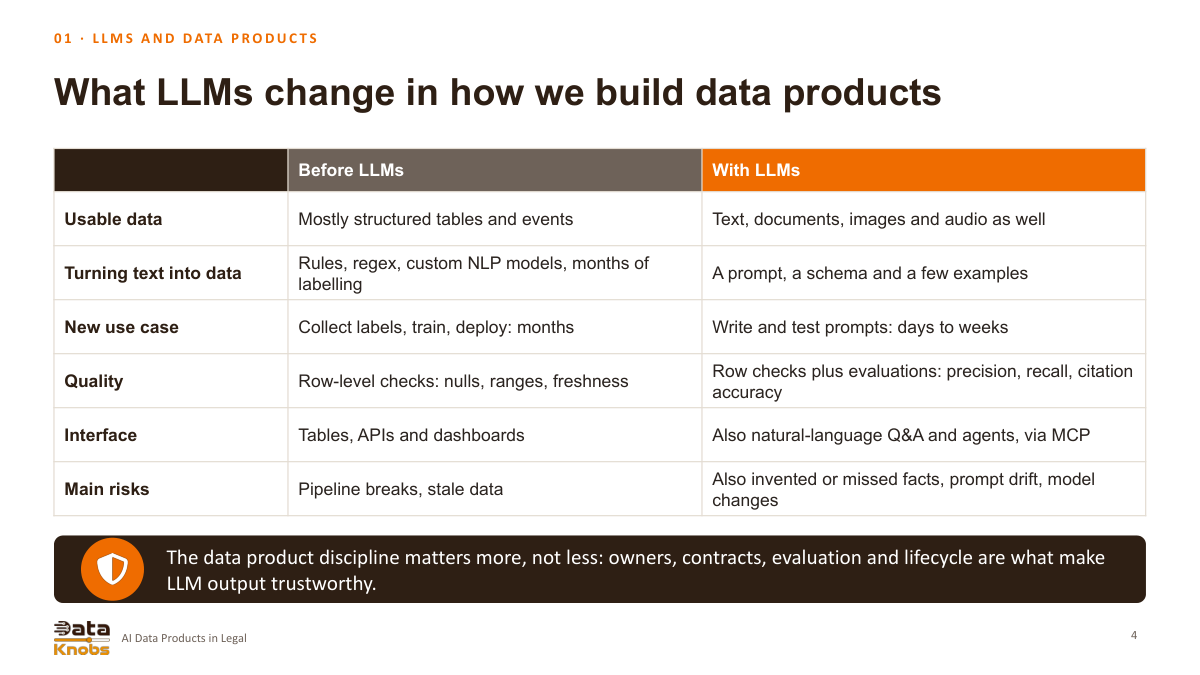
What LLMs change
LLMs can assist in transforming documents into structured data and enable natural-language interfaces. Quality now encompasses extraction accuracy, omissions, citation support, and consistency across prompt or model variations. The slide’s delivery-time comparisons are indicative; legal interpretation, integrations, and evaluation may still demand considerable effort.
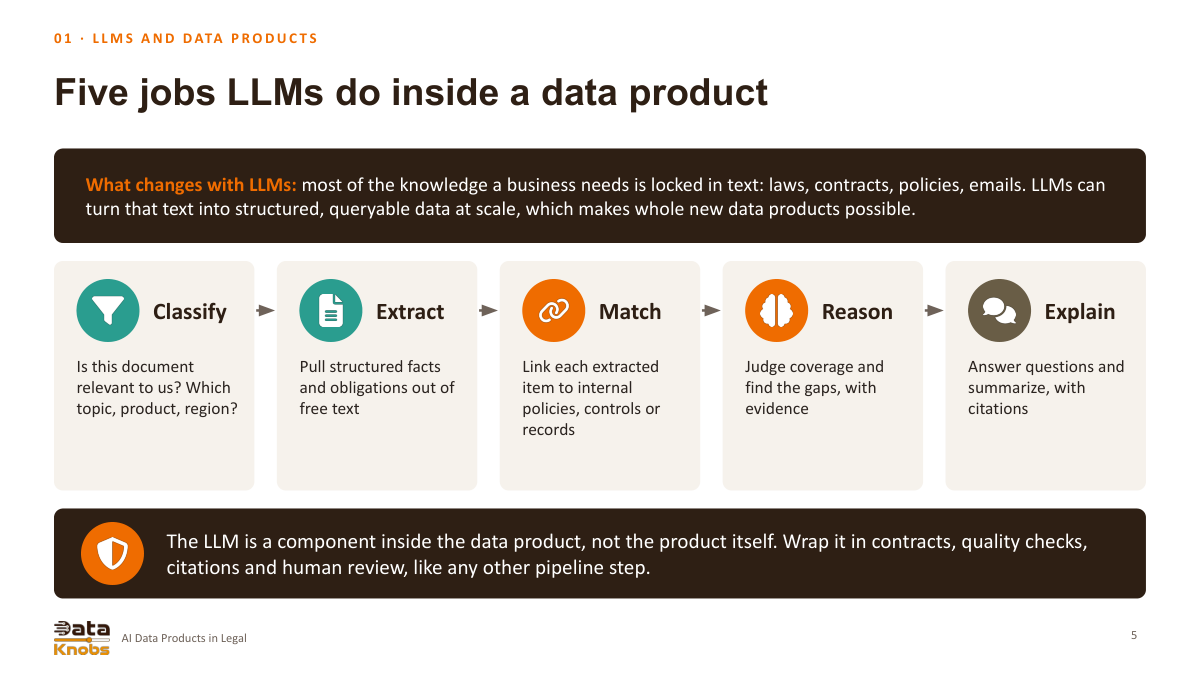
Five roles for LLMs
Determine relevance, identify obligations, align records with internal controls, suggest coverage evaluations, and clarify findings with references. Approach each role as a distinct pipeline stage whose output is verified and reviewed, rather than accepting generated text as definitive.
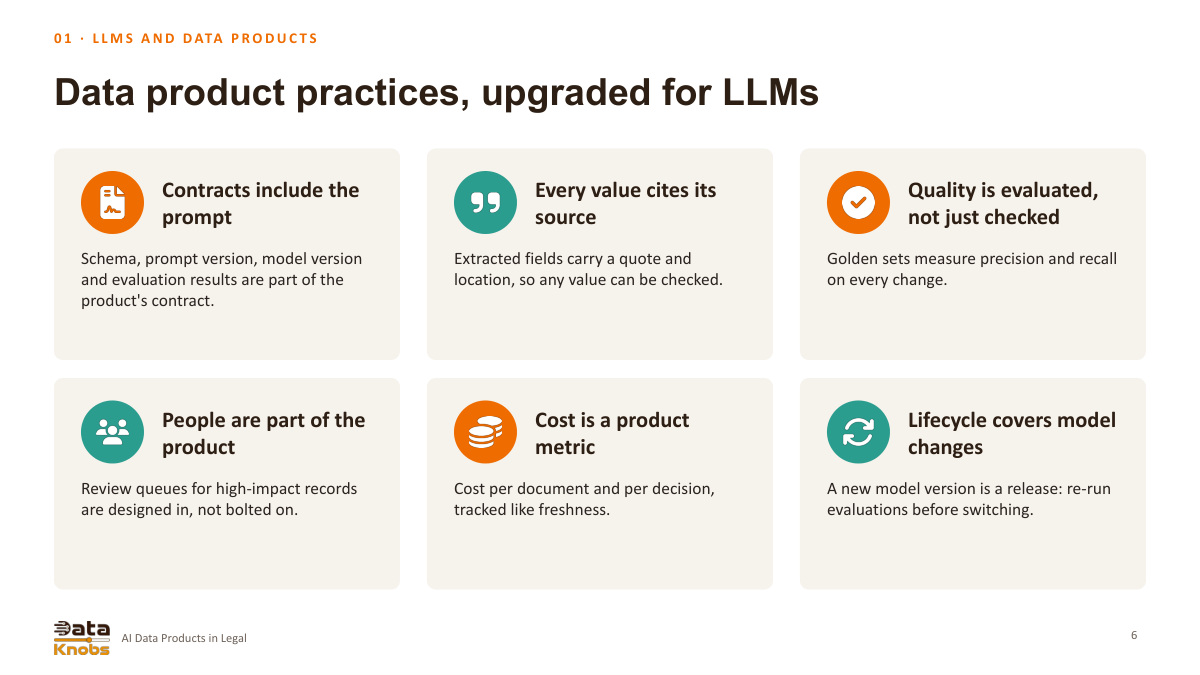
Upgrade the product contract
Combine version schemas, prompts, models, and evaluation results in one place. Link source quotes and their locations to extracted records, integrate review queues into the workflow, track processing costs, and assess changes prior to release. These methods enhance the inspectability and maintainability of outputs.
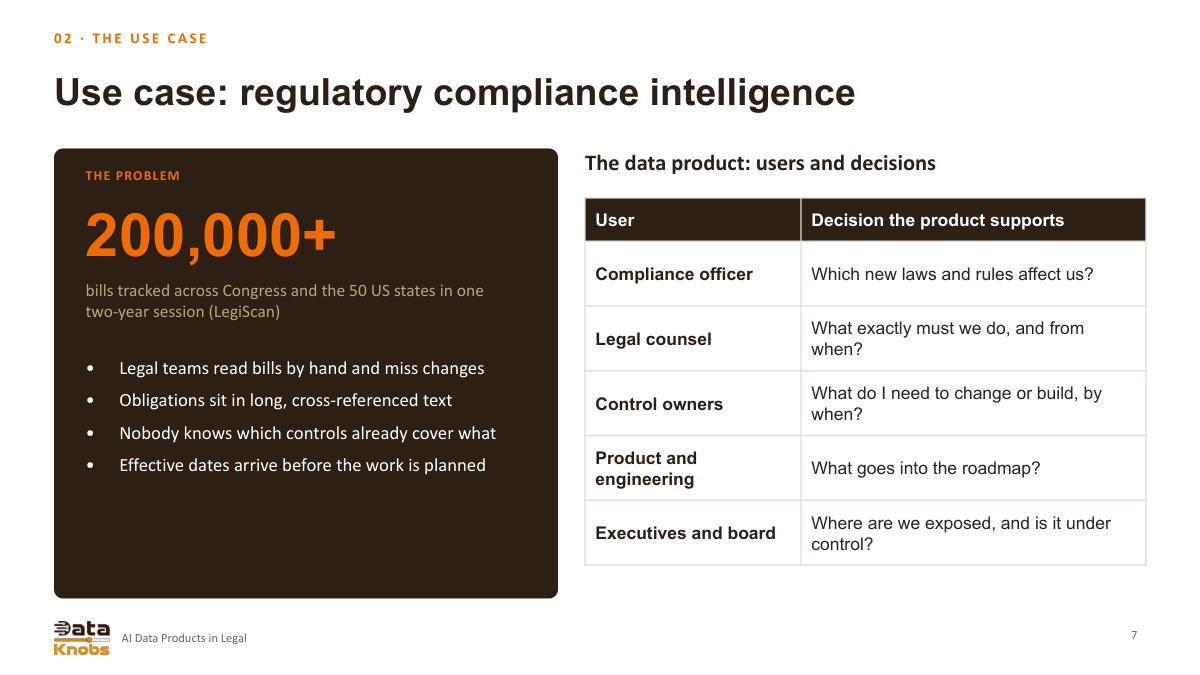
Users, decisions and reusable records
The compliance-intelligence use case
Compliance officers must recognize potentially relevant changes, counsel interpret obligations, control owners evaluate implementation, and engineering develop plans. The deck’s legislation-volume headline serves as context rather than a coverage assurance. Clearly specify the monitored jurisdictions, source types, and service boundaries.
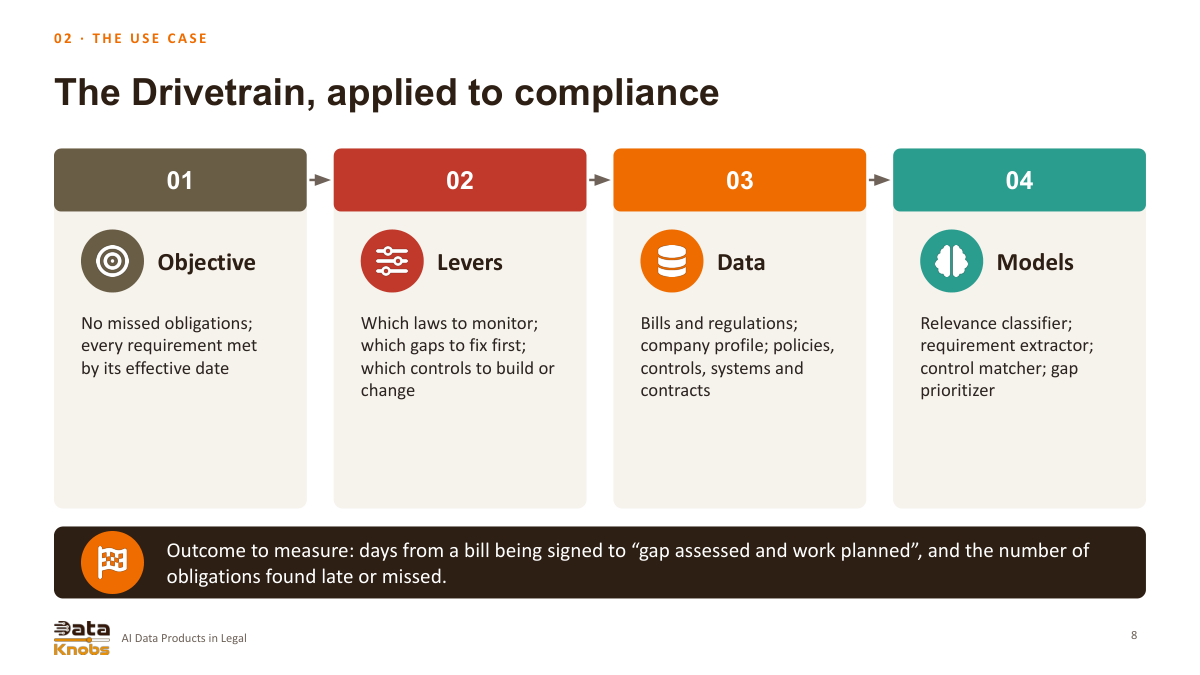
Start with objectives and decisions
The Drivetrain framework links the objective to levers, data, and models. The levers include monitoring scope, prioritization, and control changes; data is provided by legal sources and internal evidence. It tracks the time from a pertinent enacted change to identified gaps and planned actions, as well as any delayed or missed obligations.
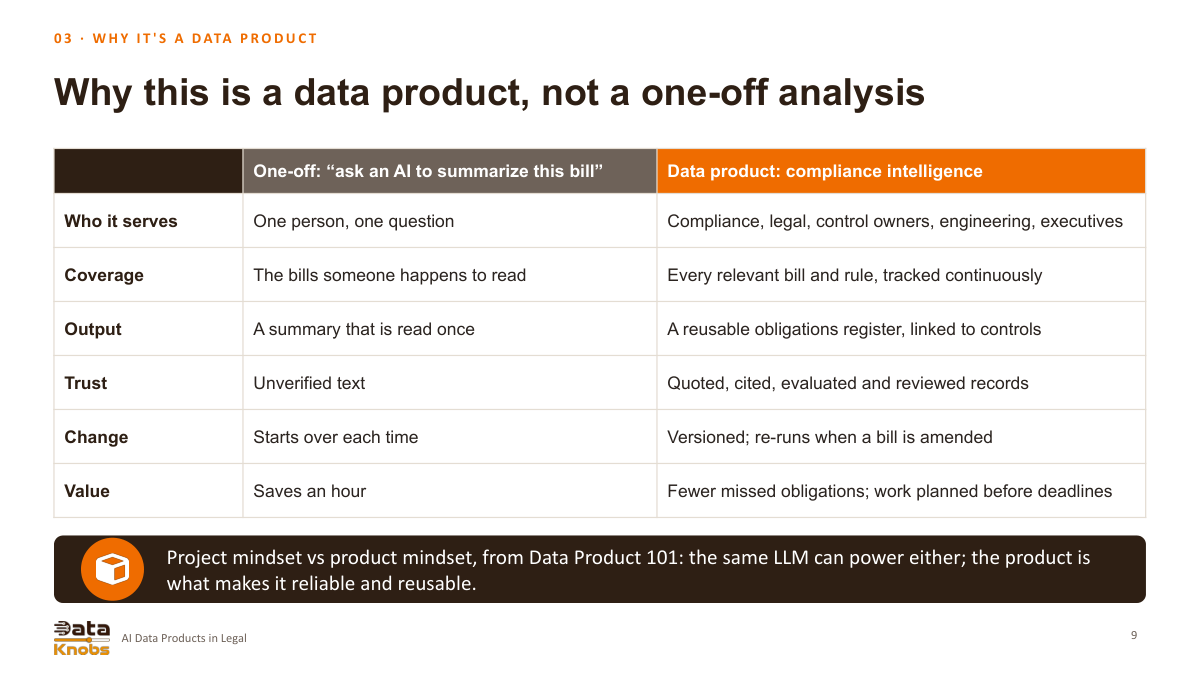
A product rather than a one-off summary
A summary addresses a single question. A compliance data product preserves consistent records for various teams, monitors versions, and supplies evidence along with updates as the source material changes. Coverage should be assessed within a specified scope instead of assuming it encompasses all applicable legal instruments.
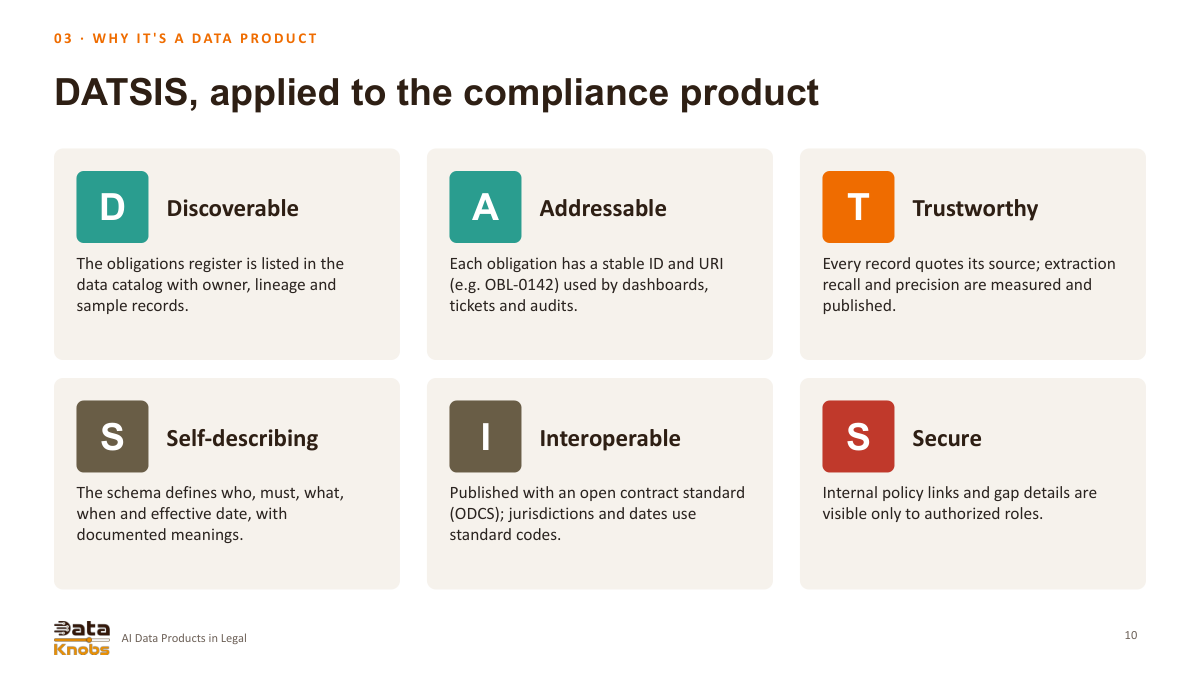
DATSIS applied to obligations
The deck employs discoverable, addressable, trustworthy, self-describing, interoperable, and secure attributes as core product design principles. Stable obligation IDs, documented fields, published quality results, lineage, and role-based access ensure records remain valuable across dashboards, tickets, and audit processes.
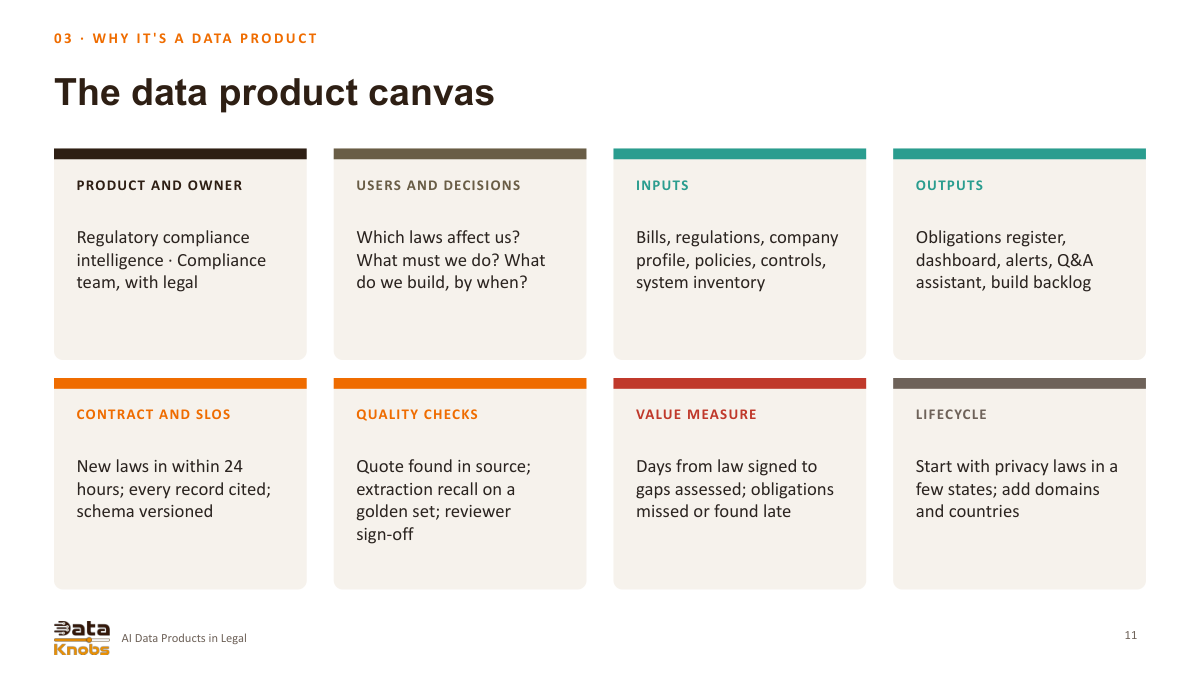
The data product canvas
Identify owners, users, decisions, inputs, outputs, quality controls, and the lifecycle. The suggested 24-hour ingestion goal and additional service targets serve as design illustrations, not actual outcomes. Start with a defined legal domain and broaden scope only once the review and evaluation procedures are dependable.
From changing text to reviewed work
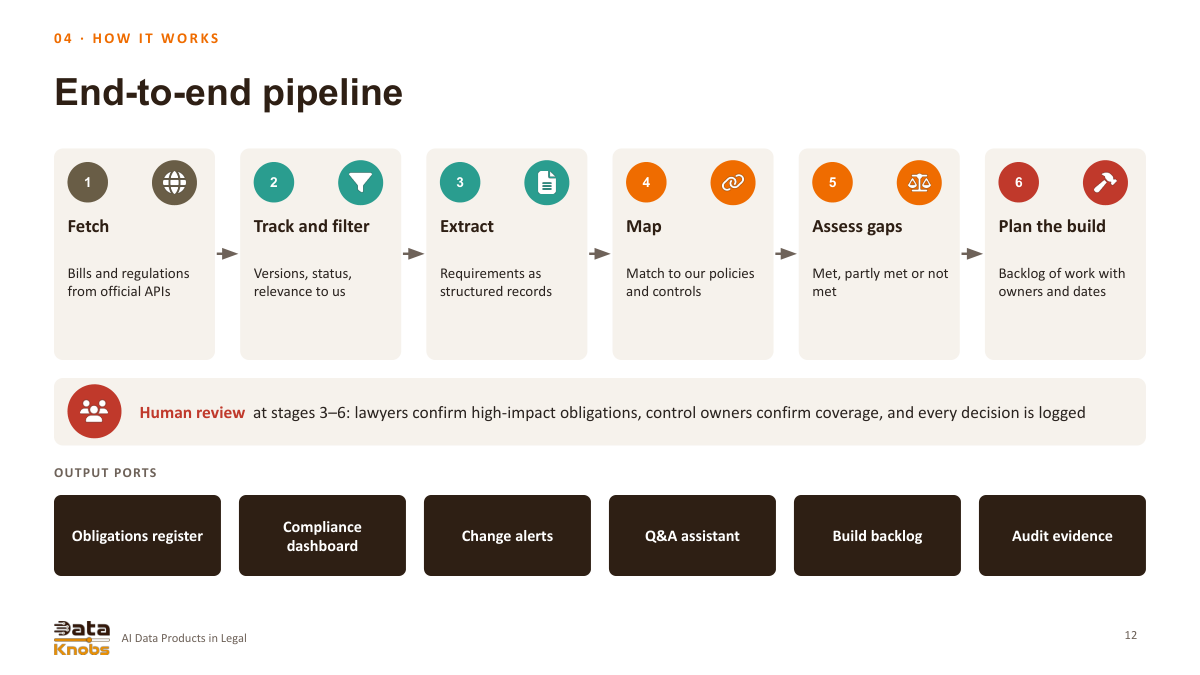
An end-to-end pipeline
Retrieve sources, monitor versions and relevance, extract requirements, map controls, evaluate gaps, and plan tasks. Human oversight covers the entire process from extraction to planning: legal counsel verifies key interpretations, owners validate control evidence, and the workflow documents decisions and modifications.
External sources and internal knowledge
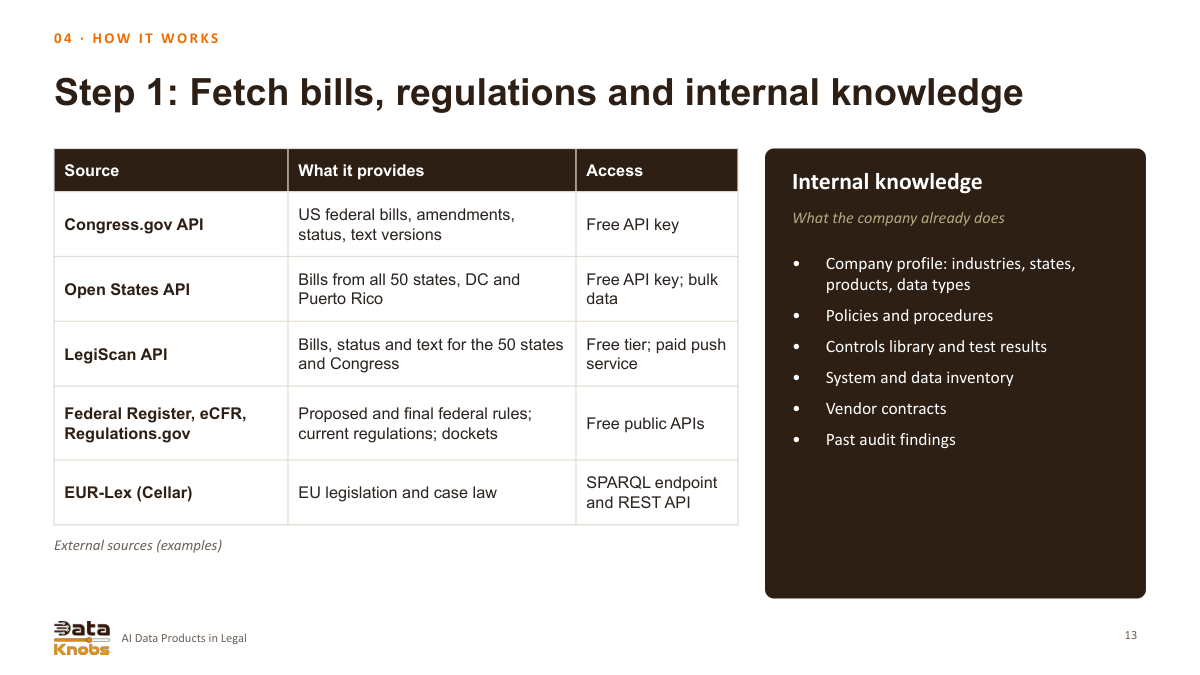
The deck identifies Congress.gov, Open States, LegiScan, Federal Register, eCFR, Regulations.gov, and EUR-Lex as potential sources. Internal context is provided by company profiles, policies, controls, inventories, contracts, and audit findings. Verify source coverage, licensing, and access conditions during implementation, as the slide’s access details are not assurances.
Track status, versions and applicability
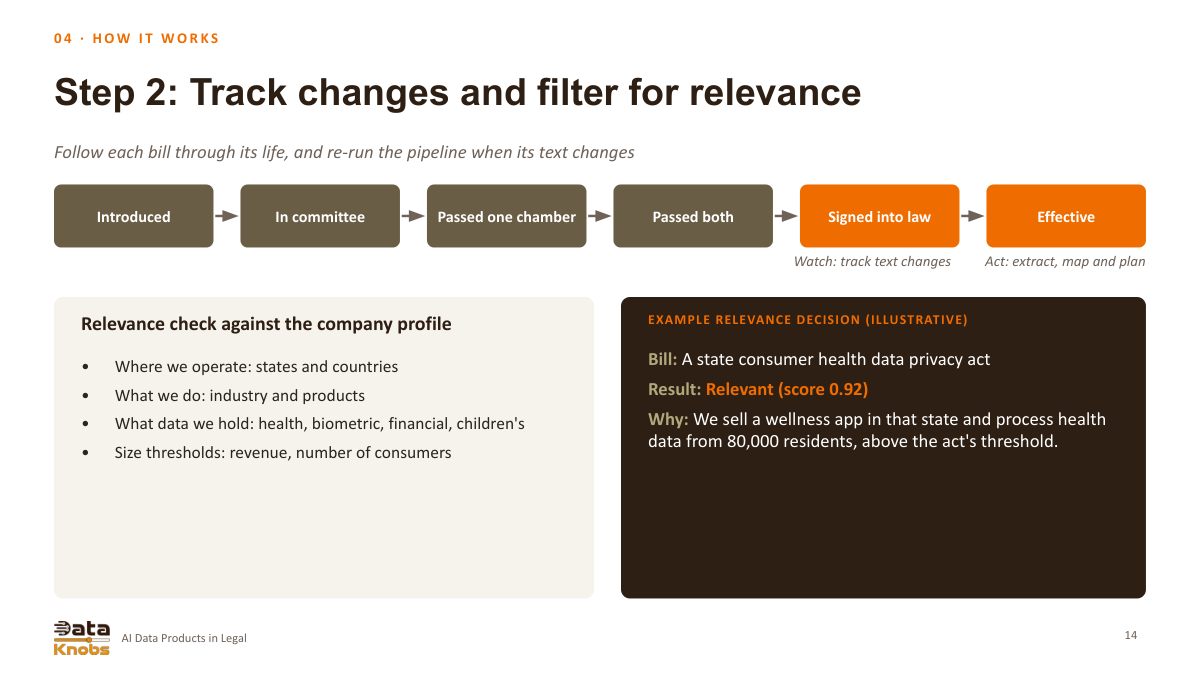
Differentiate between proposed text and enacted or effective requirements, and reassess when the text or its status is updated. Relevance varies based on jurisdiction, products, data categories, thresholds, and exceptions. The example score, the 80,000-resident number, and the hypothetical health-data act serve as illustrations, not as representations of actual legal standards.
Extract atomic obligations
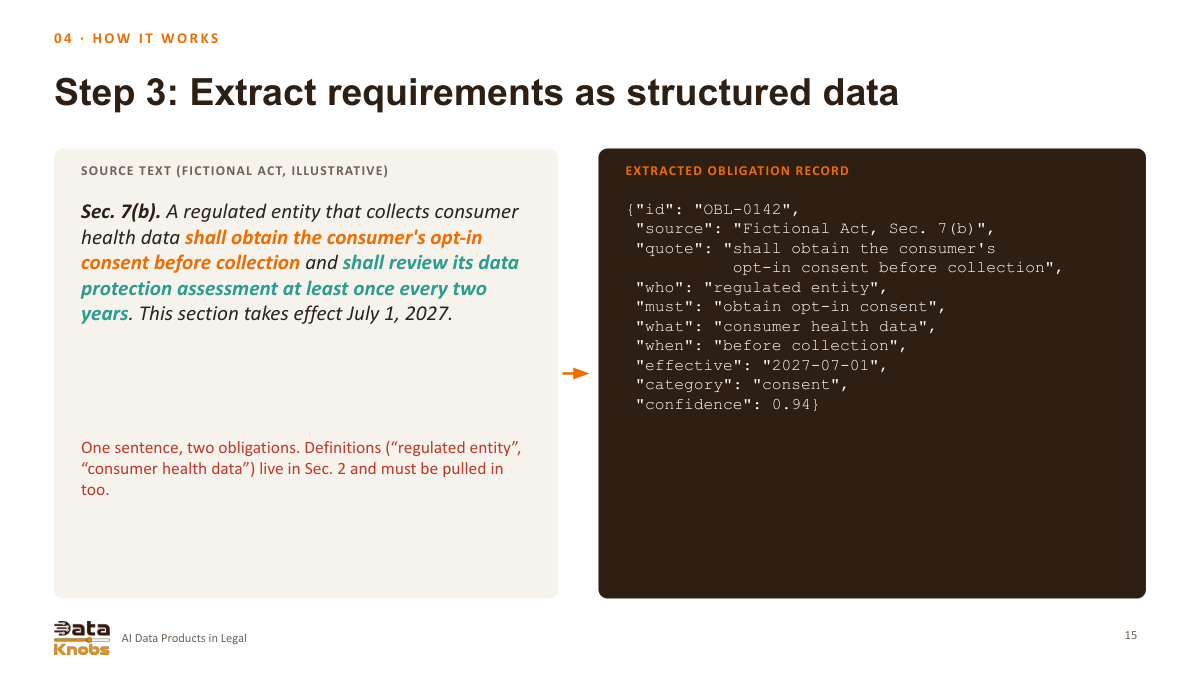
The fictional act includes duties related to both consent and assessment-review. Represent these as distinct records specifying the responsible entity, action, subject, timing, source quote, and effective date. Definitions and cross-references continue to be part of the interpretation. The date July 1, 2027, pertains to the fictional example.
Design reliable extraction
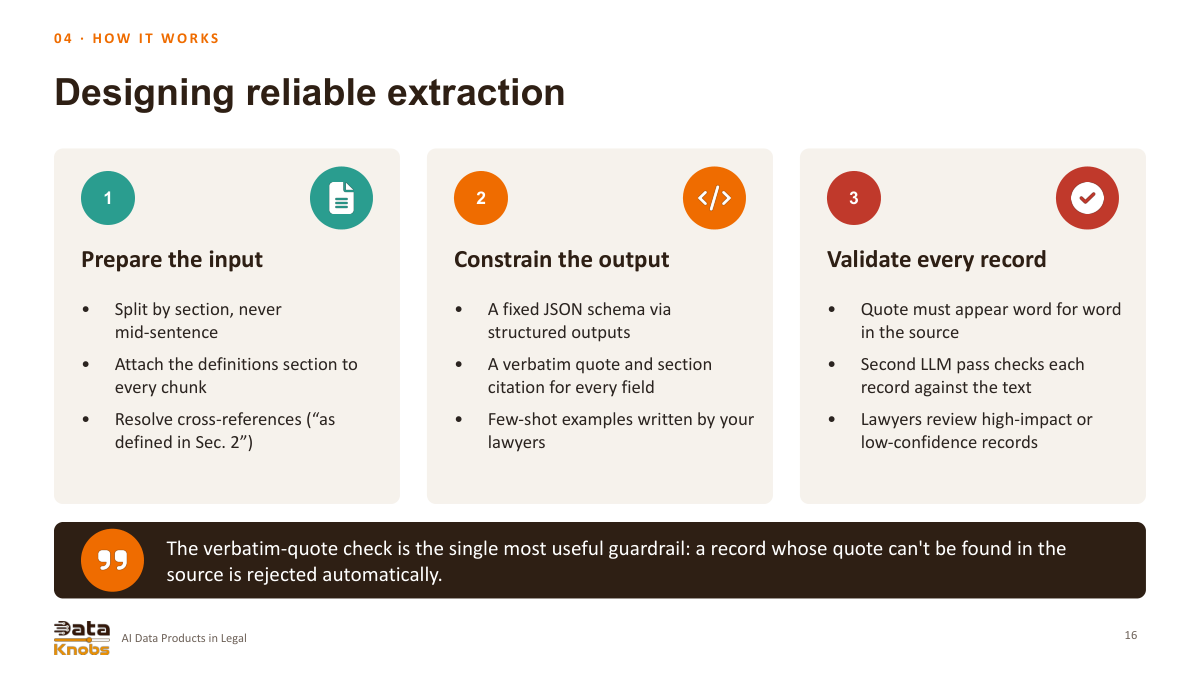
Maintain the section structure, clarify definitions and references, adhere to a specified schema, and verify quoted text against the original source. A matching quote confirms the text’s presence but does not guarantee correct interpretation of the obligation or that all duties were identified. Therefore, reviewer assessments and recall evaluations are still required.
Map to policies and controls
Identify candidate controls and suggest a coverage status backed by supporting evidence. The deck displays categories such as met, partly met, not met, not applicable, and needs information. Mere similarity in wording does not demonstrate operating effectiveness; control owners must verify scope and evidence prior to publication.
Turn reviewed gaps into planned work
Convert identified gaps into suggested changes in product, process, tooling, or policy, assigning responsible owners and deadlines. Prioritization takes into account time, impact, exposure, and effort. The April and June 2027 dates represent buffers prior to the fictional act’s effective date, rather than official legal deadlines.
Publish reusable output ports
Expose an obligations register, dashboard, alerts, cited Q&A, approved backlog items and audit evidence. A versioned contract should define freshness, provenance, review state and access behavior. Publishing structured records makes the same reviewed evidence reusable across workflows.
Risks, evaluation and product value
Control the failure modes
Invented or missing obligations, incorrect interpretations, outdated text, and unsupported coverage evaluations require distinct controls. Integrate source matching, annotated reviews, version tracking, and responsible oversight. For confidential content, verify provider terms, retention policies, training applications, and access controls instead of assuming the model service is adequate.
Evaluate each pipeline stage
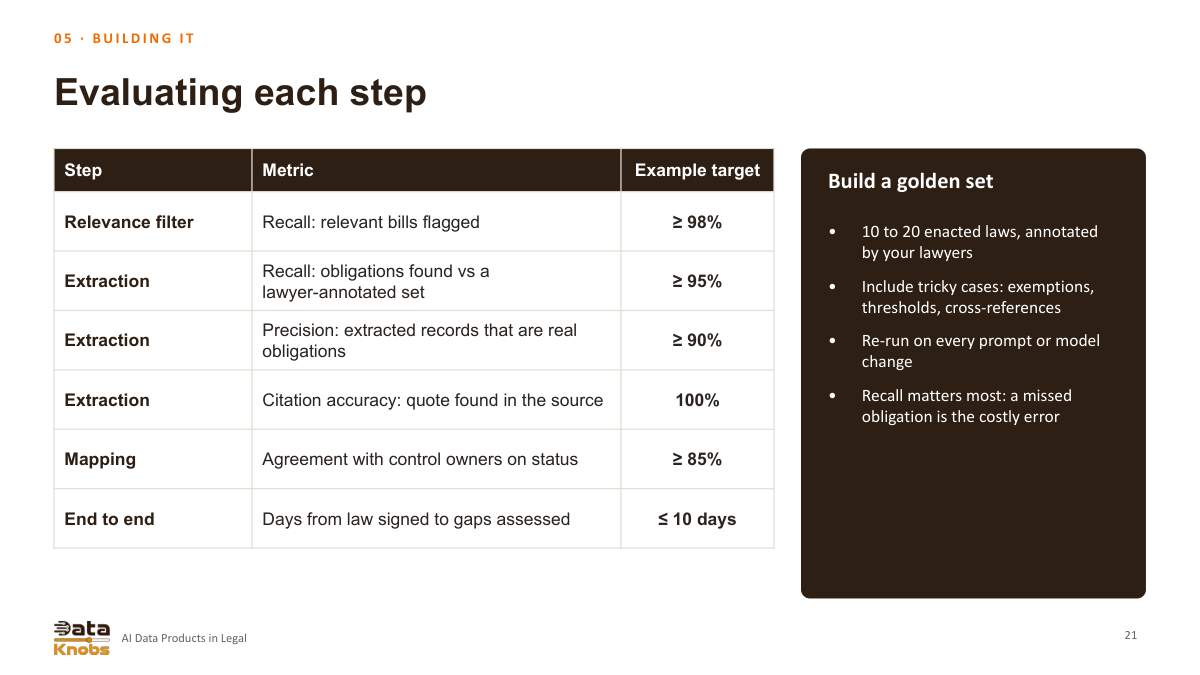
The deck suggests sample targets for relevance recall, extraction recall and precision, quote matching, mapping agreement, and assessment time. These serve as potential acceptance criteria, not benchmark outcomes. Develop a lawyer-annotated test set featuring challenging exemptions, thresholds, and cross-references, then assess changes using held-out examples.
Measure product value
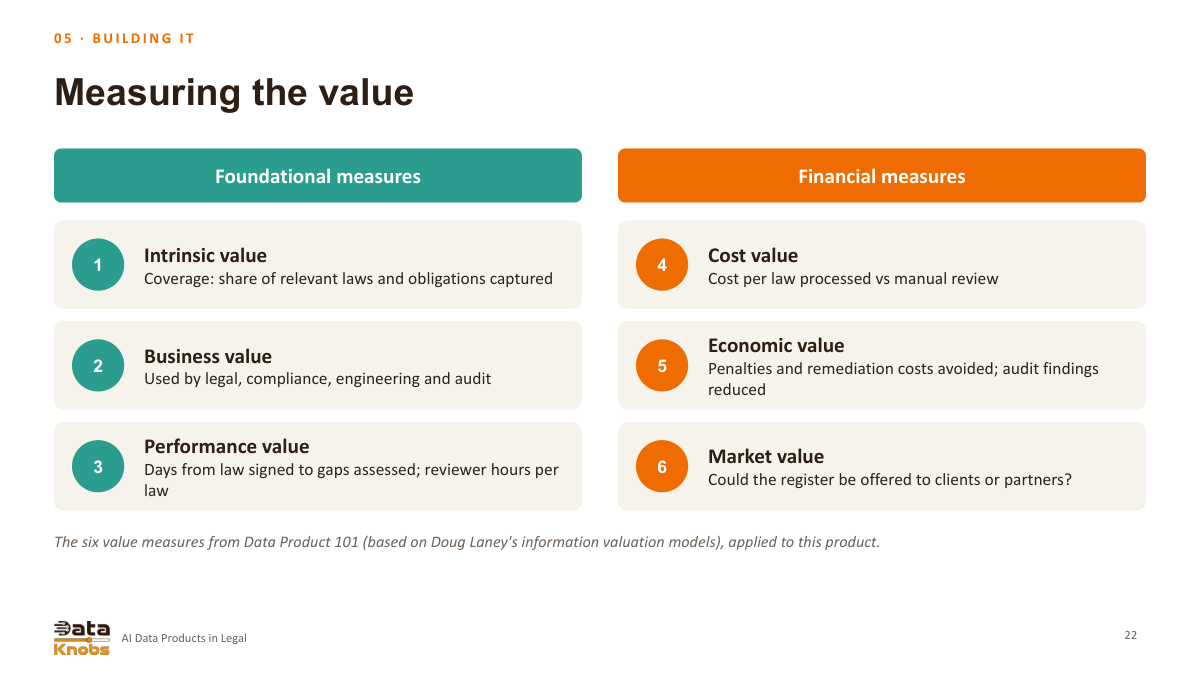
Track monitored coverage, adoption rates, time to assessment, reviewer effort, and cost per processed law. Avoided penalties or remediation expenses need a defensible estimation approach and should not be shown as guaranteed savings. Potential external reuse likewise depends on permissions and commercial viability.
Components to build
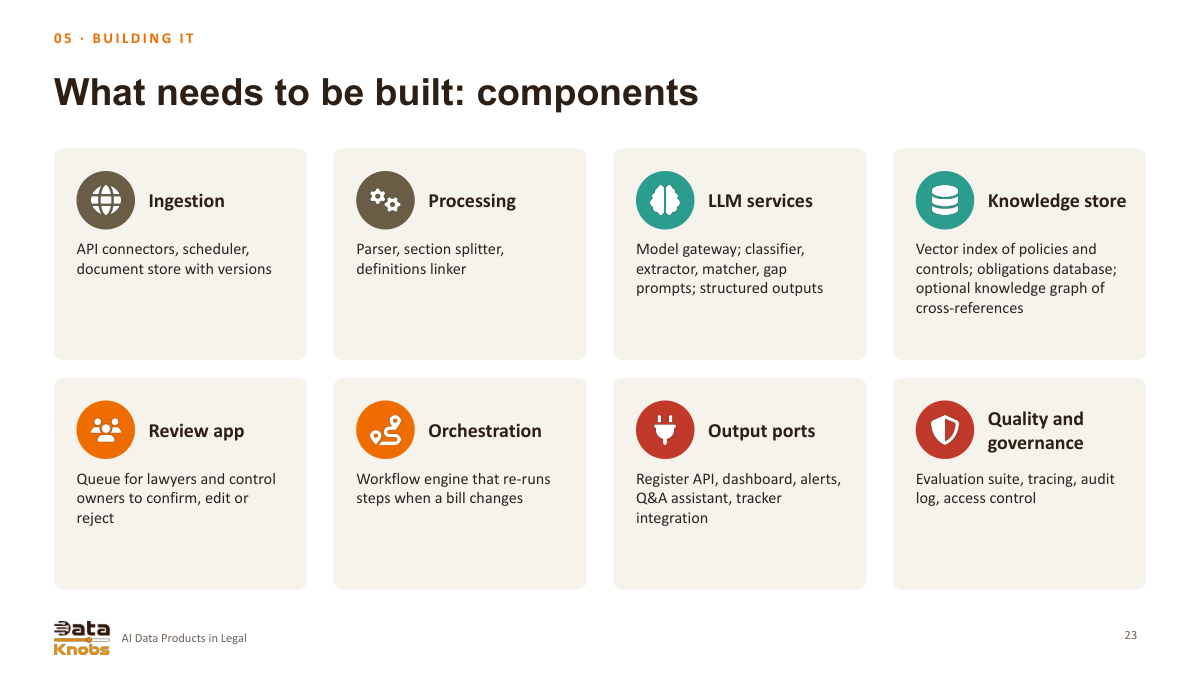
The proposed system comprises versioned ingestion, parsing, and cross-reference resolution, bounded LLM services, an obligations database, policy retrieval, review tools, orchestration, and output integrations. Evaluation, tracing, auditing, and access controls extend across the entire architecture.
A staged roadmap and team
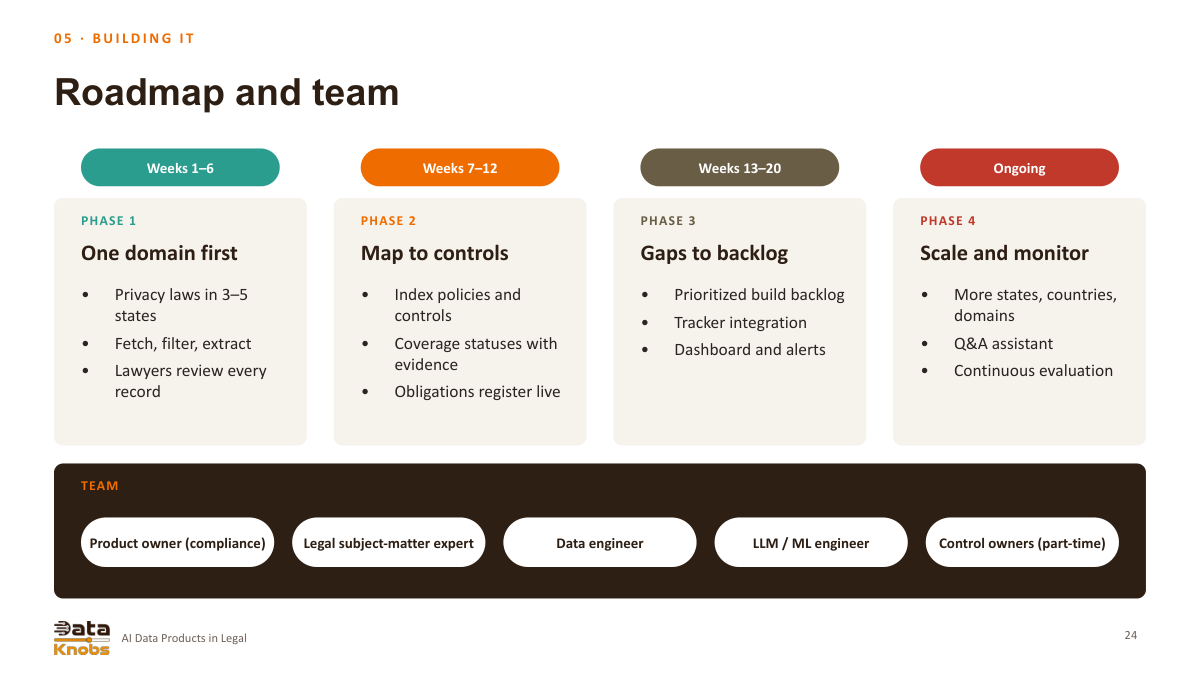
The example begins with a single privacy domain, then incorporates control mappings, backlog integrations, and an expanded scope. Compliance leads the product alongside legal experts, data engineers, LLM engineers, and control owners. The 20-week timeline serves as a suggested plan, with its speed influenced by source quality, review capacity, and integration preparedness.
Reuse the pattern across legal products
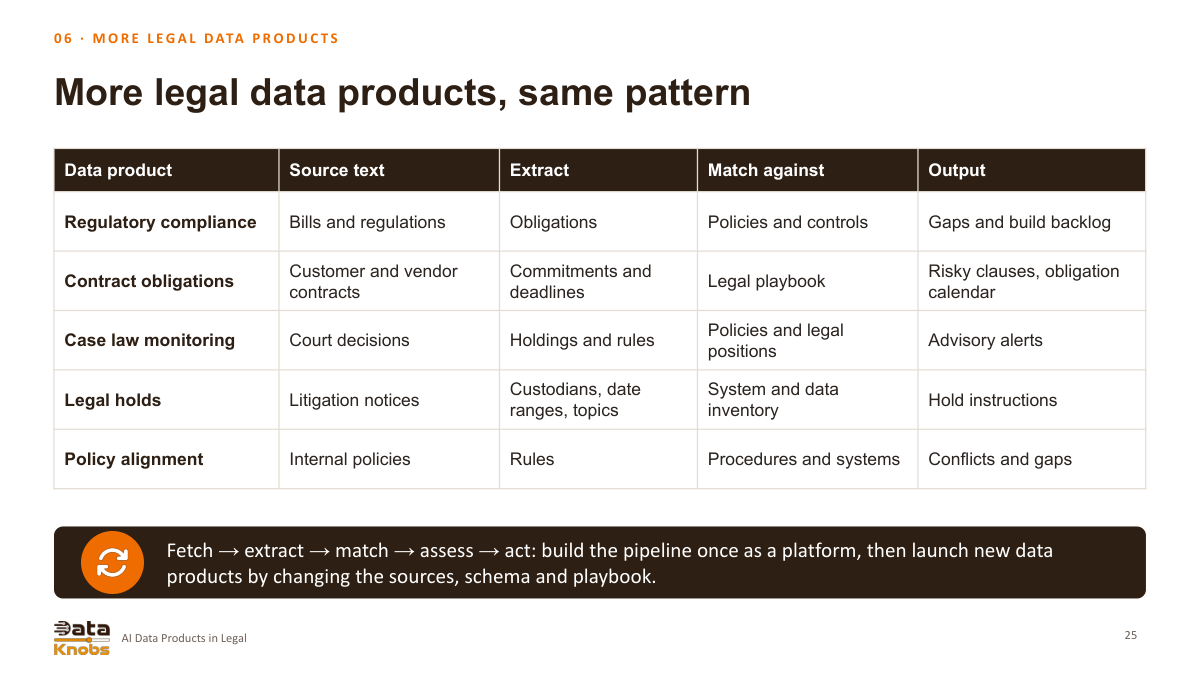
The identical source-to-record workflow can be applied to contract commitments, case-law monitoring, legal holds, and policy alignment. Each use case requires a distinct schema, evidence criteria, permissions, review procedures, and legal playbook; reusing the platform does not render these requirements interchangeable.
The product discipline is the differentiator
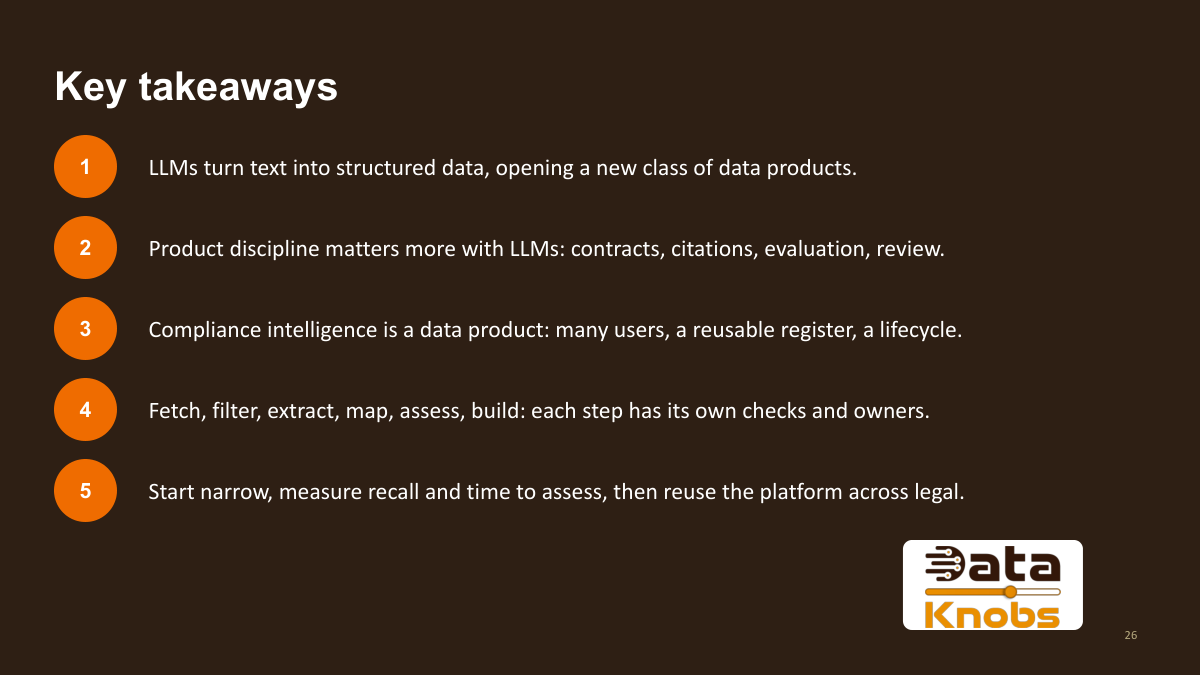
LLMs can assist in organizing legal text, but a reliable solution requires a defined scope, contracts, evidence, evaluation, ownership, and lifecycle management. Begin with a focused approach, track omissions and review duration, and grow only once the outcomes are both practical and dependable.
Legal AI data products FAQ
What is a legal AI data product?
Regulatory compliance intelligence transforms evolving legal text into a reusable repository of obligations, evidence, control mappings, and authorized work. This presentation utilizes data-product principles to guide the process from a source document to the deliverables a team may require.
In what way does it differ from requesting an LLM to summarize a law?
A summary addresses a single question. A compliance data product preserves consistent records for various teams, monitors versions, and supplies evidence along with updates as the source material changes. Coverage should be assessed within a specified scope instead of assuming it encompasses all applicable legal instruments.
What does an obligation record contain?
A valuable record includes a stable ID, source version and location, supporting quotation, responsible party, necessary action, scope, timing, and review status. Cross-references, exceptions, and definitions also need to be taken into account.
Does a source quote prove compliance?
No. A source quote ensures traceability but does not alone confirm legal applicability, accurate interpretation, full extraction, or control effectiveness.
Are the health-data act and 2027 deadlines real?
No. The deck clearly states that the act is fictional. Its thresholds, obligations, and deadlines represent the process flow, not real legal mandates.
What should be evaluated?
The deck suggests sample targets for relevance recall, extraction recall and precision, quote matching, mapping agreement, and assessment time. These serve as potential acceptance criteria, not benchmark outcomes. Develop a lawyer-annotated test set featuring challenging exemptions, thresholds, and cross-references, then assess changes using held-out examples.
About this guide
Based on the provided 26-slide “AI Data Products in Legal” presentation by Prashant Dhingra, DataKnobs, marked as updated November 2026. The original slides serve as the basis for the product framework, pipeline, fictional scenarios, and example delivery goals.
This page outlines a product architecture and workflow but does not specify the applicable law for any given organization. Verification of source availability, access conditions, and legal applicability is required during implementation; the API access details in the deck do not represent current service commitments.