

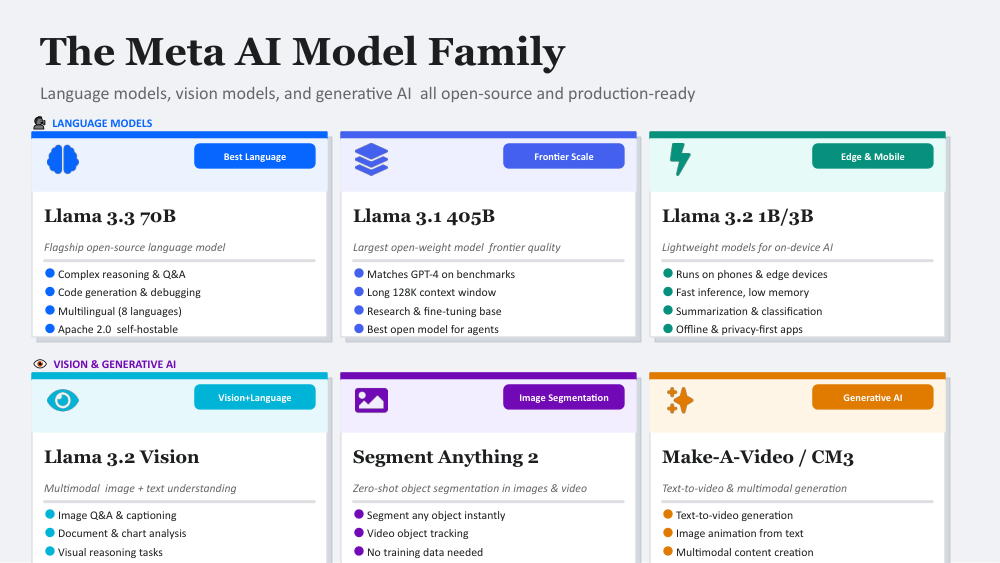
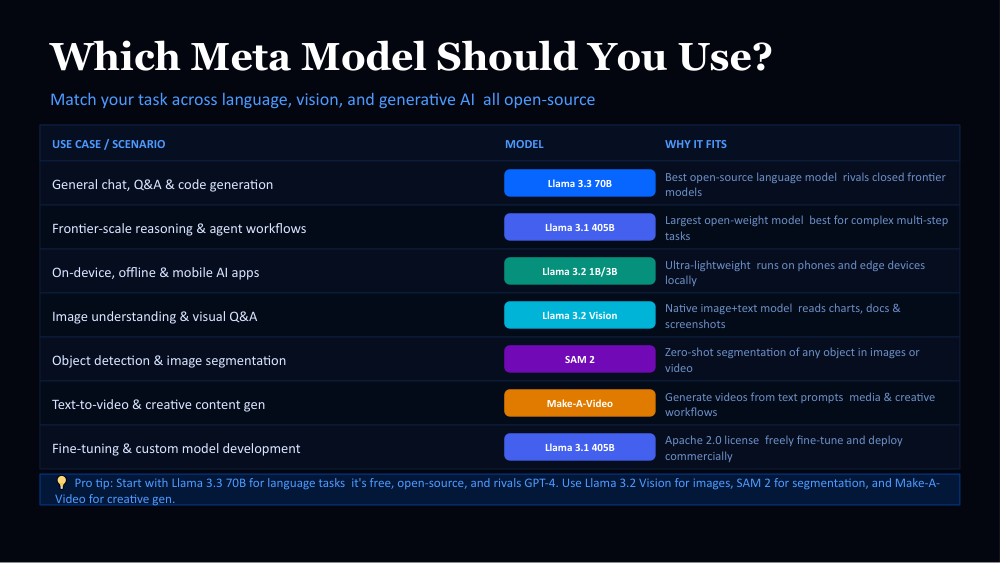
When people say "Meta's AI models," they usually mean Llama. That's only part of the picture. Meta has shipped four distinct model families that cover text, vision, video, and audio : plus a handful of smaller, purpose-built models most teams never hear about until they need one. Here's what actually makes up the lineup, and why the "open-weight" strategy behind it matters for anyone deciding whether to build on Meta's models or a closed API.
Llama: The Open-Weight Language Model Line
Llama is Meta's family of large language models, and the one piece of this lineup most builders already know. It's the reason "open-weight" became a viable alternative to closed APIs like OpenAI's or Anthropic's: Meta publishes the model weights, so anyone can download, self-host, and fine-tune them, subject to Meta's Llama Community License (which requires a separate commercial license only for services with an extremely large user base).
The current generation, Llama 4, shipped in April 2025 and was Meta's first Llama family to use a Mixture-of-Experts (MoE) architecture : instead of activating every parameter for every token, the model routes each token through a small subset of specialized "expert" sub-networks, cutting inference cost without cutting total model capacity. Two variants are broadly available:
- Llama 4 Scout : 17B active parameters (109B total across its experts), built for extremely long context. Its headline feature is a 10-million-token context window, large enough to reason over entire codebases or document sets in a single pass, and it's compact enough to run on a single high-end GPU.
- Llama 4 Maverick : also 17B active parameters, but spread across 128 experts for 400B total parameters and roughly a 1M-token context. It's the generalist workhorse of the family, and at launch it beat GPT-4o and Gemini 2.0 Flash on several widely reported benchmarks.
- Llama 4 Behemoth : Meta's largest model, at roughly 288B active parameters and near 2 trillion total. Behemoth functions as a "teacher" model used to distill Scout and Maverick rather than a product for direct use, and as of mid-2026 it had not been broadly released; its ultimate release status remains unconfirmed.
This isn't the first time Llama picked up new capability without changing its name. Llama 3.2, released in late 2024, was the point where Llama stopped being text-only and added native image reasoning (11B and 90B "Llama Vision" variants) alongside lightweight, on-device text models : the same multimodal, multi-size pattern Llama 4 continues.
Llama Vision: Multimodal Image Reasoning
"Llama Vision" isn't a separate product line so much as Llama's multimodal capability : the ability to take an image as input alongside text and reason about it: describing a photo, reading a chart, answering questions about a document scan, or grounding a response in what's actually shown in a picture. Llama 4 Maverick extends this further with native multimodal training baked into the base model rather than bolted on afterward, which is part of why it performs well on image-and-text benchmarks specifically.
For enterprise use, this matters less as a standalone feature and more as a building block: a document-understanding pipeline, a visual QA assistant, or a product-catalog tool can all run on a single self-hosted model instead of stitching together a separate OCR step, a separate vision model, and a separate language model.
Segment Anything: Knowing Where Things Are
Segment Anything Model (SAM) solves a different problem than Llama: not "what does this mean," but "where exactly is this object." Given an image or video and a prompt : a click, a box, or a text description : SAM outlines the precise pixels that belong to that object. It's the kind of unglamorous, foundational capability that ends up inside a lot of other systems.
- SAM (2023) : the original foundation model for image segmentation, trained on Meta's SA-1B dataset, one of the largest segmentation datasets ever released.
- SAM 2 (2024) : extended segmentation to video with a streaming architecture that processes frames one at a time and tracks an object across a clip, not just a single frame.
- SAM 3 (2025) : unified detection, segmentation, and tracking in one model, promptable by text, an example image, or a visual prompt, rather than requiring a click on every new object.
- SAM 3.1 (2026) : a faster, real-time-oriented update focused on video detection and tracking at production latency.
In practice, SAM shows up in photo and video editing tools (including Meta's own Instagram "Edits" app), dataset annotation pipelines, robotics perception, and increasingly as a pre-processing step that feeds cleanly segmented objects into a downstream generative or reasoning model.
Movie Gen: Text-to-Video and Audio
Movie Gen is Meta's media generation research: a set of foundation models that turn a text prompt into high-definition video with synchronized audio, edit an existing video from a text instruction, or turn a personal photo into a short video. Meta has described it as producing 1080p video at multiple aspect ratios : a first for the industry at the time it was announced. Meta was notably cautious about broad release here compared to Llama, citing the need for further safety work before shipping the underlying models directly; capabilities in this space have instead surfaced gradually through Meta's own consumer media-generation features. Treat Movie Gen as the research direction rather than a model you can download today.
The Rest of the Lineup
Beyond the headline models, Meta maintains several smaller, purpose-built models that matter more the closer you get to production:
- Llama Guard : a classifier fine-tuned to flag unsafe inputs and outputs, meant to sit in front of and behind a Llama deployment as a moderation layer.
- Prompt Guard : a small model trained specifically to detect prompt injection and jailbreak attempts, a narrower and cheaper problem than general content moderation.
- Code Llama : a code-specialized fine-tune of earlier Llama generations; Llama 4's native coding ability has narrowed the gap, but dedicated code models from Meta and others still lead on some coding benchmarks.
- DINOv2 : a self-supervised vision model that produces general-purpose image embeddings without needing labeled training data, useful for search, clustering, and classification tasks that don't need a full generative model.
Why the Open-Weight Strategy Matters
The common thread across this entire lineup is that most of it ships as open weights, not just an API. That's a deliberate strategic bet, and it changes the calculus for enterprises deciding what to build on:
| Consideration | Favors Open-Weight (Llama, SAM) | Favors Closed API |
|---|---|---|
| Data sovereignty | Model runs inside your own infrastructure : data never leaves | Data is sent to a third-party API |
| Fine-tuning | Full weight access; fine-tune however you need | Limited to vendor-provided fine-tuning options |
| Cost at high volume | Marginal cost drops toward compute cost, not per-token pricing | Per-token pricing scales linearly with usage |
| Absolute frontier performance | Competitive, but not always the top scorer on every benchmark | Often the highest-scoring option on hardest reasoning tasks |
| Operational ownership | You own hosting, scaling, and security | Vendor owns uptime, scaling, and security |
Most production stacks we see don't pick one side of that table : they mix both: a self-hosted Llama model handling cost-sensitive, high-volume tasks (classification, extraction, routine drafting), and a closed frontier model reserved for the hardest reasoning work where the extra cost is easy to justify. Segmentation (SAM) and vision capability often sit alongside either choice as a shared building block.
The harder question isn't which model is "best" in the abstract : it's which mix is best for your workload, your data-sovereignty requirements, and your cost curve at scale. That's exactly the kind of decision worth testing against real data rather than defaulting to whichever model was easiest to integrate first: Dataknobs' AbExperiment lets teams benchmark open-weight and closed models side by side on their own tasks, and Kontrols keeps lineage on which model : self-hosted or API : produced which output, so a mixed-model stack stays governable instead of becoming a black box.
Frequently Asked Questions
What are Meta's main AI models?
Meta's principal AI model families are Llama (open-weight large language models, now in its fourth generation with Scout and Maverick), Llama Vision (multimodal image reasoning built into Llama since version 3.2), Segment Anything Model or SAM (image and video segmentation, now at SAM 3), and Movie Gen (text-to-video and audio generation research), alongside supporting models like Llama Guard and Code Llama.
Is Llama 4 open source?
Scout and Maverick are released as open-weight models under Meta's Llama Community License : downloadable, self-hostable, and fine-tunable, with a separate commercial license required only above an extremely large user threshold. Behemoth, the much larger teacher model, had not been broadly released as of mid-2026.
What is Segment Anything Model (SAM) used for?
SAM identifies and outlines objects in images and video from a prompt such as a click, box, or text description. It's used for photo and video editing, dataset annotation, robotics perception, and as a pre-processing step inside larger AI systems, and has progressed from image-only segmentation to unified detection, segmentation, and tracking across video in SAM 3.
Should enterprises use Meta's open-weight models instead of a closed API?
Open-weight models make the most sense when data sovereignty, self-hosting, fine-tuning freedom, or cost at high volume outweigh having the single top-scoring model on every benchmark. Many production systems use both : a self-hosted Llama model for cost-sensitive, high-volume tasks, and a closed frontier model for the hardest reasoning work : with the right split determined by testing against real workloads.