1
Too many hidden AI knobs
Prompts, datasets, thresholds, retrieval settings, model choices, tool permissions and policy rules are scattered across teams. No one can clearly see which knobs control accuracy, risk, cost or user experience.
KNOBS EKIP™ helps enterprises identify, measure, govern and optimize the decision variables that shape AI outcomes: data, prompts, rules, retrieval, tools, models, agents, evaluation criteria, risk policies and business workflows.
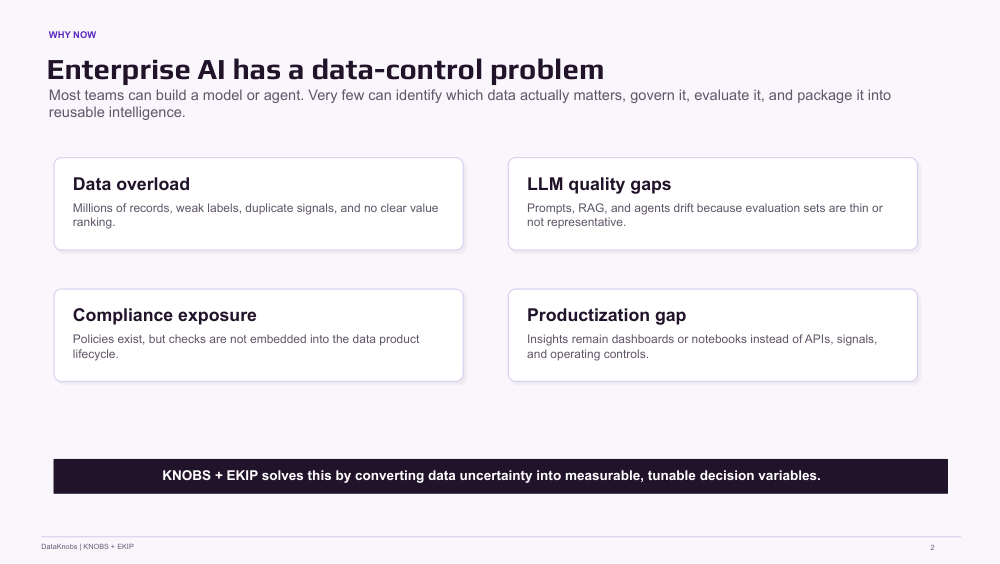
Most enterprise AI programs start with pilots, models and demos. The hard part is operationalizing them: choosing the right data, controlling behavior, proving value, enforcing policy and continuously improving outcomes.
Prompts, datasets, thresholds, retrieval settings, model choices, tool permissions and policy rules are scattered across teams. No one can clearly see which knobs control accuracy, risk, cost or user experience.
Teams create impressive prototypes, but they lack a repeatable lifecycle for turning experiments into governed, monitored, production-grade AI systems.
Enterprises often rely on ad hoc reviews, small test sets and subjective judgments. EKIP turns evaluation into a managed asset with reusable datasets, scoring criteria and continuous measurement.
Critical meaning lives across spreadsheets, documents, call transcripts, tickets, databases, APIs and tribal knowledge. EKIP helps convert raw context into high-impact, reusable intelligence assets.
Legal, compliance, risk, security and business teams need control, but manual approval workflows slow delivery. EKIP embeds governance into the AI operating model instead of treating it as an afterthought.
AI teams can show demos, but executives need measurable improvement in revenue, cost, productivity, risk reduction and customer experience. EKIP connects knobs to business outcomes.
Agents combine models, memory, tools and workflows. Without a control plane, small changes can create large unintended consequences. EKIP provides traceability and operating controls.
Decisions, experiments, failures and lessons are rarely captured as enterprise memory. EKIP keeps institutional learning tied to datasets, evaluations, workflows and business decisions.
Most teams tune one prompt or one model at a time. EKIP manages the full optimization surface across data, prompts, policies, tools, agents and feedback loops.
EKIP treats every AI system as a portfolio of controllable knobs. Each knob can be discovered, documented, tested, governed, monitored and improved.
Inventory the data, prompts, models, agents, rules, APIs, memory sources and business constraints that influence outcomes.
Create benchmark datasets, golden examples, scenario tests, risk tests and scoring rubrics for each business workflow.
Attach ownership, approval rules, policy constraints, audit trails and version history to important enterprise AI knobs.
Run experiments across prompts, context windows, retrieval strategies, thresholds, agents, user journeys and business policies.
Track live quality, drift, cost, latency, safety, compliance, user satisfaction and business impact after deployment.
Turn successful patterns into reusable enterprise assets across products, markets, teams and customer segments.
Start with the decision, workflow, risk or customer experience that matters.
Identify every adjustable input that can change the outcome.
Build test datasets, rubrics, edge cases and control scenarios.
Test versions safely with traceability, approvals and rollback.
Promote what works, retire what fails and connect gains to ROI.
EKIP is useful anywhere AI behavior depends on many interacting variables. Instead of treating the model as the only lever, EKIP exposes the whole system.
The flagship landing page for Enterprise Knobs Intelligence Platform.
FoundationCore definition of enterprise knobs across data, prompts, models and workflows.
Value ChainHow EKIP connects raw data to measurable enterprise AI outcomes.
DatasetManaging high-impact training, evaluation and grounding datasets.
GovernanceControls, approvals, evidence and risk management inside AI workflows.
PortfolioManaging AI use cases, signal products and enterprise assets as a portfolio.
ConsumptionAPIs, apps, assistants and dashboards that consume governed intelligence.
Operating SystemA control-plane view of enterprise AI execution and optimization.
DashboardOutcome, quality, risk and ROI visibility for leadership teams.
EKIP helps enterprises move beyond model selection and build a governed optimization system for every AI decision, workflow and agent.