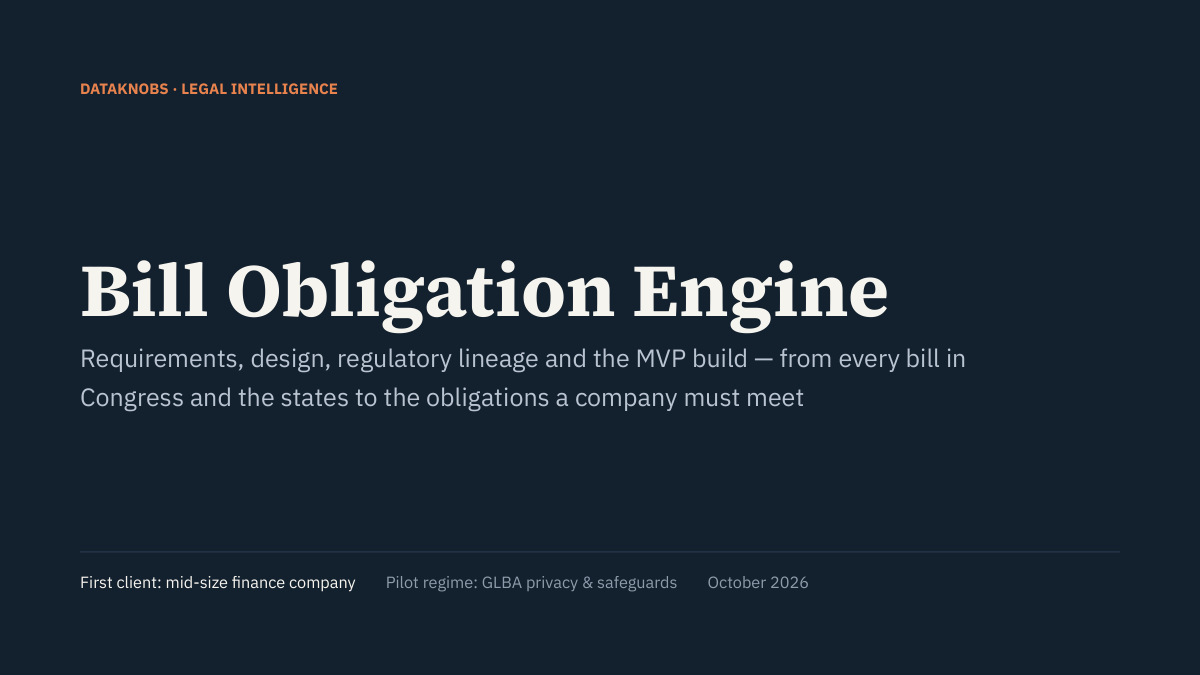
The Bill Obligation Engine integrates legislative tracking, systematic obligation extraction, company profile alignment, and regulatory lineage. Its goal is to produce an actionable register detailing what applies, why, by when, and which control addresses it.
The architecture distinguishes between proposed requirements and enacted duties, employs deterministic matching whenever feasible, and channels interpretation through a review process. The initial pilot project targets a single mid-sized financial services firm.
About this presentation. This page outlines the provided Dataknobs deck from October 2026. Cost estimates, access conditions, regulatory scenarios, and MVP outcomes are shown as statements from the source deck and have not been independently verified as current facts. Targets are differentiated from actual results. Compliance outputs are meant for review by qualified personnel.
A proposed compliance-intelligence solution integrates legislative tracking, obligation identification, applicability assessment, and regulatory lineage. The presentation showcases a financial-services pilot and its progression from an offline MVP to client validation.
Bill Obligation Engine · Dataknobs, Bill Obligation Engine · October 2026Back to slide index ↑
SLIDE 02 / 27
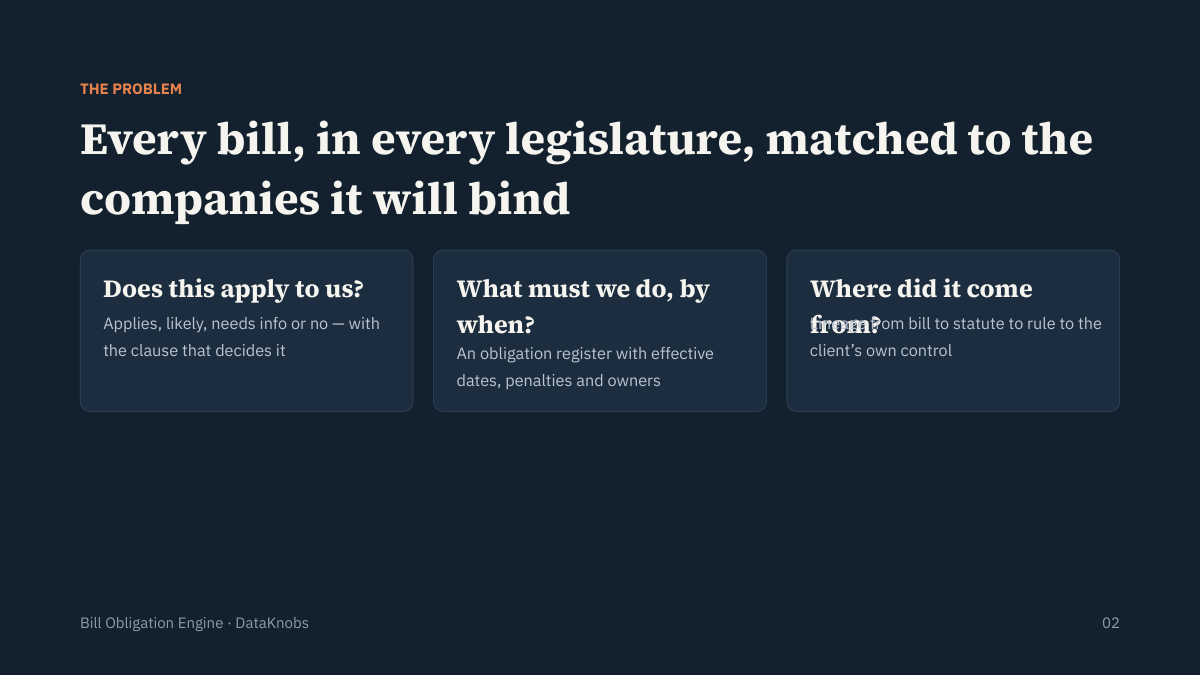
Three questions for compliance teams
The product is structured based on applicability, necessary action, and origin. Every response must link a company fact to a decision clause, a deadline, and a responsible owner.
Three questions for compliance teams · Dataknobs, Bill Obligation Engine · October 2026Back to slide index ↑
SLIDE 03 / 27
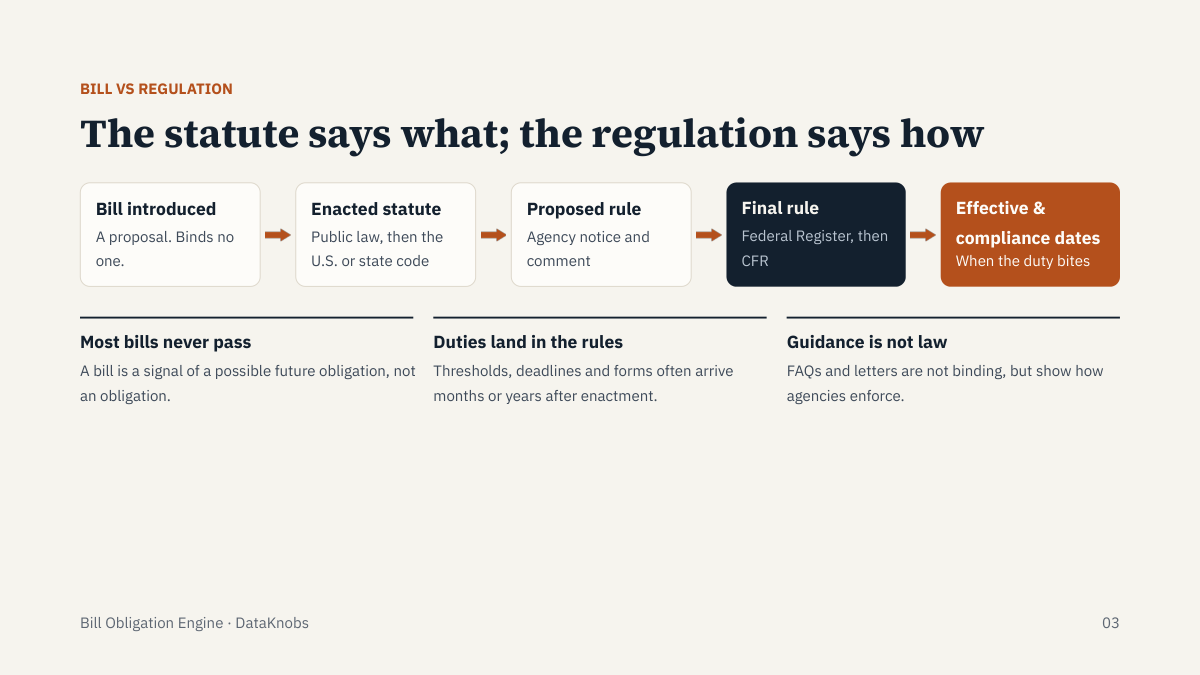
From bill to enforceable duty
The deck differentiates between proposed bills, enacted statutes, proposed rules, and final rules. Its structure separates legal status and dates to ensure that forecasts are not portrayed as confirmed obligations.
From proposal to binding obligation · Dataknobs, Bill Obligation Engine · October 2026Back to slide index ↑
SLIDE 04 / 27
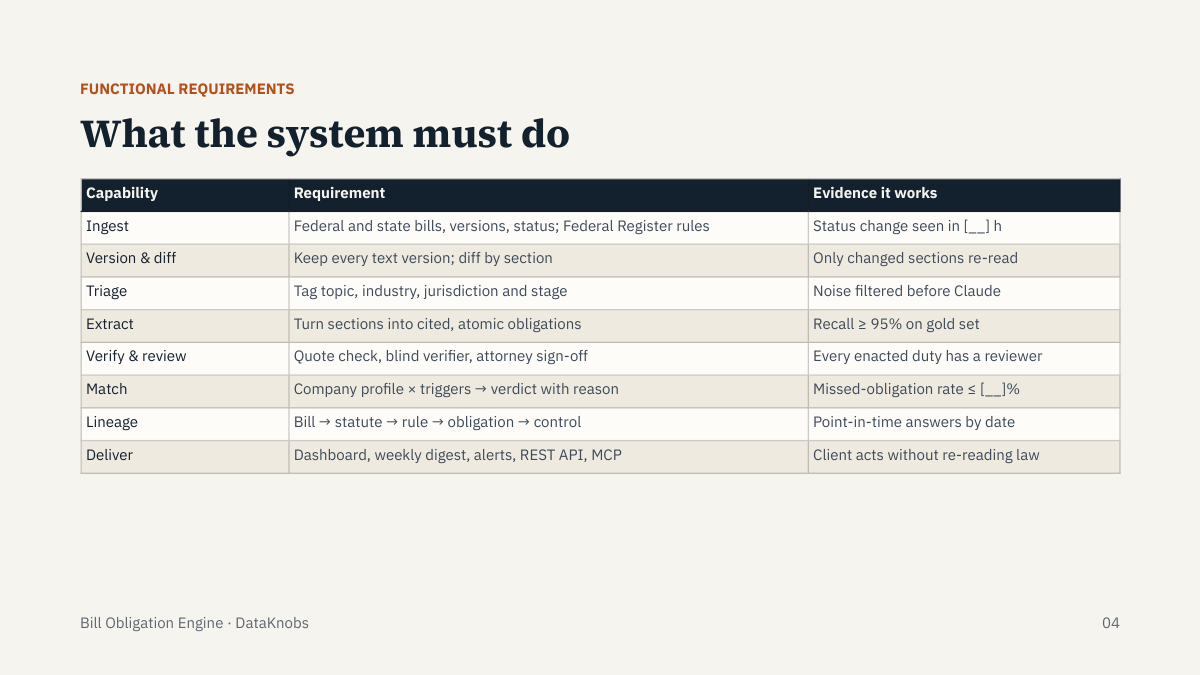
Functional requirements
The core workflow consists of ingestion, section-level versioning, triage, cited extraction, review, matching, and delivery. Recall targets serve as acceptance criteria; the blank latency and missed-obligation thresholds are yet to be determined.
Functional requirements · Dataknobs, Bill Obligation Engine · October 2026Back to slide index ↑
SLIDE 05 / 27
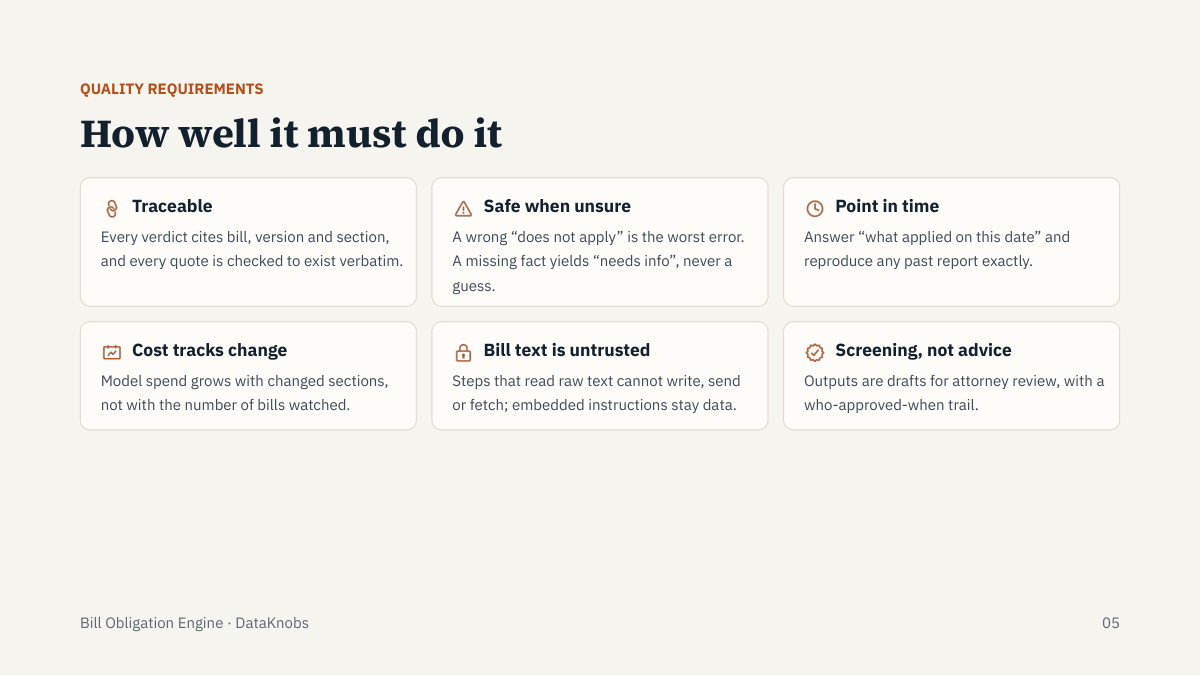
Quality and safety requirements
Each verdict must be reproducible using versioned evidence. Absent facts trigger a request for additional information, whereas components interpreting untrusted bill text lack the authority to carry out any instructions contained within it.
Quality and safety standards · Dataknobs, Bill Obligation Engine · October 2026Back to slide index ↑
SLIDE 06 / 27
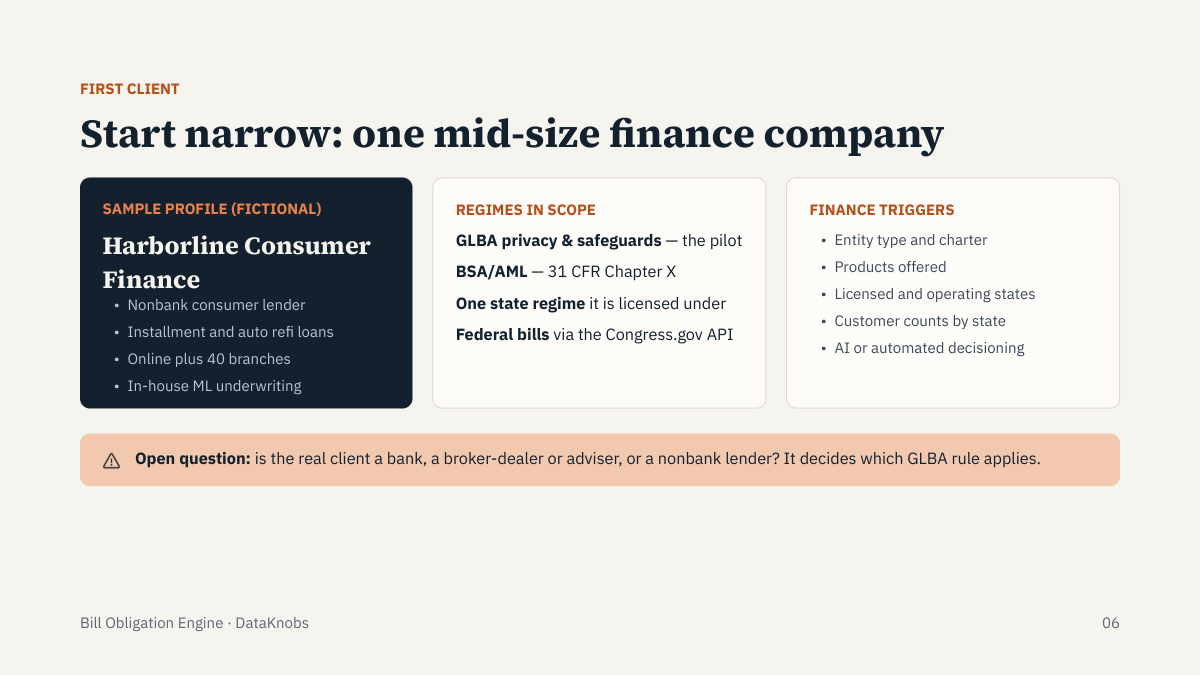
A focused finance pilot
Harborline Consumer Finance is a fictional sample profile, not an identified customer. The pilot begins with GLBA-related privacy and safeguards; the real client's entity type must be confirmed before selecting applicable rule paths.
A targeted finance initiative · Dataknobs, Bill Obligation Engine · October 2026Back to slide index ↑
02 · Architecture and economics
SLIDE 07 / 27
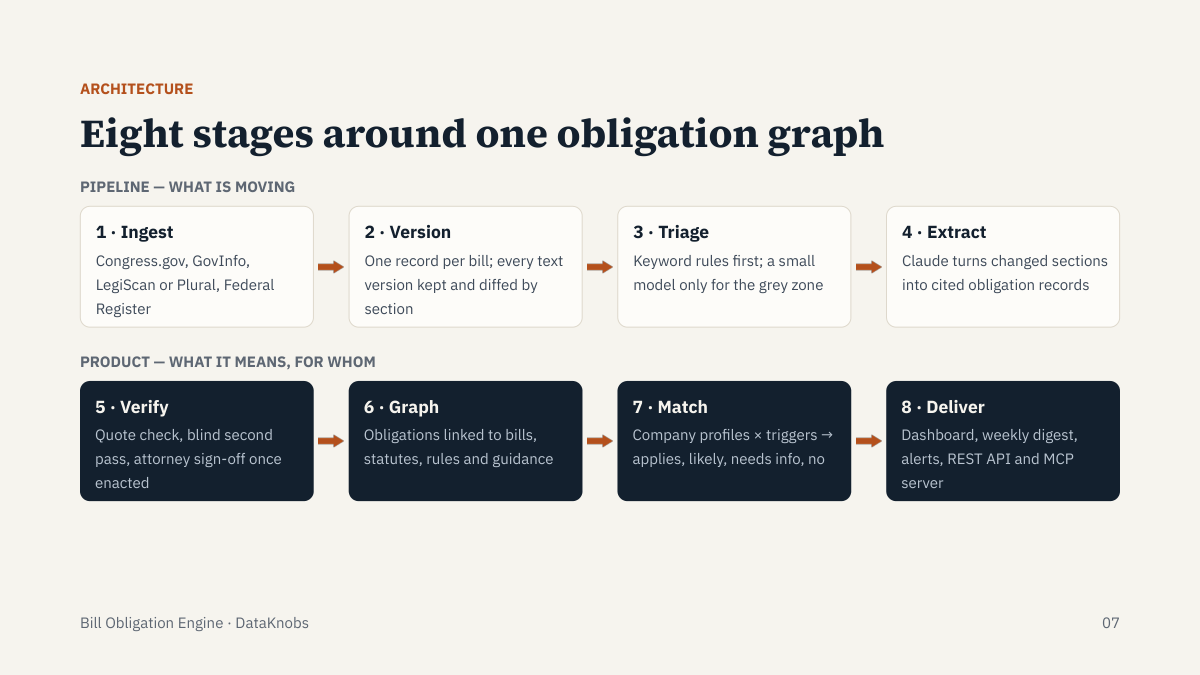
Eight-stage architecture
Ingest, version, triage, and extract to prepare candidate obligations. Verify, graph, match, and deliver transform those records into reviewed, company-specific compliance intelligence.
Eight-stage architecture · Dataknobs, Bill Obligation Engine · October 2026Back to slide index ↑
SLIDE 08 / 27
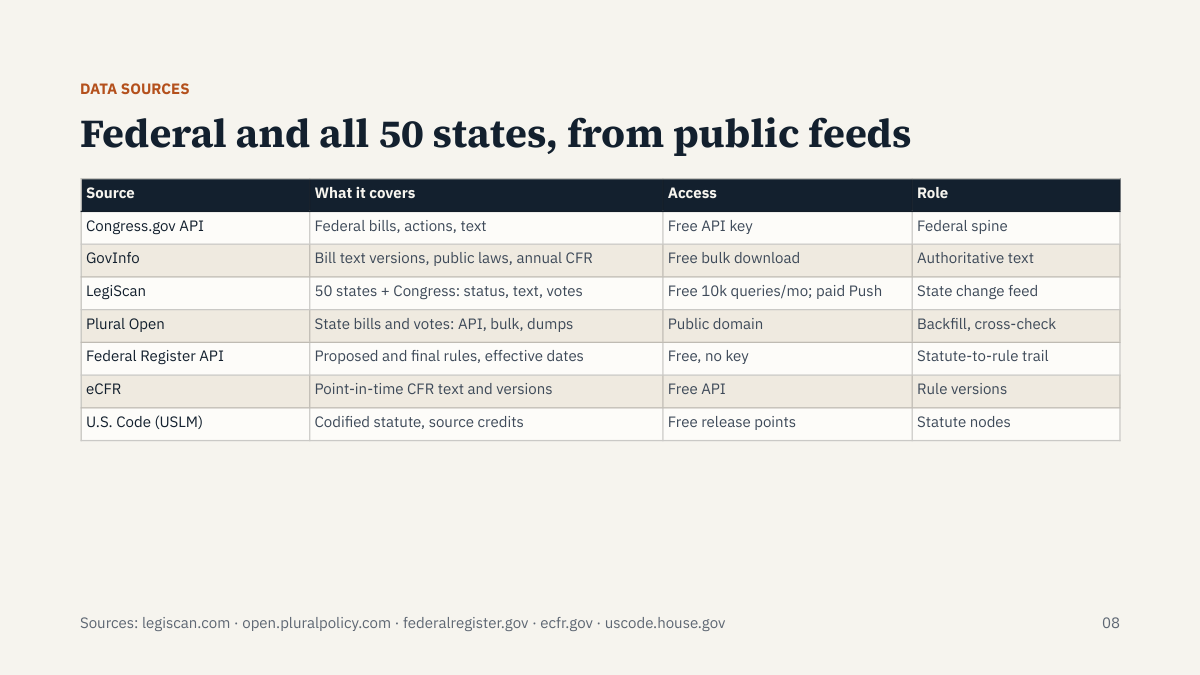
Source coverage
The suggested source stack integrates Congress.gov, GovInfo, state legislative feeds, the Federal Register, eCFR, and U.S. Code resources. The access restrictions and commercial conditions displayed on the slide are assumptions about the source deck that require verification prior to procurement.
Source coverage · Dataknobs, Bill Obligation Engine · October 2026Back to slide index ↑
SLIDE 09 / 27
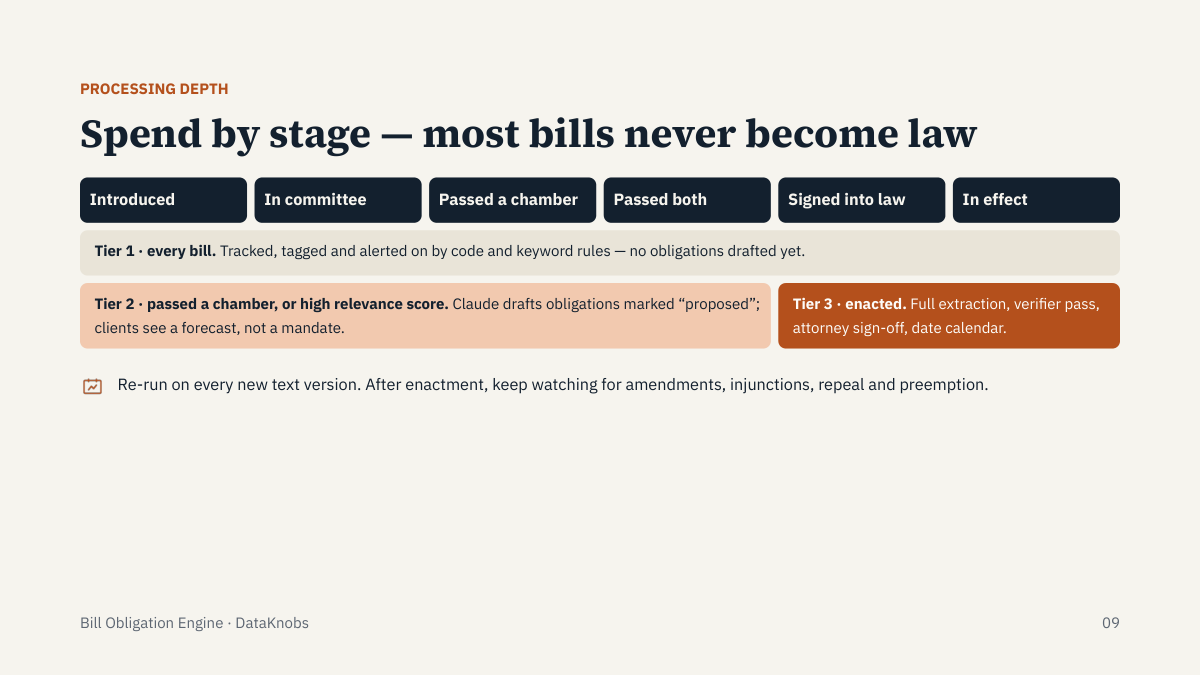
Processing depth follows legislative progress
Bills in early stages undergo low-cost tracking and tagging. Bills that are more pertinent or developed receive proposed-obligation drafts; once enacted, the content prompts comprehensive extraction, verification, and review.
Processing depth corresponds with legislative advancement · Dataknobs, Bill Obligation Engine · October 2026Back to slide index ↑
SLIDE 10 / 27
The atomic obligation record
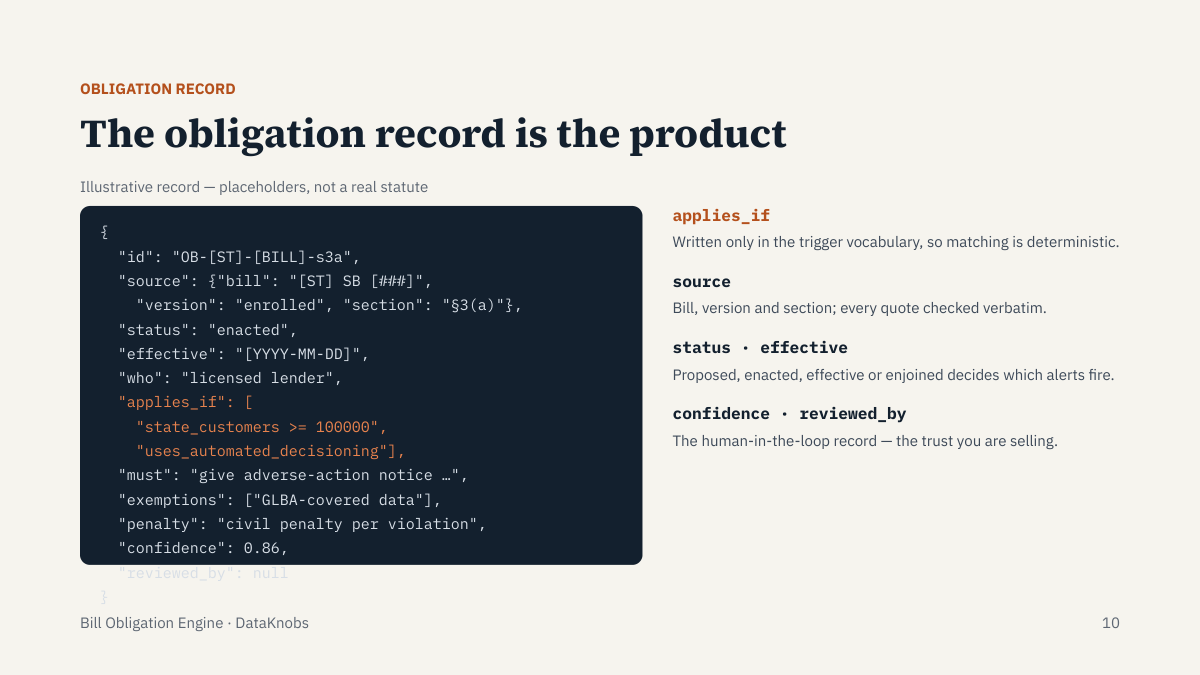
A structured record includes source version, section, status, dates, covered entities, trigger predicates, required actions, and exceptions. The shown record serves as a placeholder example and does not represent an actual statutory obligation.
The atomic obligation ledger · Dataknobs, Bill Obligation Engine · October 2026Back to slide index ↑
SLIDE 11 / 27
Applicability from company facts
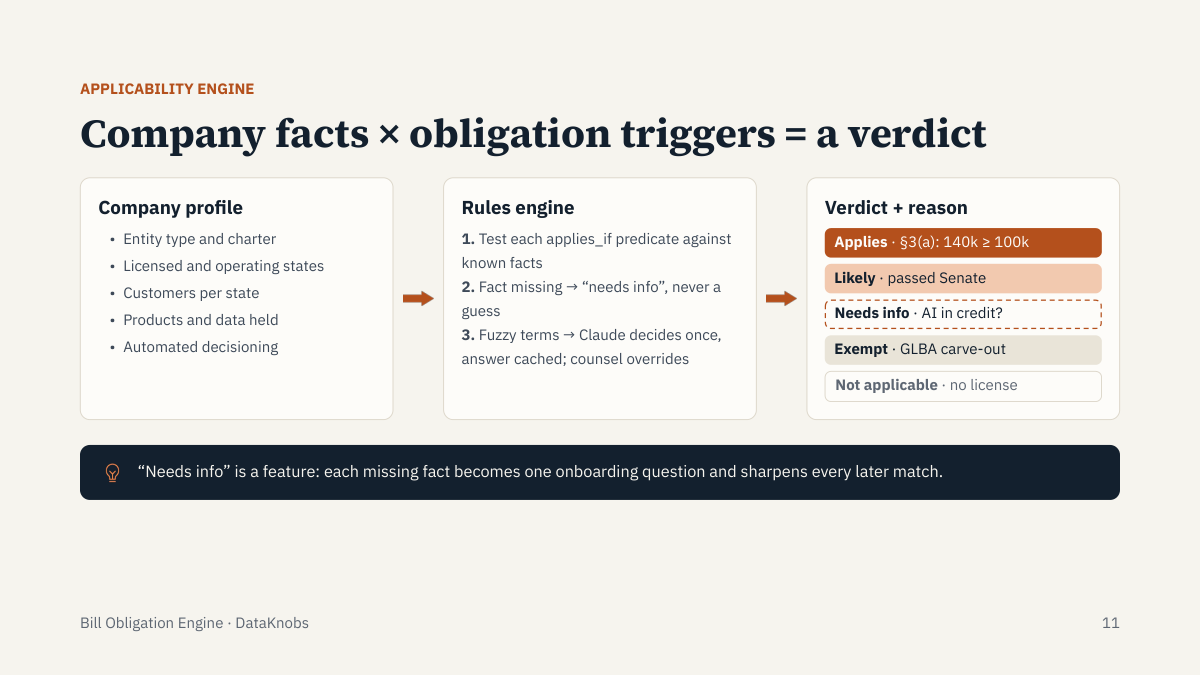
A deterministic rules engine assesses normalized triggers in relation to company profiles. Absent data results in a “needs info” status; unclear interpretations are stored and can be overridden by counsel, while legislative status remains clearly displayed.
Relevance based on company data · Dataknobs, Bill Obligation Engine · October 2026Back to slide index ↑
SLIDE 12 / 27
Code, models and reviewers
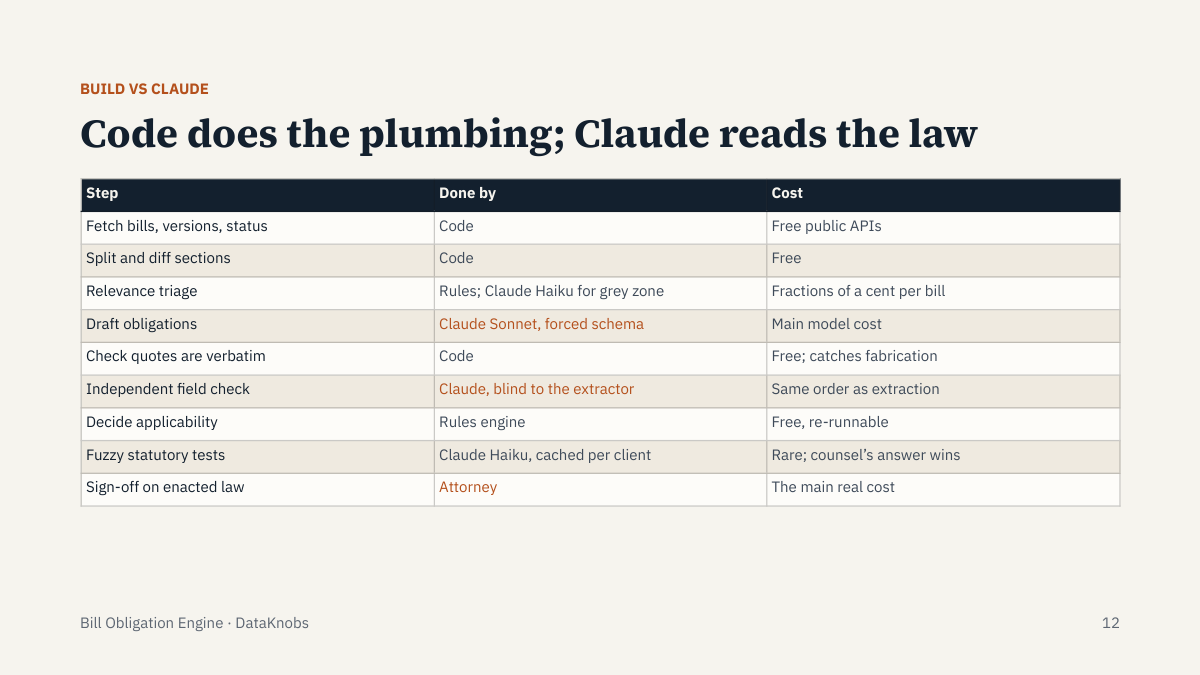
The code manages fetching, diffing, quote validation, and repeatable matching. Language models generate or verify interpretations, while attorneys examine enacted obligations; automated quote matching by itself does not establish legal accuracy.
Code, models, and reviewers · Dataknobs, Bill Obligation Engine · October 2026Back to slide index ↑
SLIDE 13 / 27
Cost assumptions and controls
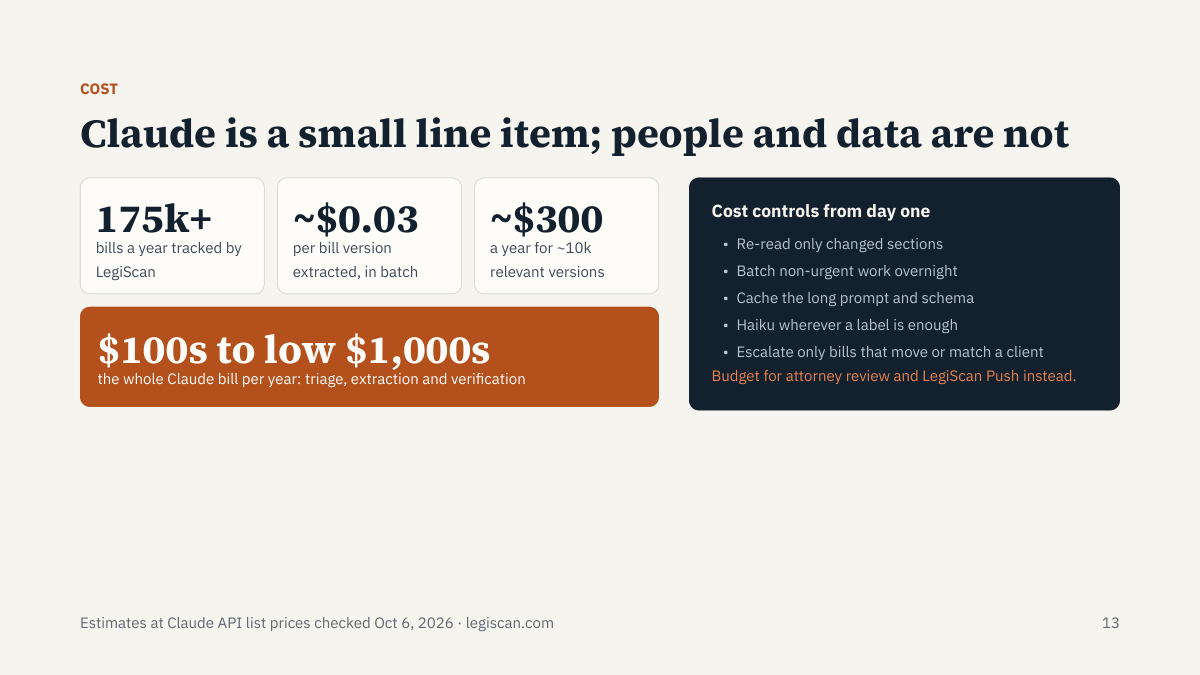
The October 2026 deck projects approximately $0.03 per extracted version and around $300 for 10,000 relevant versions. These figures are historical planning estimates, not a current quote; the actual cost varies based on document length, retries, verification, model selection, data licensing, and review effort.
Cost assumptions and management · Dataknobs, Bill Obligation Engine · October 2026Back to slide index ↑
SLIDE 14 / 27
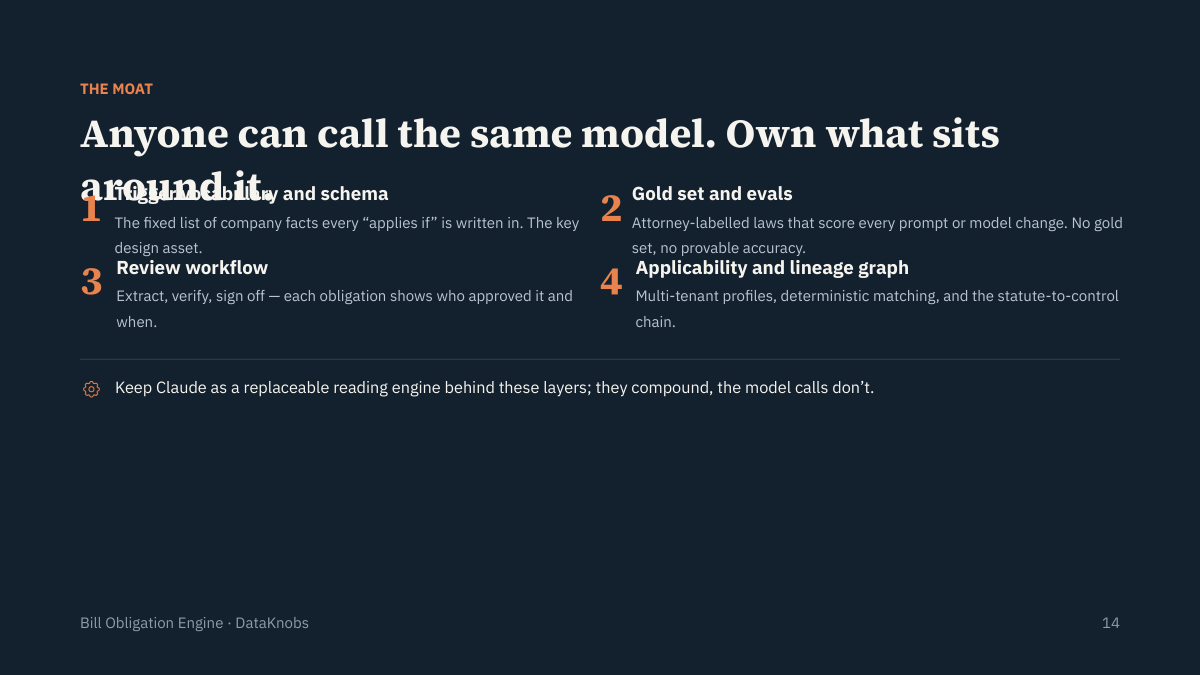
What differentiates the product
The suggested durable assets include a trigger vocabulary, labeled evaluation data, a review workflow, and an applicability graph. The reading model is intended to function as a replaceable component supporting these assets.
What sets the product apart · Dataknobs, Bill Obligation Engine · October 2026Back to slide index ↑
03 · Regulatory lineage and the GLBA pilot
SLIDE 15 / 27
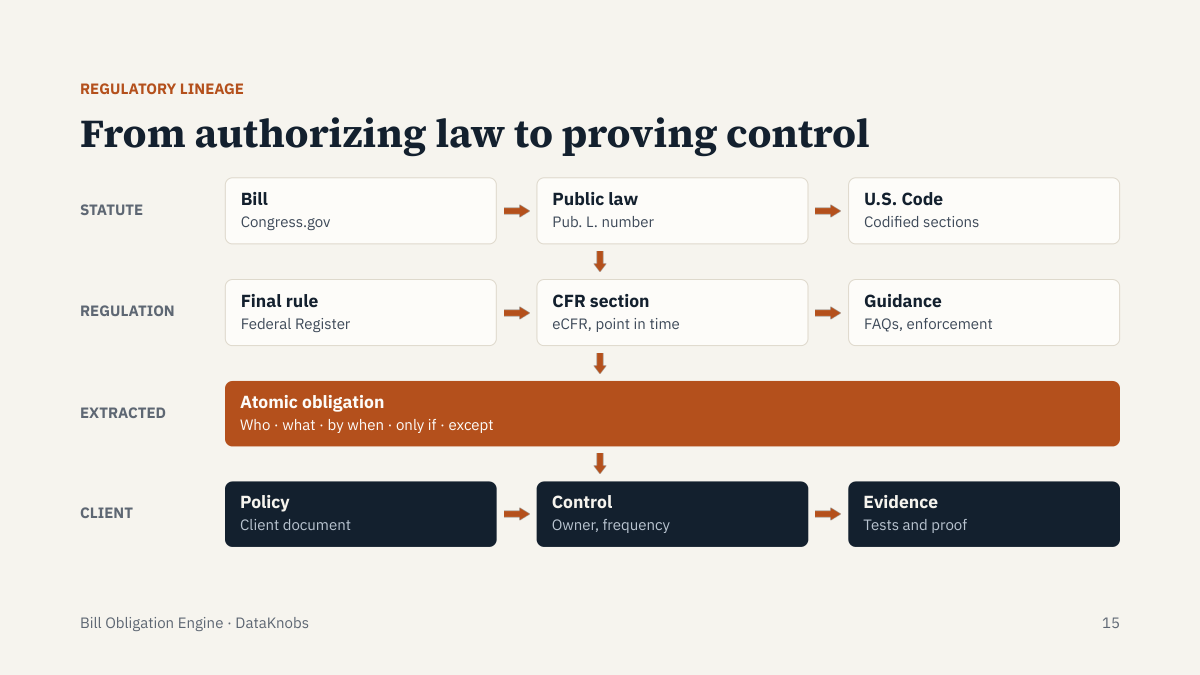
Regulatory lineage to controls
The lineage model associates bills, public laws, codified statutes, regulatory materials, and extracted obligations with client policies, controls, and evidence. Each link should document the asserted relationship along with the supporting evidence.
Regulatory origin of controls · Dataknobs, Bill Obligation Engine · October 2026Back to slide index ↑
SLIDE 16 / 27
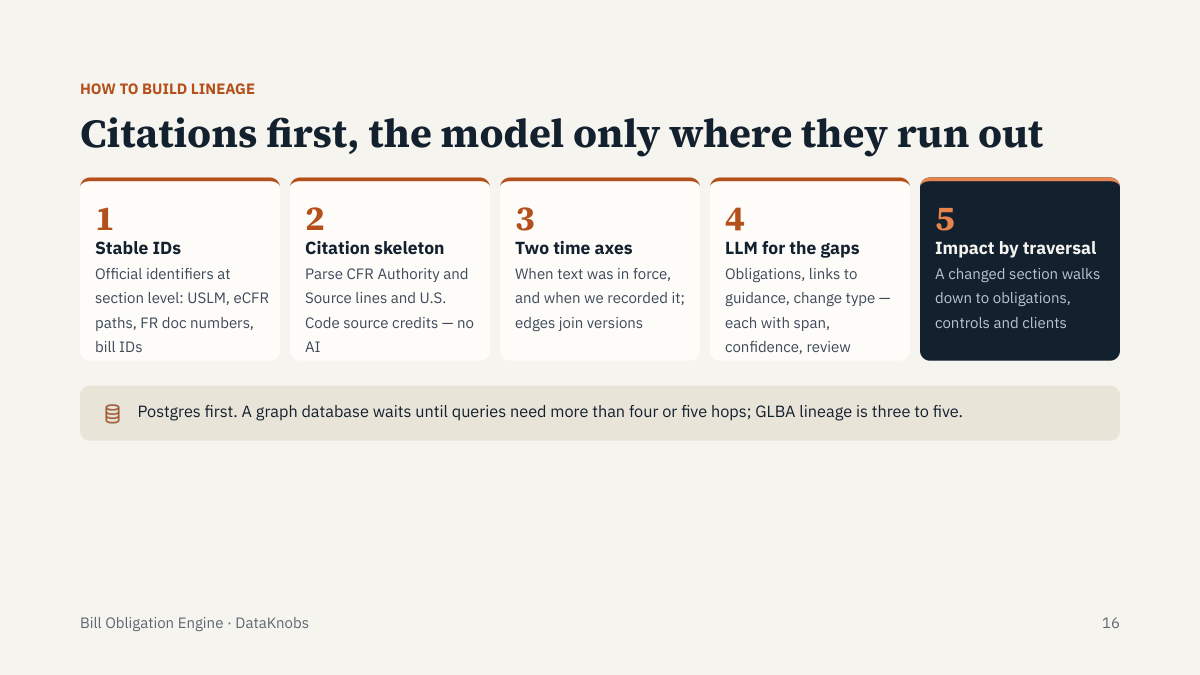
Build lineage from citations
Stable identifiers and deterministic citation parsing form the foundational graph. Dual time axes maintain legal validity alongside recording history; model-assisted links bridge gaps by providing provenance and review status.
Construct lineage through citations · Dataknobs, Bill Obligation Engine · October 2026Back to slide index ↑
SLIDE 17 / 27
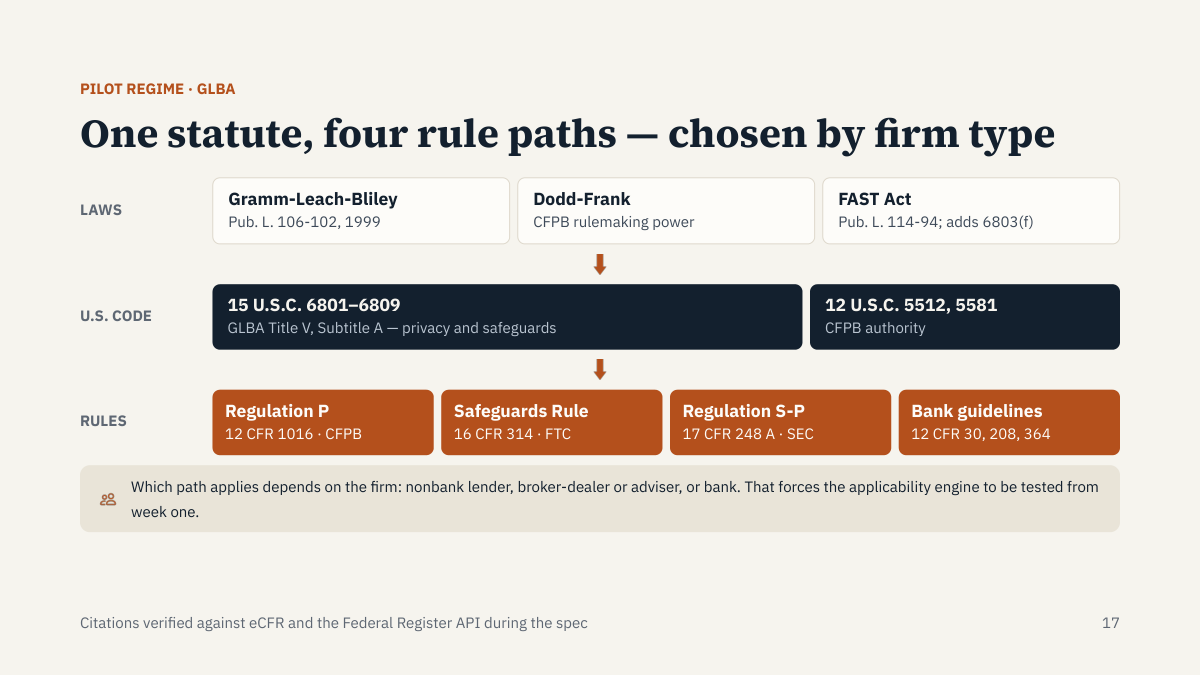
GLBA pilot rule paths
The deck uses Regulation P, the FTC Safeguards Rule, SEC Regulation S-P and banking guidelines to exercise firm-type matching. These are the pilot's proposed coverage paths, not a determination that every path applies to a particular organization.
GLBA pilot rule pathways · Dataknobs, Bill Obligation Engine · October 2026Back to slide index ↑
SLIDE 18 / 27
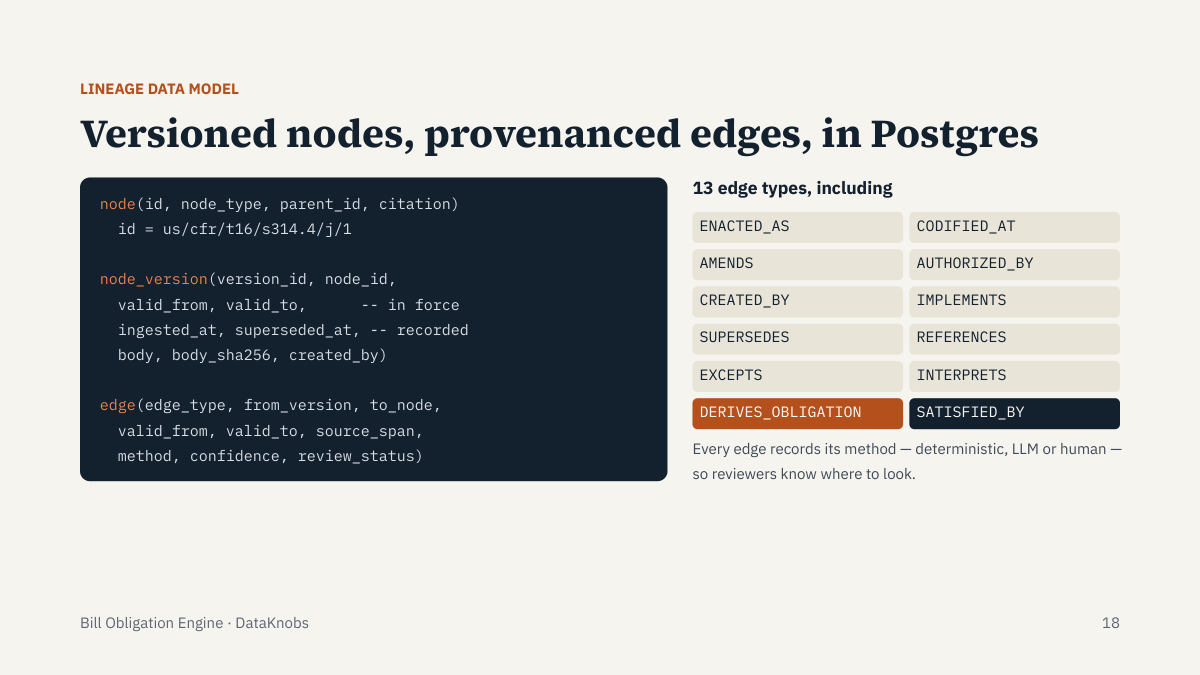
A versioned lineage data model
Nodes represent legal objects, versions track modifications in text and dates, and typed edges define relationships. Indicating whether a link originated from parsing, a model, or a reviewer aids in prioritizing verification.
A versioned lineage data model · Dataknobs, Bill Obligation Engine · October 2026Back to slide index ↑
SLIDE 19 / 27
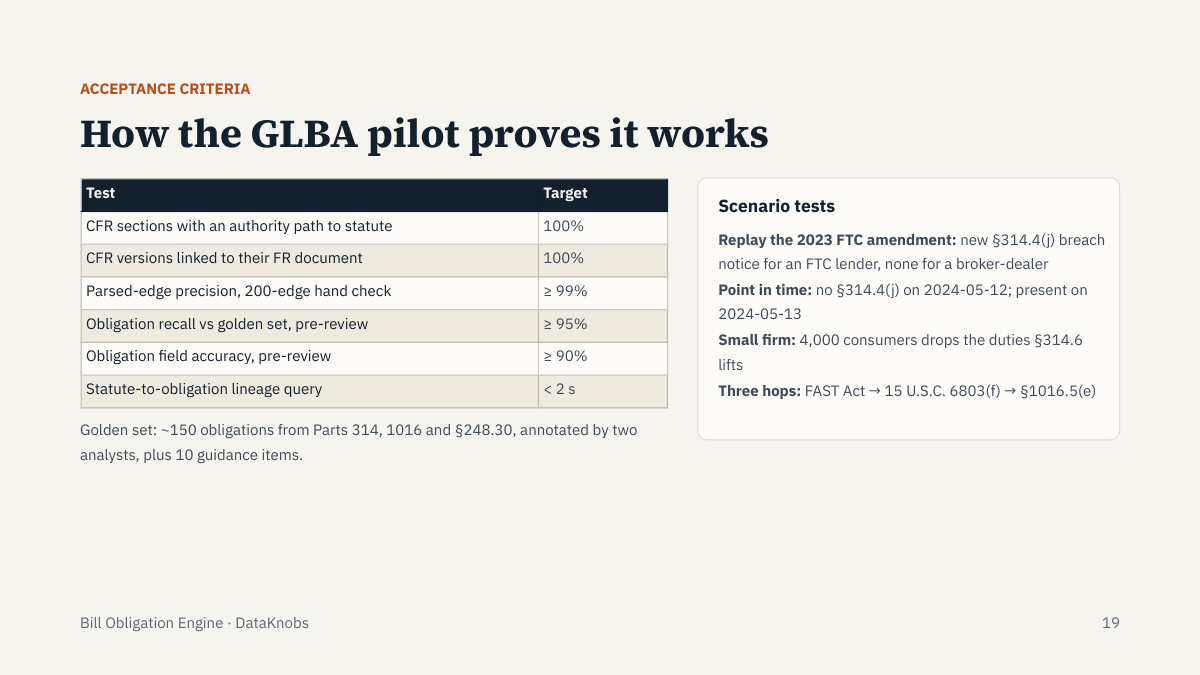
Pilot acceptance criteria
The proposed gates encompass full authority paths, a minimum of 99% parsed-edge precision, at least 95% obligation recall, and no less than 90% field accuracy. These figures represent goals rather than proven outcomes; the historical scenarios shown on the slide serve as test cases for validation against authoritative references.
Pilot acceptance criteria · Dataknobs, Bill Obligation Engine · October 2026Back to slide index ↑
SLIDE 20 / 27
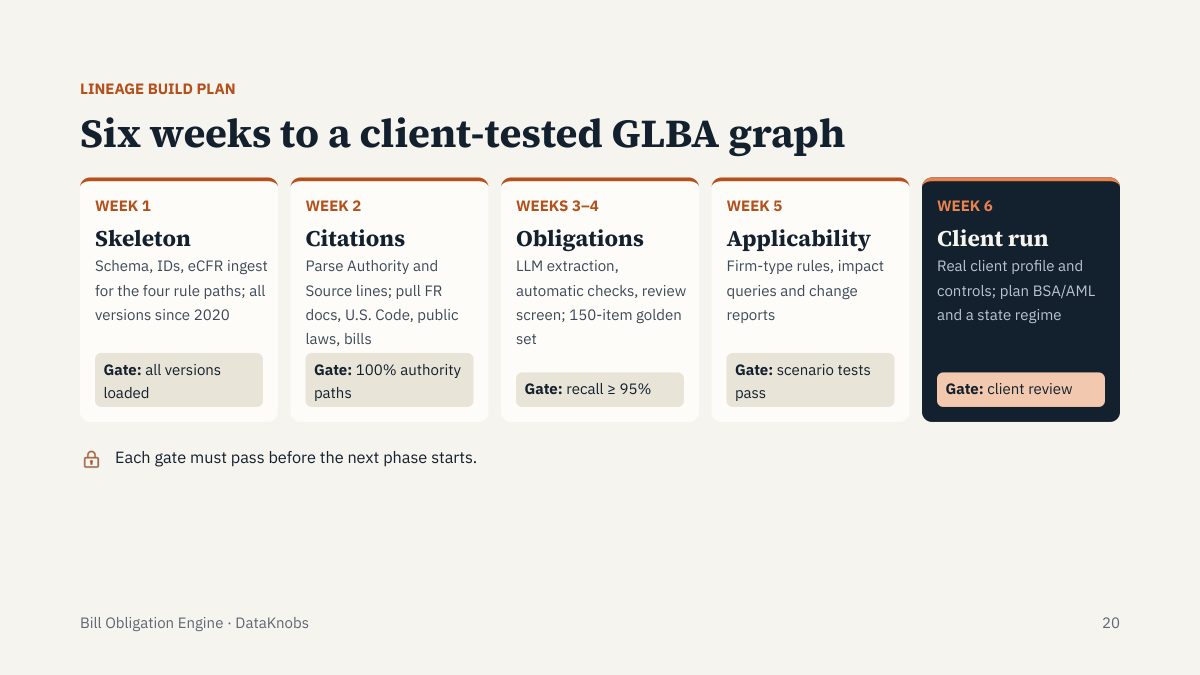
Six-week build sequence
The plan progresses from schema and ingestion to citation links, obligations, applicability, and client review. Each stage includes an exit gate, requiring proof of accuracy before broadening the scope.
Six-week construction timeline · Dataknobs, Bill Obligation Engine · October 2026Back to slide index ↑
SLIDE 21 / 27
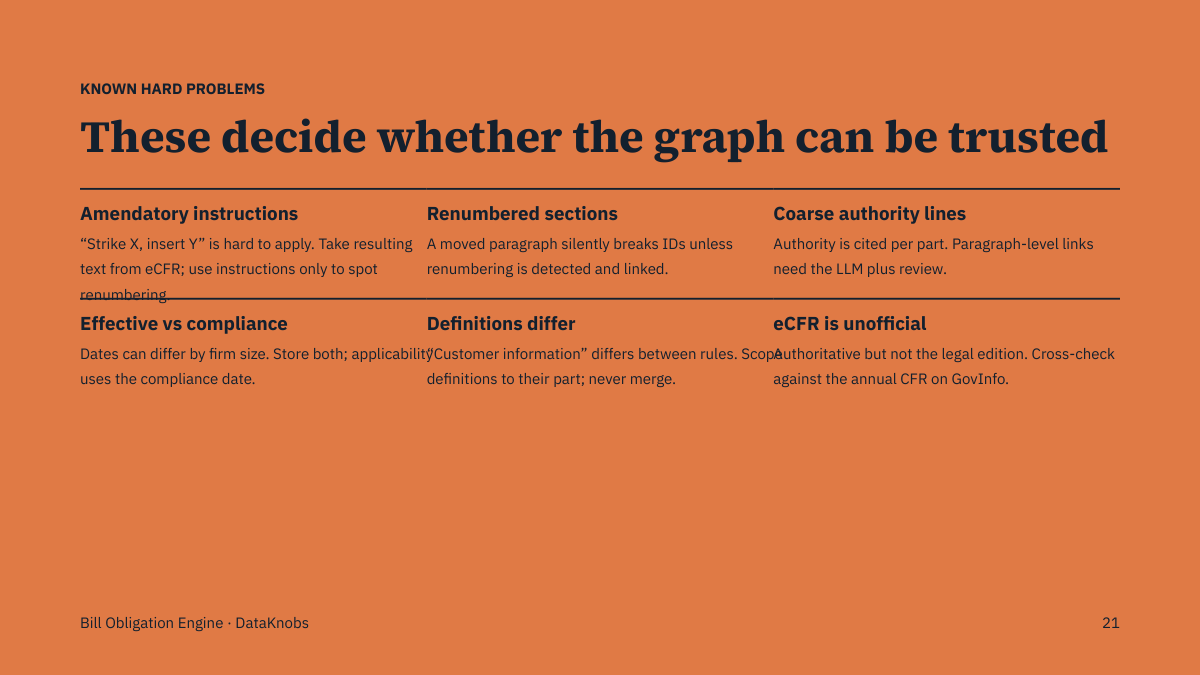
Hard problems in legal versioning
Amendment directives, renumbering, wide-ranging authority references, and varying definitions make lineage complex. Separate fields are necessary for effective and compliance dates, and the regulatory text’s source status must be clearly indicated.
Challenging issues in legal versioning · Dataknobs, Bill Obligation Engine · October 2026Back to slide index ↑
04 · MVP, trust and roadmap
SLIDE 22 / 27
Reported MVP capabilities
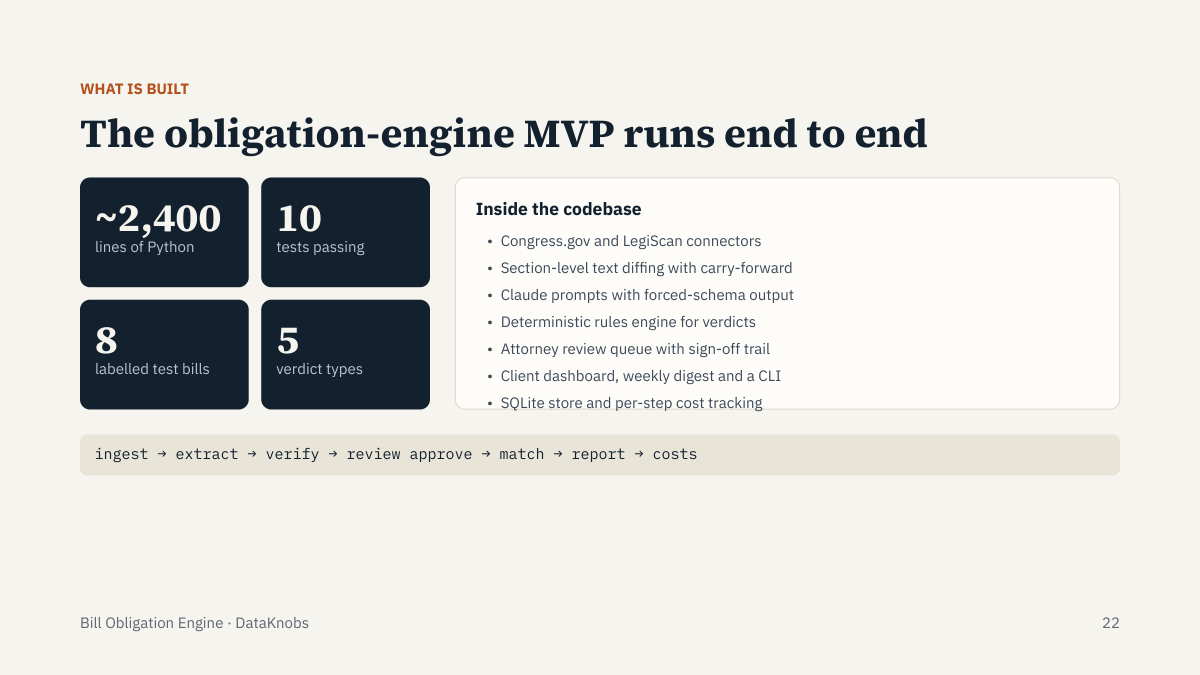
The deck contains around 2,400 lines of Python code, ten passing tests, and eight labelled synthetic bills, along with connectors, matching, review, and reports. These are source-deck claims; the underlying implementation was neither provided nor independently verified for this webpage.
Documented MVP features · Dataknobs, Bill Obligation Engine · October 2026Back to slide index ↑
SLIDE 23 / 27
What remains unproven
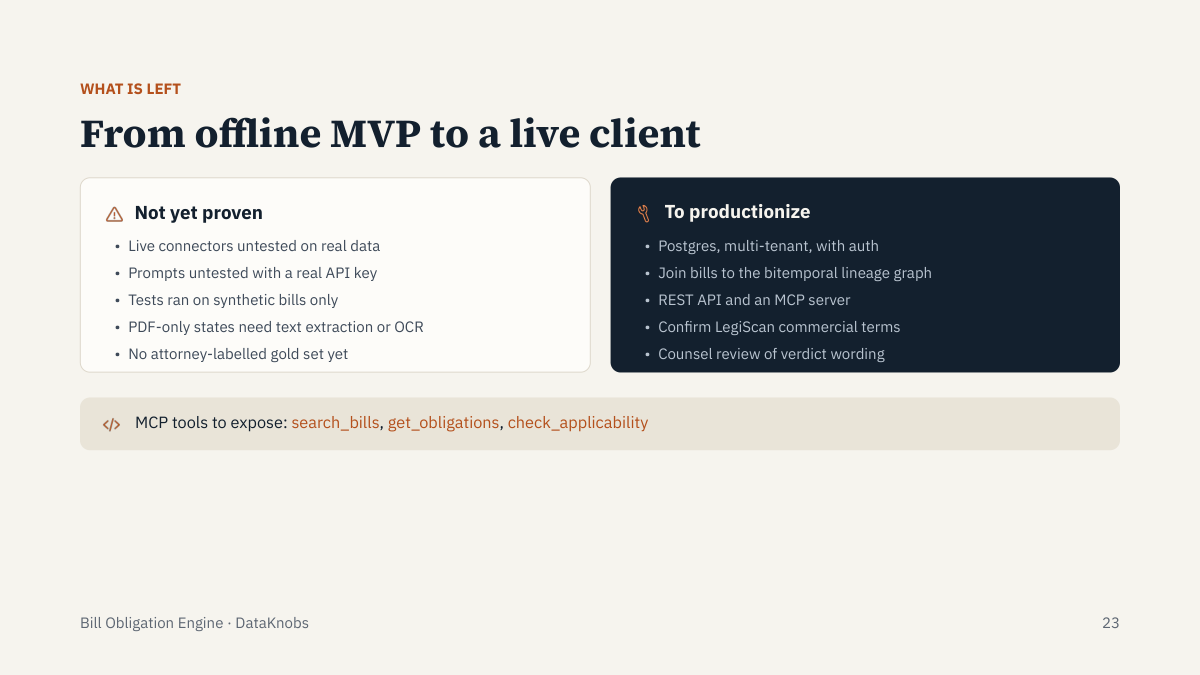
The deck clearly states that live connectors and model prompts have not yet been tested with actual service access, and there is no attorney-labeled gold set available at this time. Production tasks involve authentication, tenant isolation, Postgres, lineage integration, APIs, and commercial data review.
Unverified Aspects · Dataknobs, Bill Obligation Engine · October 2026Back to slide index ↑
SLIDE 24 / 27
Trust and review controls
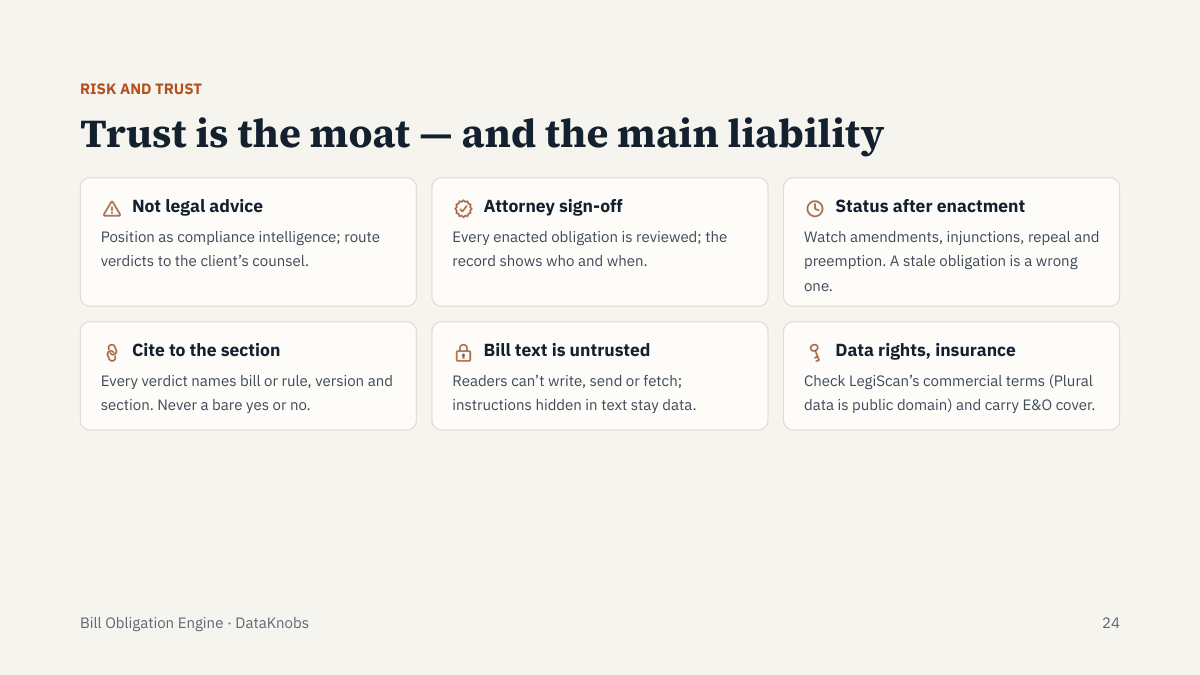
Section-level citations, reviewer identification, and continuous status tracking are essential product features. The presentation frames the output as compliance intelligence for legal counsel review, with untrusted text separated from tool processing.
Trust and review controls · Dataknobs, Bill Obligation Engine · October 2026Back to slide index ↑
SLIDE 25 / 27
Product packaging
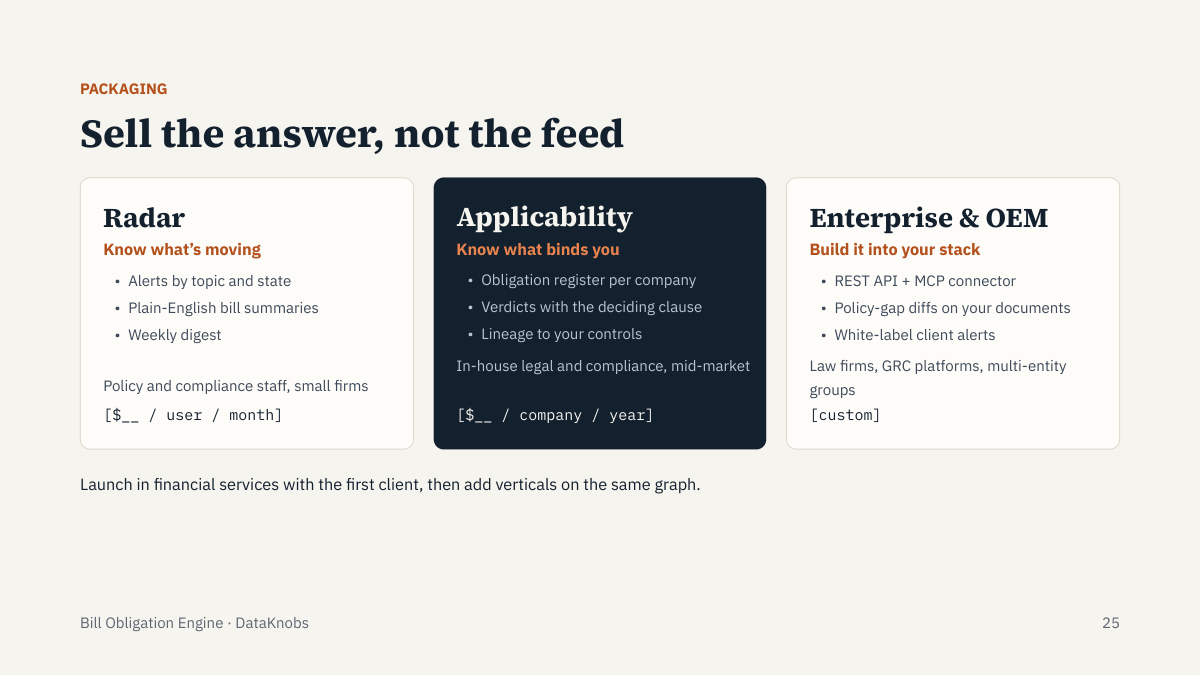
Radar emphasizes alerts and summaries; Applicability provides company-specific registers and control lineage; Enterprise and OEM include integration. Since prices are not determined in the source, this page does not display placeholder figures as offers.
Product packaging · Dataknobs, Bill Obligation Engine · October 2026Back to slide index ↑
SLIDE 26 / 27
Four-phase roadmap
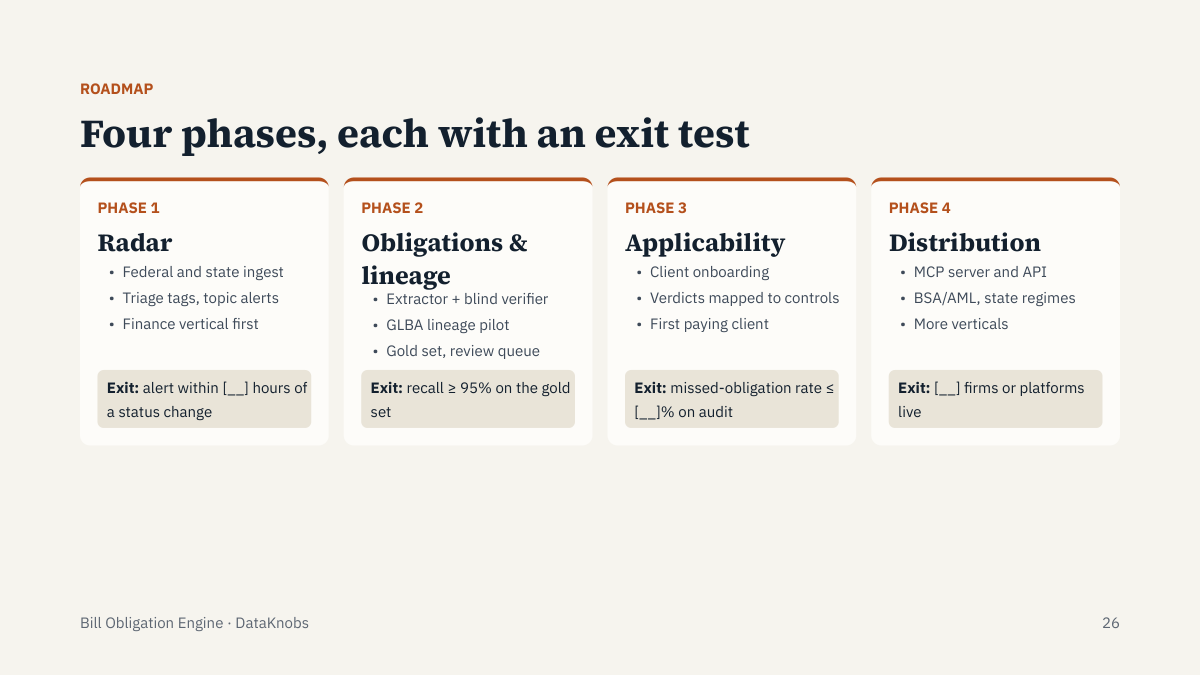
Radar, obligations and lineage, applicability, and distribution represent key product milestones. Some exit criteria are still undefined and need to be finalized before declaring production readiness.
Four-phase roadmap · Dataknobs, Bill Obligation Engine · October 2026Back to slide index ↑
SLIDE 27 / 27
Immediate decisions
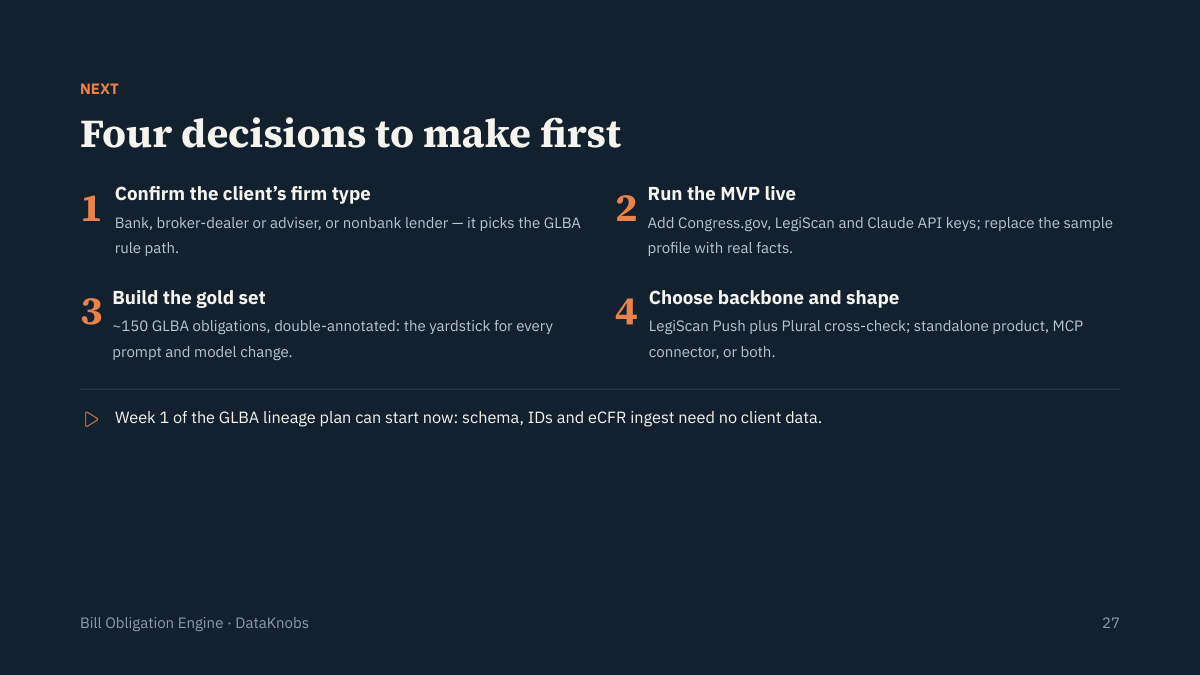
Confirm the client's firm type, exercise the MVP with real integrations, build the double-annotated GLBA gold set and choose the data backbone and delivery model. Schema and identifier work can begin while client-specific facts are gathered.
Immediate decisions · Dataknobs, Bill Obligation Engine · October 2026Back to slide index ↑
Questions answered
What is the Bill Obligation Engine?
A proposed compliance-intelligence platform that converts versioned legislative and regulatory documents into referenced obligations and assessments tailored to a company's specific applicability.
Does a proposed bill create an obligation?
The deck regards proposed bills as anticipatory indicators and maintains their status separate from enacted and active regulations.
How does the system handle missing company facts?
It responds with “needs info” and converts the missing fact into an onboarding question rather than assuming that a requirement is not applicable.
Is the MVP production-ready?
The source deck outlines an offline MVP using synthetic tests. Validation is still needed for live integrations, real-model testing, an attorney-labeled gold set, and production controls.
What does regulatory lineage connect?
The design links legal source versions to atomic obligations, which are then connected to a company’s policies, controls, and evidence.