Vector Search in the Modern Data Stack
A comparative analysis of PostgreSQL, MongoDB, ChromaDB, and Pinecone to help you choose the right vector search solution for your AI applications.
Vector Capabilities in General-Purpose Databases
Leveraging existing, mature database platforms offers the advantage of familiar infrastructure, operational expertise, and powerful hybrid query capabilities.
PostgreSQL with pgvector
An open-source extension that seamlessly integrates vector storage and search into PostgreSQL's robust, ACID-compliant environment. It allows vector embeddings to be managed alongside traditional relational data.
- Hybrid Queries: Combine vector similarity search with the full power of SQL for complex filtering on metadata.
- Indexing: Supports IVFFlat and HNSW indexing for Approximate Nearest Neighbor (ANN) search, but requires careful tuning for optimal performance.
- Ecosystem: Leverages PostgreSQL's mature ecosystem for data integrity, recovery, high availability, and observability.
- Operational Cost: While powerful, requires significant operational expertise to manage indexing, tuning, and scaling.
MongoDB with Atlas Vector Search
Integrated vector search capabilities within MongoDB's managed cloud offering, designed for a seamless developer experience with JSON-style documents.
- Data Colocation: Stores vector embeddings within the same document as their metadata, eliminating data synchronization complexity.
- Querying: Uses the powerful `$vectorSearch` aggregation stage, allowing for pre-filtering and score projection.
- Architecture: Offers dedicated Search Nodes for workload isolation, preventing resource contention between search and database operations.
- Scalability: Inherits MongoDB's well-established horizontal scalability through automatic sharding.
The Specialized Approach of Dedicated Vector Databases
Databases designed from the ground up to manage and query vector embeddings at scale, offering purpose-built architectures and performance characteristics.
ChromaDB
An AI-native, open-source embedding database designed for simplicity and developer ergonomics, making it easy to build LLM-powered applications.
- Developer-First: Simple API and tight integration with frameworks like LangChain and LlamaIndex. Ideal for prototyping.
- Self-Hosted: Can be run locally, in Docker, or as a standalone server, offering full control over the environment.
- Use Case: Best for small-to-medium scale applications and developer-centric workflows where speed of development is paramount.
- Limitations: Primarily single-node architecture, which limits horizontal scalability for enterprise-level workloads.
Pinecone
A proprietary, fully managed, and cloud-native vector database engineered for extreme performance, low latency, and massive scalability.
- High Performance: Delivers consistently low-latency queries across billions of vectors with real-time indexing.
- Managed Service: Fully managed and serverless, offloading all operational overhead related to scaling, backups, and maintenance.
- Use Case: The solution of choice for demanding, large-scale production applications with low-latency requirements.
- Trade-Offs: Higher direct costs and proprietary nature mean less control and flexibility compared to open-source alternatives.
Comparative Analysis and Strategic Trade-Offs
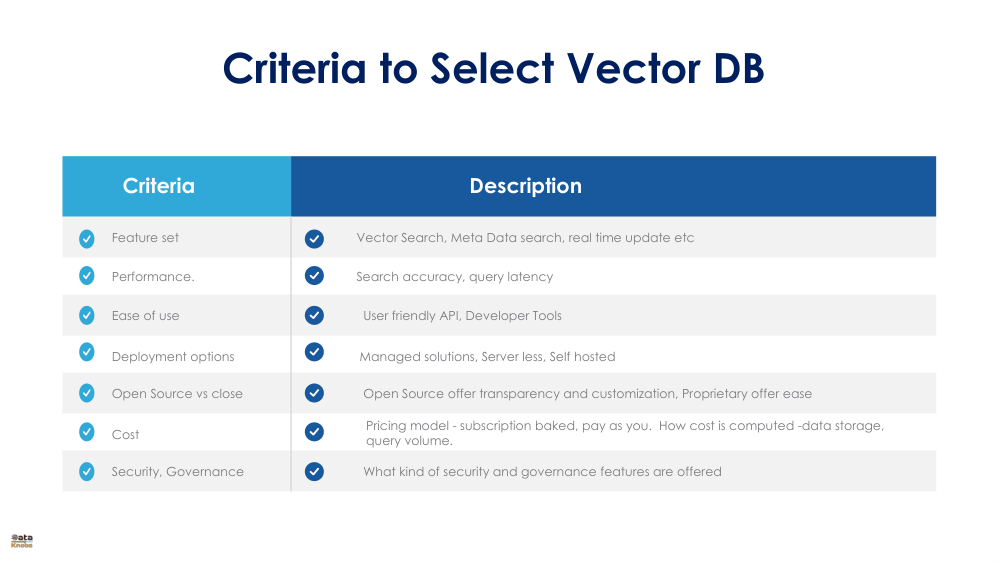
Choosing a vector search solution is a critical architectural decision. This section provides a direct comparison across key axes.
| Attribute | PostgreSQL (pgvector) | MongoDB (Atlas) | ChromaDB | Pinecone |
|---|---|---|---|---|
| Architecture | Integrated (Relational) | Integrated (Document) | Dedicated (Open-Source) | Dedicated (Managed) |
| Primary Use Case | Hybrid apps with strong relational data needs | Apps on MongoDB needing integrated vector search | Prototyping, local development, small projects | High-scale, low-latency production apps |
| Scalability | Vertical; Horizontal via extensions | Vertical & Horizontal (built-in) | Vertical (Single-Node) | Horizontal (Cloud-Native) |
| Performance | High with expert tuning | Good; excellent with Search Nodes | Moderate | Very High, low latency at scale |
| Query Interface | SQL | MQL (Aggregation) | SDK | SDK |
| Operational Overhead | High (Self-managed) | Low (Managed) | High (Self-managed) | Very Low (Managed) |
| Cost Model | Low direct cost, high indirect cost | Pay-as-you-go (managed) | Very low direct cost, high indirect cost | High direct cost, low indirect cost |
| Data Consistency | Strong (ACID Transactions) | Strong (within document) | Eventual (if syncing) | Eventual (if syncing) |
Strategic Guidance & Use-Case Mapping
The optimal choice is highly dependent on your specific requirements, existing technology stack, team expertise, and strategic priorities.
When to Use an Integrated Solution
Use PostgreSQL (pgvector) when...
- You have a significant existing investment in PostgreSQL.
- You need to perform complex hybrid queries joining vector and relational data.
- Transactional consistency (ACID) is a critical business requirement.
- Minimizing direct costs and avoiding vendor lock-in are primary goals.
Use MongoDB Atlas when...
- Your application is already built on MongoDB.
- You require performance isolation via dedicated Search Nodes.
- You prefer a fully managed service to reduce operational burden.
- Your data is naturally represented in a semi-structured document model.
When to Use a Dedicated Solution
Start with ChromaDB when...
- You are in the prototyping or early development phase.
- You need a free, open-source tool that can be run locally with zero friction.
- Your initial dataset is small to medium in size.
- Your goal is to validate a concept or build a minimum viable product quickly.
Choose or Migrate to Pinecone when...
- Your application requires extreme performance and low latency at massive scale.
- You want to completely offload all infrastructure management.
- You require enterprise-grade features like guaranteed uptime and advanced security.
- The premium direct cost is justified by the reduction in operational risk and faster time-to-market.