
Data as a Product combines data, business logic, and delivery into a single, scalable asset, empowering organizations to go beyond simply observing information and start operationalizing intelligence.
Included are the slides and a step-by-step guide to assist you in understanding data products and acquiring hands-on experience.
CIOs, CDOs, and CPOs must master data products to turn data investments
into scalable, measurable business outcomes..
A straightforward series that follows the slide advancement from basics and definitions to testing, drivetrain, and organizational design.
Every card on a separate slide should be linked to a corresponding page in the Data Product deck.

Start here: the 'Why' and 'What' plus core frameworks.

The decision to treat data as a product and the associated business rationale.

Core principles and the paradigm shift from projects to products.

Architecture: pillars, ports (interfaces), and deployable units.

The six baseline characteristics that make data usable and trustworthy.

How state, testing, lifecycle, and failure modes differ.

The builder’s dilemma: accuracy vs. time-to-market.
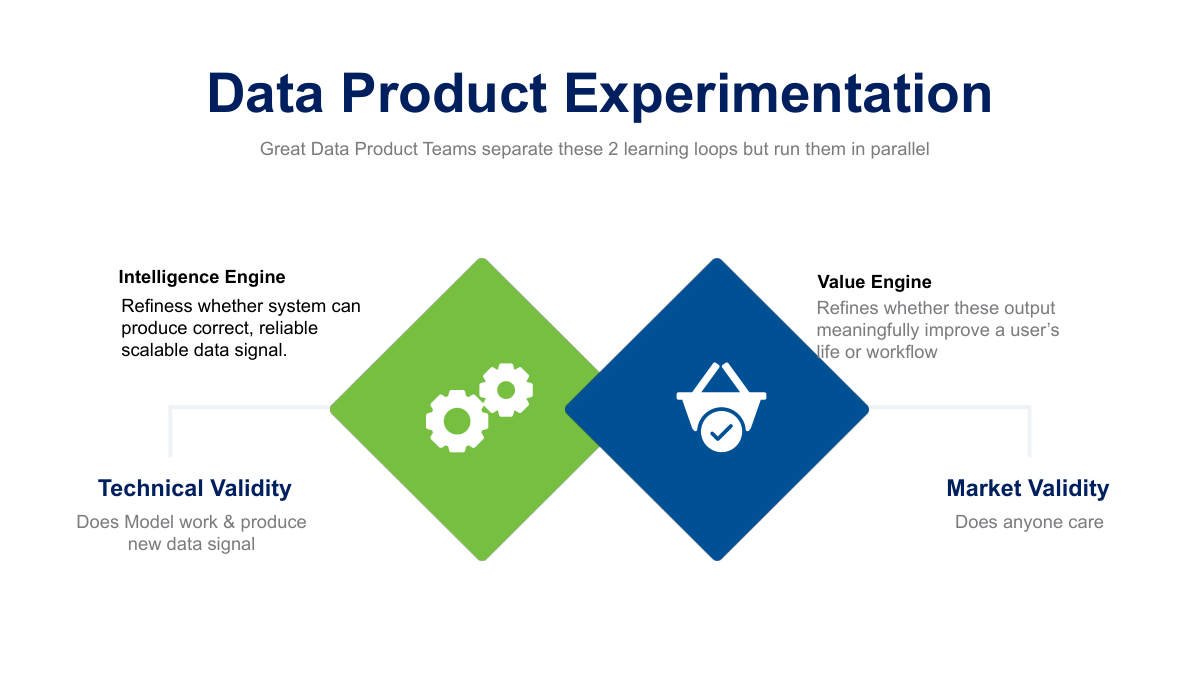
Dual engines: intelligence (technical) and value (market) validity.

Objective → levers → data → models: build prescriptive products.

Centralized vs hub-and-spoke vs full data mesh.

End to End Journey to Build and Govern

Levers to Control Data Product Output

Align User Task and Data

Data Product to Cognitive Intelligence to Impactful Result

Exploring the Data Product Capability Spectrum: 5 Ways to Leverage Data Products
Data products serve as the foundation for AI and agentic systems, offering a reliable framework for LLMs, robust feature stores for ML models, effective retrieval layers for RAG architectures, and enforceable data contracts for real-time decision-making. In the realm of agentic AI, stable and clearly defined data products empower autonomous agents to think, act, and adapt workflows independently.
1-data-product-1012-data-as-resource-vs-data-as-product3-data-product-mindset4-what-is-data-product5-data-product-attributes6-software-product-vs-data-products7-inherent-tension-algorithm-usability8-data-product-experimentation9-drive-train-approach10-data-product-operating-model