How IT moves from assistance to autonomous execution
Generative AI helps IT teams create, summarize, recommend, and accelerate work. Agentic AI goes a step further: it can plan, decide, and execute approved actions across systems. For CTOs, the opportunity is not just better productivity : it is a new operating model for service delivery, platform engineering, security, and infrastructure operations.
Last verified July 2026. Enterprise agent platforms move fast : data points below are dated and worth re-checking against current vendor documentation.
GenAIBoosts human productivity across support, code, knowledge, and reporting.
Agentic AICoordinates tools and workflows to resolve issues and complete IT tasks.
Best fitHigh-volume, repeatable workflows with clear policies and measurable outcomes.
CTO goalShift IT from reactive operations to proactive, governed, AI-enabled delivery.
Core distinction
Generative AI vs. Agentic AI in IT
CTOs should treat these as complementary layers. Generative AI improves human throughput. Agentic AI improves workflow throughput.
Generative AI
Assistive intelligence
Drafts runbooks, incident summaries, change records, knowledge articles, and scripts.
Explains alerts, correlates logs, recommends fixes, and accelerates engineering work.
Best where humans review output before execution.
Agentic AI
Goal-driven execution
Plans and sequences steps across ITSM, observability, IAM, CMDB, CI/CD, and cloud tooling.
Can trigger remediations, route approvals, provision software, reclaim licenses, and coordinate multi-step workflows.
Best where policies, permissions, and rollback are explicit.
Priority use cases
Where CTOs should deploy AI in IT first
These use cases combine the supplied IT-operations context with current enterprise patterns around autonomous workflow execution.
1. Service desk and end-user support
Use GenAI to summarize tickets, propose solutions, and generate knowledge. Use agents to classify, route, fulfill, and close low-risk requests.
2. Incident response and AIOps
Use GenAI to explain anomalies and produce executive summaries. Use agents to execute approved playbooks, gather evidence, and trigger remediations.
3. Software engineering and platform ops
Use GenAI for code suggestions, test generation, refactoring, and documentation. Use agents to coordinate CI/CD checks, patching, and release workflows.
4. Security operations
Use GenAI for alert explanation and triage support. Use agents to enrich cases, quarantine endpoints, revoke access, and open remediation tasks with approval gates.
5. Cloud and asset optimization
Use GenAI to recommend right-sizing and policy changes. Use agents to reclaim licenses, stop idle resources, and enforce cost controls.
6. Data governance and compliance
Use GenAI for classification and policy interpretation. Use agents to apply retention actions, update metadata, and flag oversharing risks.
Latest trends
What is happening now
Recent enterprise signals show a pivot from experimentation to governed deployment, especially in IT operations, identity, and workflow orchestration.
Trend 1: Enterprise apps are embedding agents
AI assistants are becoming task-specific agents inside enterprise platforms. Microsoft's 2026 Copilot Studio release wave added agent quality evaluation, agent-to-agent (A2A) communication, and multi-agent orchestration across Microsoft 365 and third-party systems, while Salesforce Agentforce and ServiceNow's AI Agent Orchestrator compete for the same workflow real estate. This changes the CTO roadmap from standalone copilots to platform-level orchestration.
Trend 2: Autonomous IT is a design target
Vendors are positioning AI to prevent outages, reduce service desk volume, automate provisioning, and accelerate routine IT operations with oversight. ServiceNow was ranked #1 for Building and Managing AI Agents in Gartner's 2025 Critical Capabilities report, and Gartner projects 40% of enterprise applications will carry task-specific agents by the end of 2026.
Trend 3: Identity and governance are now first-class
Non-human identities, including agent credentials, now outnumber human identities in many enterprises by ratios reported from 40:1 to over 100:1. Microsoft's Entra Agent ID reached general availability in April 2026 to extend Zero Trust controls to agents, and the Cloud Security Alliance published its Agentic Trust Framework in February 2026 as the first Zero Trust maturity model built specifically for autonomous agents.
Trend 4: CFO-grade ROI scrutiny is rising
Enterprises are becoming more selective about use cases: roughly 51% report AI agents running in production, but as many as 88% of individual agent projects reportedly never get there. Enterprises are emphasizing measurable business value, lower cancellation risk, and deployment in domains with clean workflows and clear baselines.
By the numbers
The 2026 data behind these trends
Figures reported across 2026 industry research, presented directionally — verify current numbers before using them in a board deck.
40%
of enterprise applications are projected to feature task-specific AI agents by the end of 2026, per Gartner — up from under 5% in 2025.
51% / 88%
of enterprises report AI agents running in production, but as many as 88% of individual agent projects reportedly never reach that stage.
40:1–100:1+
the ratio of non-human to human identities reported in many enterprises today, a large share of it now driven by AI agent credentials.
Operating model
A practical maturity path for CTOs
Successful teams move from augmentation to constrained autonomy rather than jumping directly to full automation.
01
Assist
Deploy GenAI for summarization, search, ticket drafting, runbook generation, and engineering acceleration.
02
Recommend
Introduce AI-generated remediation options, policy-aware suggestions, and confidence scoring with human approval.
03
Automate
Use workflow automation and AI to execute repeatable low-risk tasks such as software fulfillment, access recertification, and log correlation.
04
Orchestrate
Adopt agentic AI that can plan across systems, call tools, handle exceptions, and escalate only when needed.
05
Govern
Add agent identity, policy enforcement, observability, rollback, human override, and KPI instrumentation at every stage.
Success metrics
KPIs the CTO should track
Use a balanced scorecard that combines efficiency, resilience, cost, security, and user outcomes.
Dimension
GenAI KPI
Agentic AI KPI
Executive outcome
Service desk
Deflection rate, draft quality, response time
Auto-resolution rate, fulfillment cycle time
Lower support cost and faster employee service
Operations
Alert summarization quality, triage speed
MTTR reduction, incident containment speed
Higher uptime and fewer escalations
Engineering
Code acceptance rate, test generation coverage
Deployment throughput, rollback success
Faster releases with lower toil
Security
Analyst productivity, investigation time
Threat response time, remediation completion
Lower exposure window and stronger control
Cost
Hours saved, asset optimization recommendations
License reclamation, cloud cost actions taken
Visible ROI and disciplined scaling
Guardrails
Non-negotiables for production deployment
As AI moves from recommendations to actions, governance becomes architecture not policy paperwork.
Identity for agents
Every agent needs a unique identity, scoped permissions, secrets management, and lifecycle controls. This is not a hypothetical risk: non-human identities already outnumber human ones by 40:1 to over 100:1 in many enterprises, and one 2026 industry study found 68% of organizations cannot distinguish human from AI agent activity in their own logs.
Human override
High-risk changes, security actions, and production-impacting workflows should require human checkpoints.
Observability
Log prompts, tools called, data used, decisions made, approvals received, and rollback actions.
Data boundaries
Prevent oversharing, classify sensitive data, and apply retention, masking, and compliance controls.
Fallback paths
Every autonomous workflow should have timeout, rollback, and safe-fail behavior.
ROI discipline
Prioritize domains with clear baselines, measurable savings, and operational ownership.
Supplied visuals
Reference images for the IT AI narrative
These images can be reused to support presentations, executive briefings, or internal planning discussions. Each is paired below with current context connecting the theme to 2026 enterprise data.
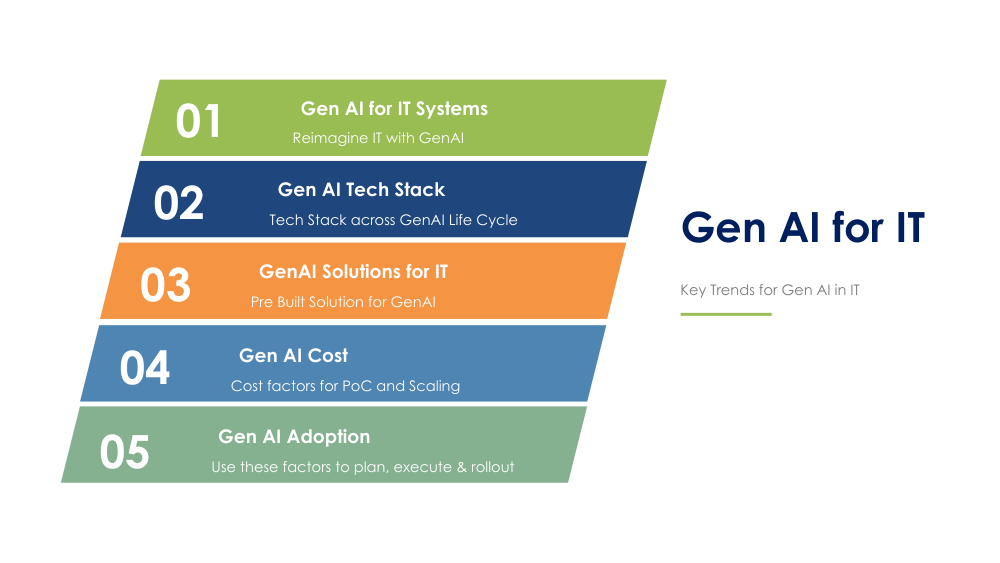
Generative AI can accelerate IT budgeting and prioritization around high-impact, low-risk use cases.
This is where ROI discipline earns its keep: with roughly 88% of individual agent projects reportedly never reaching production, the budgeting conversation should start from a measurable baseline and a narrow use case, not a broad AI mandate.
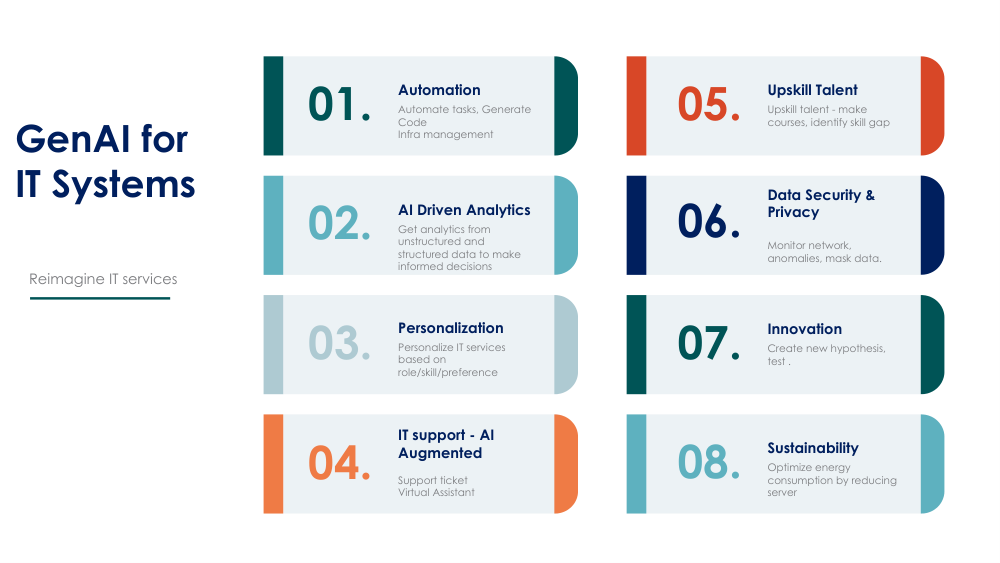
IT support and operations are natural early targets for AI-enabled productivity and automation.
This tracks with where vendors are actually investing: ServiceNow was ranked #1 for Building and Managing AI Agents in Gartner's 2025 Critical Capabilities report, and Gartner projects 40% of enterprise applications will carry task-specific agents by the end of 2026 — IT service management is one of the deepest, most mature agent libraries available today.
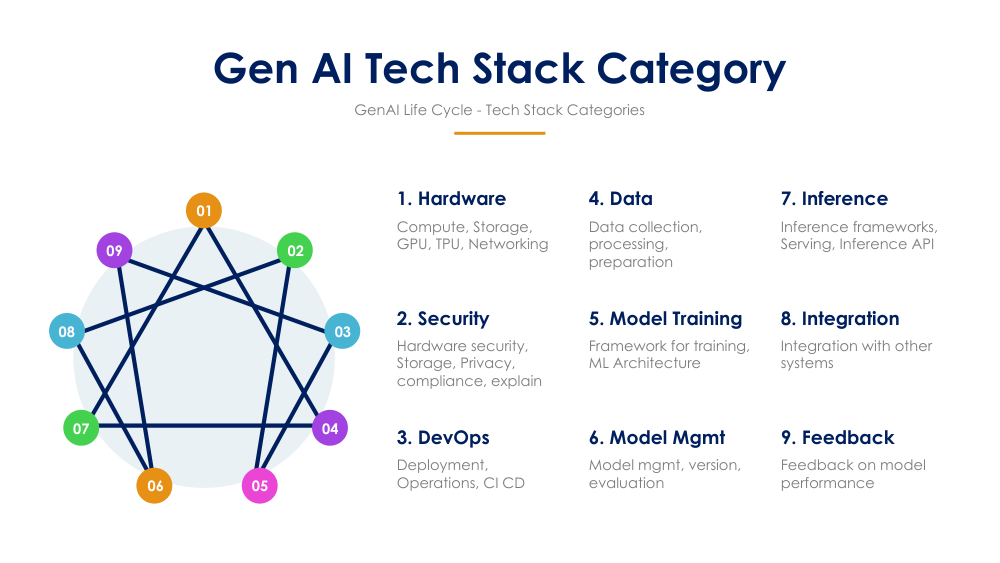
AI-assisted software development and infrastructure management create visible delivery gains.
Platform vendors are building specifically for this: Microsoft's 2026 Copilot Studio release wave added agent-to-agent (A2A) communication and multi-agent orchestration aimed squarely at coordinating CI/CD, patching, and release workflows rather than single code completions.
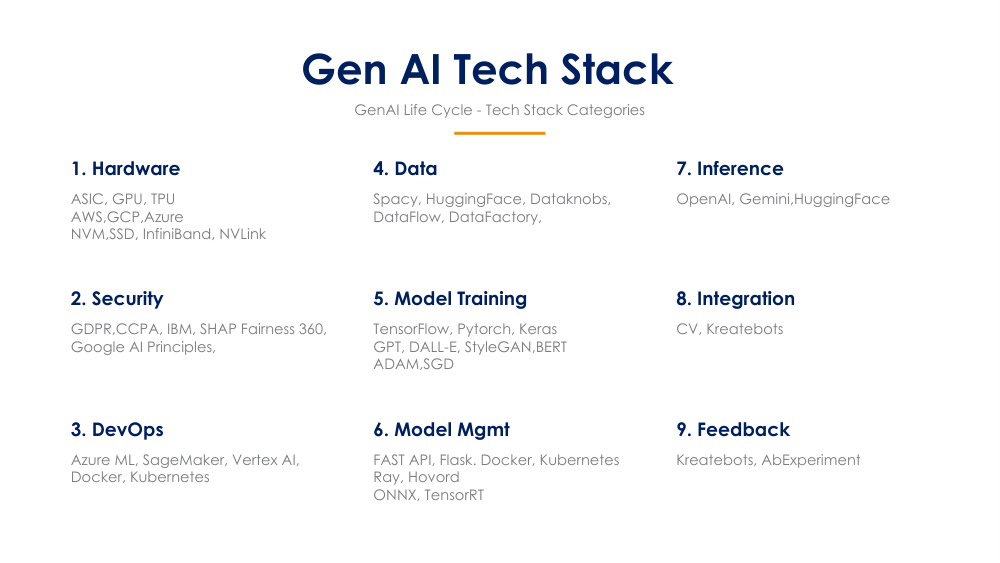
Security, governance, and operational controls determine whether agentic AI can scale safely.
This is not a hypothetical concern: non-human identities already outnumber human ones by 40:1 to over 100:1 in many enterprises. Microsoft's Entra Agent ID (general availability April 2026) and the Cloud Security Alliance's Agentic Trust Framework (published February 2026) are the first dedicated responses to that gap.