Intent, entities, timeframe, metric and required level of detail.

LLMs can make databases, spreadsheets and APIs accessible through natural language. The enterprise challenge is not merely generating SQL: it is producing answers that are accurate, authorized, explainable, reproducible and safe to use in decisions.
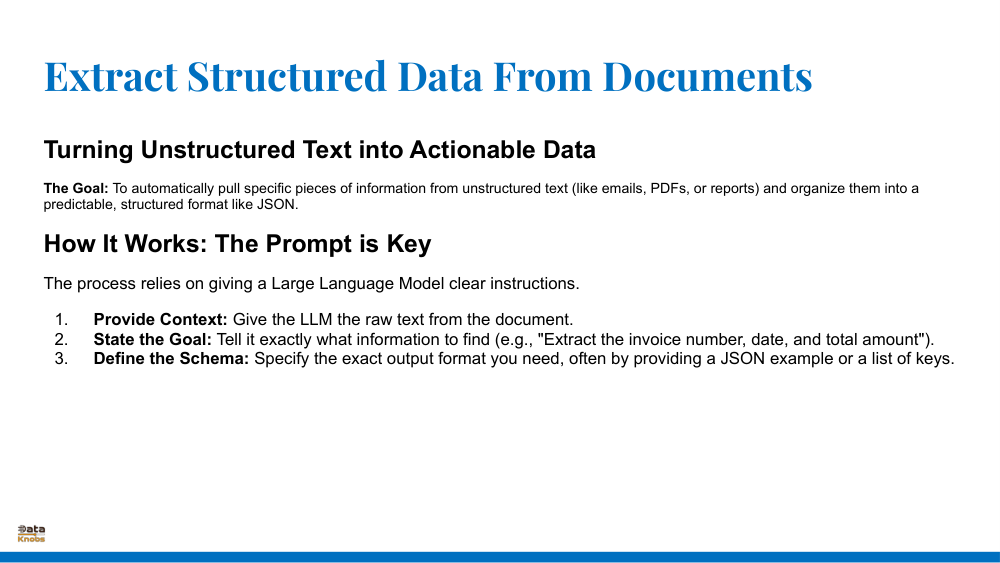
Analyzing structured data with LLMs means using a model to interpret a user question, map it to approved business concepts and data sources, generate or select a query, validate the result and explain the answer. A production system should not allow a model to query everything freely. It needs a semantic layer, access controls, query validation, execution limits, evidence, evaluation and monitoring.
The useful system is an orchestrated analytics workflow: not a single prompt that asks an LLM to write SQL.
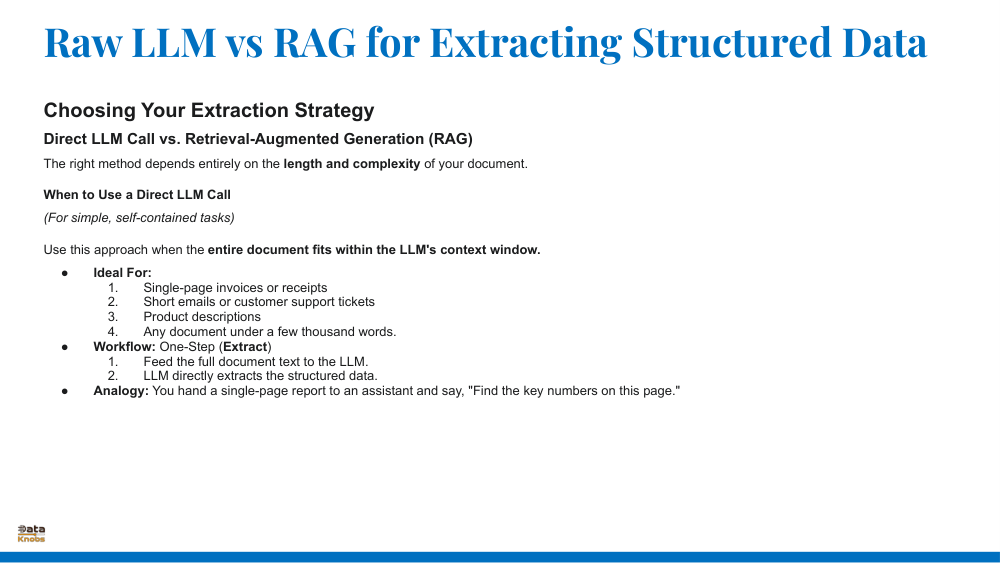
The model interprets the business question, identifies the relevant metrics and dimensions, selects approved tables or APIs, generates a constrained query and returns a summarized result.
Each layer exposes controllable knobs that can be evaluated, governed and optimized independently.
Intent, entities, timeframe, metric and required level of detail.
Approved metrics, dimensions, synonyms, definitions and data ownership.
Choose the correct warehouse, database, spreadsheet, API or data product.
Generate SQL, filters, joins, calculations and execution constraints.
Check authorization, syntax, cost, row limits, metric consistency and anomalies.
Return result, explanation, provenance, confidence, caveats and reusable output.
They are the controllable variables that influence answer quality, cost, access, consistency and business impact.
Control which datasets, columns, date ranges, joins and metric definitions can be used for a particular user or use case.
Set clarification rules, maximum joins, query complexity, acceptable assumptions, fallback behavior and response format.
Enforce row- and column-level access, PII masking, approved actions, audit trails, citations and human review thresholds.
Tune model routing, context size, cache use, query timeout, sampling, retry behavior and cost per verified answer.
They can serve executives, analysts, operations teams, risk teams and customer-facing applications from the same controlled foundation.
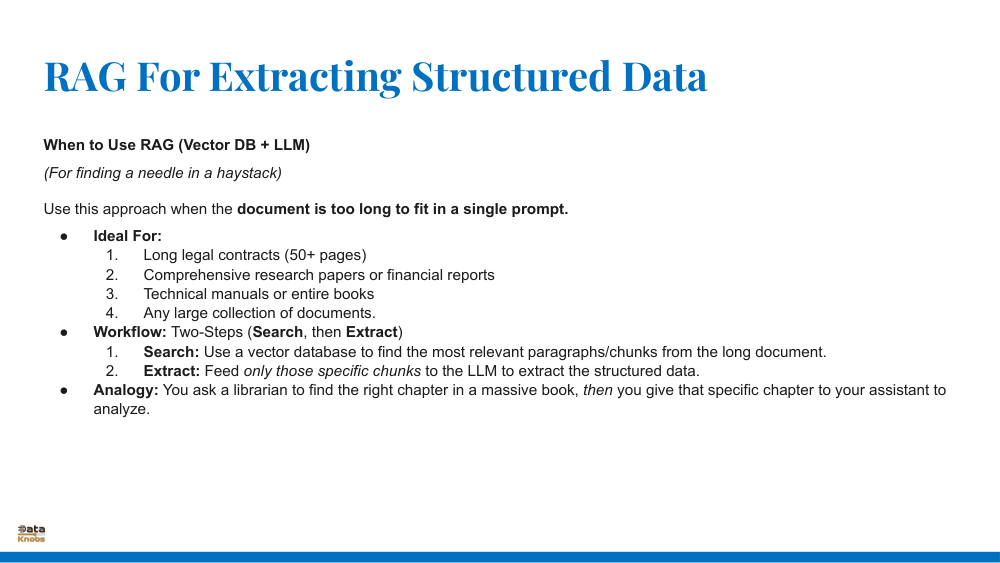
Users ask questions in business language without knowing schemas, table names or SQL syntax.
The system combines governed queries, calculations, comparisons, trends and anomaly detection.
Approved workflows can trigger reports, alerts, reviews or downstream agent actions.
A smaller governed domain is more valuable than a broad assistant that produces inconsistent or unverifiable answers.
Select one data product, decision workflow or KPI family with clear owners and users.
Document metrics, dimensions, synonyms, joins, business rules and authoritative sources.
Test representative questions, edge cases, ambiguous wording, unauthorized requests and expected answers.
Track execution accuracy, answer quality, query cost, latency, drift, access violations and user corrections.
| Capability | Basic text-to-SQL demo | DataKnobs production approach |
|---|---|---|
| Data access | Model sees broad schema context | Policy-scoped sources, columns, rows and actions |
| Business meaning | Inferred from names and prompt examples | Governed semantic definitions and metric ownership |
| Query safety | Syntax check only | Authorization, complexity, cost, joins, filters and result checks |
| Answer quality | Manual spot checking | Golden datasets, evaluation slices and continuous regression tests |
| Explainability | Natural-language summary | Query, source, timestamp, assumptions, confidence and evidence |
| Optimization | Prompt tuning | Data, behavioral, governance and cost knobs tuned together |
Use Kreate to assemble the experience and agent, Kontrols to enforce access and evidence, and Knobs to evaluate and optimize the variables that influence quality, cost and business outcomes.
Explore Kreate, Kontrols and Knobs →