Intent, entities, timeframe, metric and required level of detail.

LLMs have the ability to provide access to databases, spreadsheets, and APIs using natural language. The challenge for businesses goes beyond just creating SQL queries; it involves delivering precise, authorized, explainable, replicable, and secure answers for decision-making.
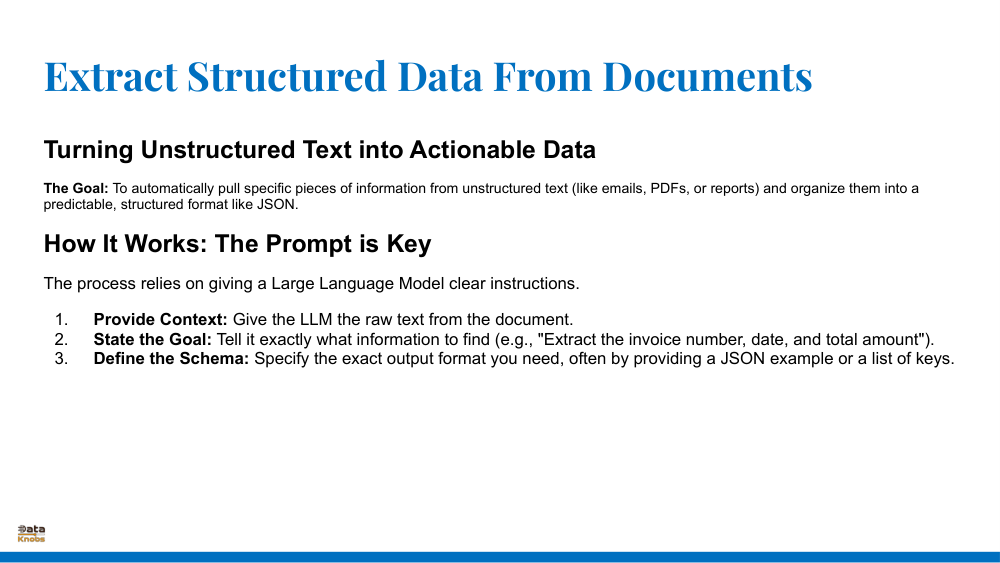
Analyzing structured data with LLMs Using a model to analyze a user query, align it with predefined business concepts and data sources, generate a query, verify the results, and provide an explanation is essential in a production system. To prevent unrestricted querying, a semantic layer, access controls, query validation, execution limits, evidence, evaluation, and monitoring are necessary components.
The system is a well-coordinated analytics workflow, requiring more than just a simple SQL prompt for an LLM to write.
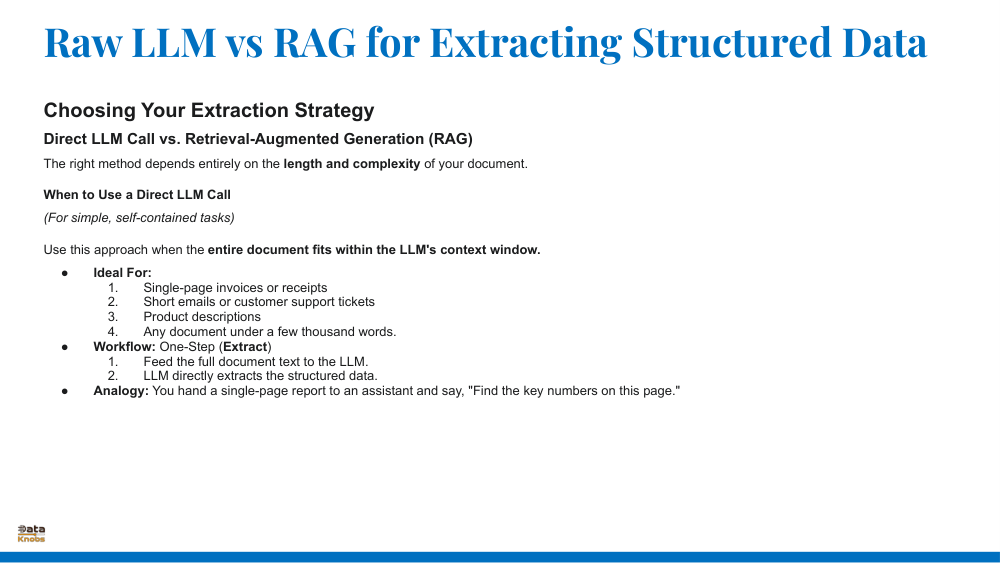
The model analyzes the business query, highlights key metrics and dimensions, chooses authorized tables or APIs, creates a limited query, and presents a condensed outcome.
Every layer has adjustable knobs that can be individually assessed, managed, and enhanced.
Intent, entities, timeframe, metric and required level of detail.
Approved metrics, dimensions, synonyms, definitions and data ownership.
Choose the correct warehouse, database, spreadsheet, API or data product.
Generate SQL, filters, joins, calculations and execution constraints.
Check authorization, syntax, cost, row limits, metric consistency and anomalies.
Return result, explanation, provenance, confidence, caveats and reusable output.
These variables can be controlled and have an impact on the quality of answers, costs, access, consistency, and business outcomes.
Manage the datasets, columns, date ranges, joins, and metric definitions available for a specific user or purpose.
Establish rules for clarification, limit on joins, query complexity, assumptions, fallback actions, and format of responses.
Implement row and column access controls, PII masking, approved actions logging, audit trails, citations tracking, and human review thresholds.
Adjust model routing, context size, cache utilization, query timeout, sampling rate, retry strategy, and cost for each verified answer.
Executives, analysts, operations teams, risk teams, and customer-facing applications can all be supported by a single controlled foundation.
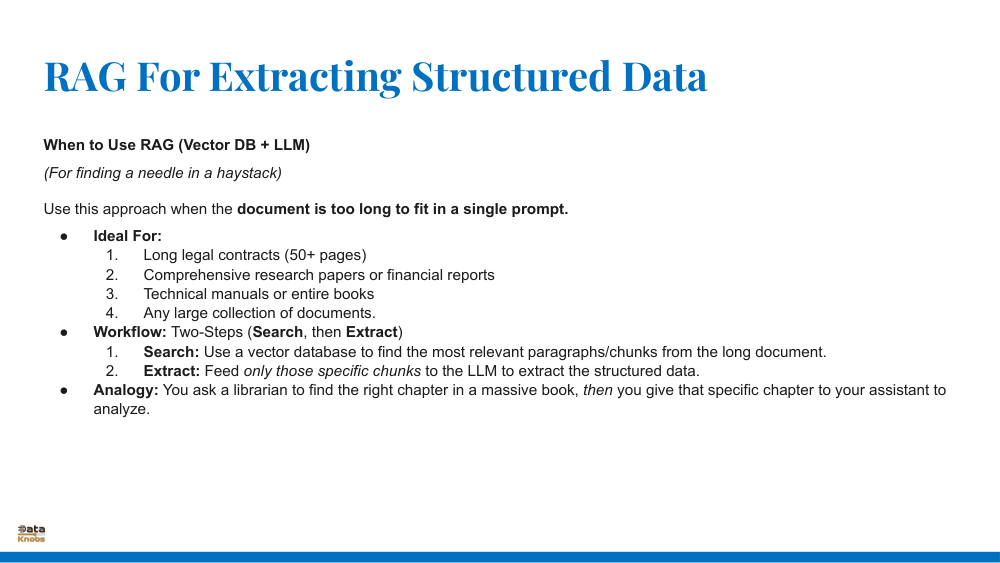
Users inquire using common business terminology without having knowledge of schemas, table names, or SQL syntax.
The system integrates controlled queries, calculations, comparisons, trends, and anomaly detection.
Workflows that have been approved can initiate reports, alerts, reviews, or actions by downstream agents.
A narrow controlled area is more beneficial than a wide-ranging helper that gives unreliable or unconfirmable responses.
Choose a single data product, decision workflow, or KPI family that has clearly defined owners and users.
Document metrics, dimensions, synonyms, joins, business rules and authoritative sources.
Evaluate possible scenarios, boundary conditions, unclear phrasing, invalid inquiries, and anticipated responses.
Monitor the precision of execution, quality of answers, cost of queries, latency, drift, access violations, and user corrections.
| Capability | Basic text-to-SQL demo | DataKnobs production approach |
|---|---|---|
| Data access | Model sees broad schema context | Policy-scoped sources, columns, rows and actions |
| Business meaning | Inferred from names and prompt examples | Governed semantic definitions and metric ownership |
| Query safety | Syntax check only | Authorization, complexity, cost, joins, filters and result checks |
| Answer quality | Manual spot checking | Golden datasets, evaluation slices and continuous regression tests |
| Explainability | Natural-language summary | Query, source, timestamp, assumptions, confidence and evidence |
| Optimization | Prompt tuning | Data, behavioral, governance and cost knobs tuned together |
Utilize Kreate for crafting the experience and agent, Kontrols for enforcing access and evidence, and Knobs for evaluating and optimizing variables that impact quality, cost, and business results.
Explore Kreate, Kontrols and Knobs →