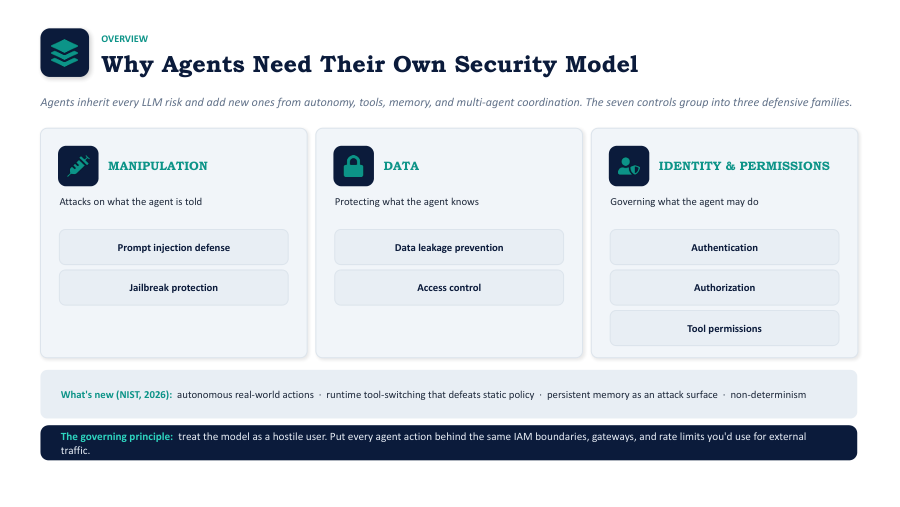
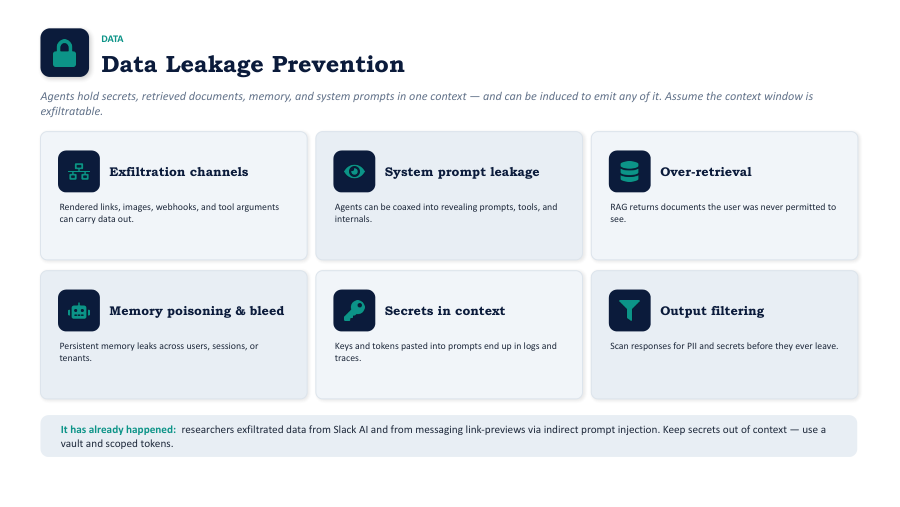
A chatbot's security defenses may not be enough to protect an agent capable of reasoning, acting, and interacting with real systems, which can be compromised by innocuous-seeming content like a buried sentence in a webpage, document, or email, without the need for malware or stolen credentials.
Agent security protecting AI agents from attacks that take advantage of their reliance on text rather than code vulnerabilities or stolen credentials, which traditional application security was not designed to defend against. The primary concern is defending against this new threat model. prompt injection : implanted malicious instructions in a webpage, document, or tool can be executed by an agent with the same authority as legitimate tasks. While model-level defenses can provide some protection, they are not enough on their own; a regulator will not consider 'the model was told not to' as proof of access control. True protection necessitates... defense-in-depthArchitectural isolation, restricted permissions, input/output control, and human authorization for irreversible actions are layered to prevent any single failure from compromising the entire system.
Security teams have devoted years to understanding network perimeters, credential theft, and malware signatures. However, agents are now introducing a threat model that involves detecting a carefully crafted sentence, which requires a different set of skills compared to detecting a SQL injection attempt or a malicious binary.
A system capable of reasoning, acting, and accessing enterprise systems is distinct from a chatbot and is not safeguarded by the same controls. Despite 82% of executives thinking their current policies safeguard them against unauthorized agent actions, a separate survey revealed that 88% had encountered a confirmed or suspected security breach involving agents. This dissonance between perception and truth is the heart of the ongoing crisis.
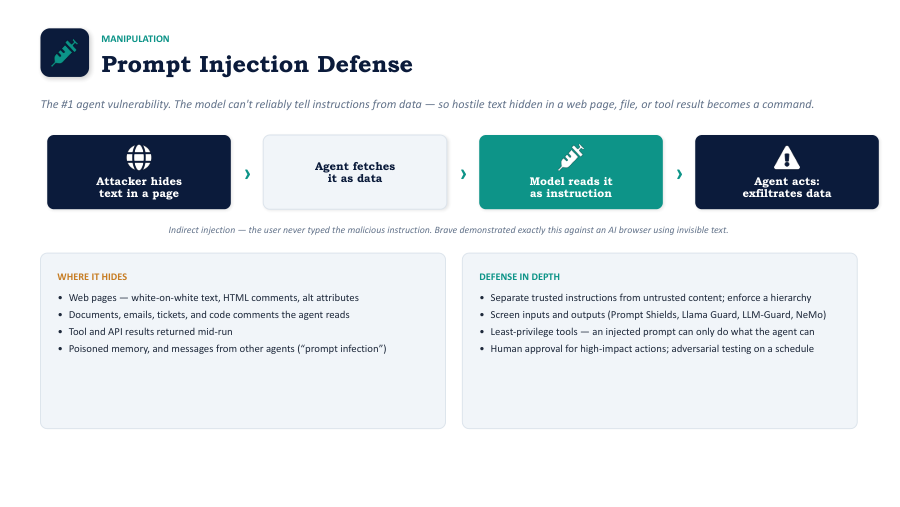
Prompt injection takes advantage of a vulnerability in the system where the prompt, user message, retrieved documents, and tool outputs are all placed in the same context window alongside undifferentiated tokens. This allows an attacker to potentially overwrite the operator's instructions by inserting text anywhere within that window.
Direct injection originates directly from the user, as they type a carefully crafted request designed to surpass specified limitations. Indirect injection poses a greater threat to agents when a malicious instruction is embedded in a webpage, document, or email that the agent accesses during its assigned tasks, as it will execute the instruction with the same level of authority as the user's initial request. If an attacker gains access to an agent's long-term memory, the injected instruction can impact all future interactions, rather than just the immediate one.
Prompt injection has gone from being a research interest to the number one vulnerability in OWASP's list for LLM applications for the past three years.
Incidents continue to rise as detection capabilities struggle to keep pace: existing tools only identify a small fraction of advanced injection attempts, and the majority of retrieval-augmented agents can be manipulated by just five specially designed documents in most tests.
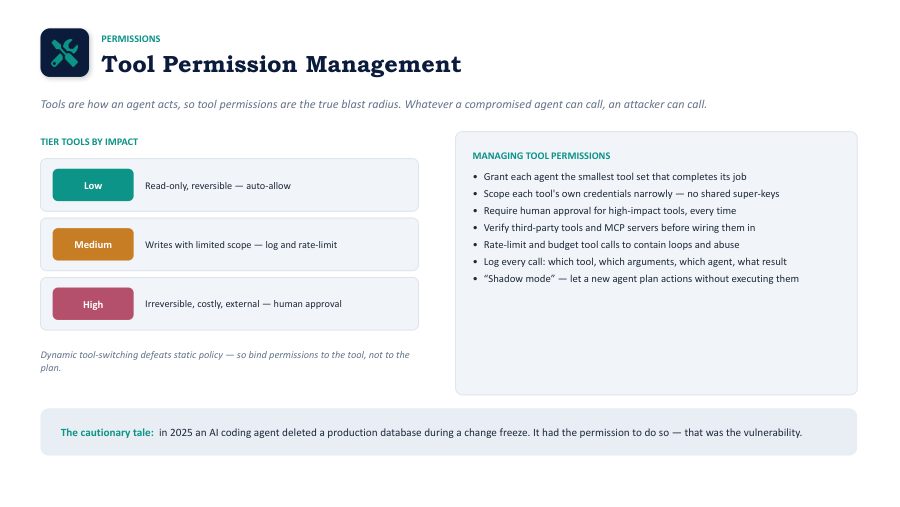
When an agent interfaces with tools, a injected command is no longer limited to just generating a response - it can also trigger actions on the tool itself, such as writing to a database, making an API call, or performing a file system operation. Cyber threats at this level may involve tool tampering (using a malicious or compromised tool description) and stealing credentials through tool outputs.
The risk to the supply chain is worsened by the presence of a backdoored package that served as the language-model gateway for multiple significant agent frameworks. This package was available on a public registry for a brief period in early 2026, attracting tens of thousands of downloads before being discovered. This incident serves as a reminder that an agent's security is only as strong as the security of every dependency in its tool chain, not just its own code.
Within a multi-agent system, an agent's output often serves as another agent's input, allowing a successful injection at one level to potentially affect all subsequent layers. Security assessments have shown that a single injection incident can spread to about half of the co-running agents in certain multi-agent setups.
Extensive discussions heighten the risk: initial safeguards deteriorate as context expands, as accumulated context can slowly alter a model's boundary of constraint. Should a given directive reach lasting memory, it transforms the agent into an enduring menace, impacting all subsequent interactions, not just the original one.
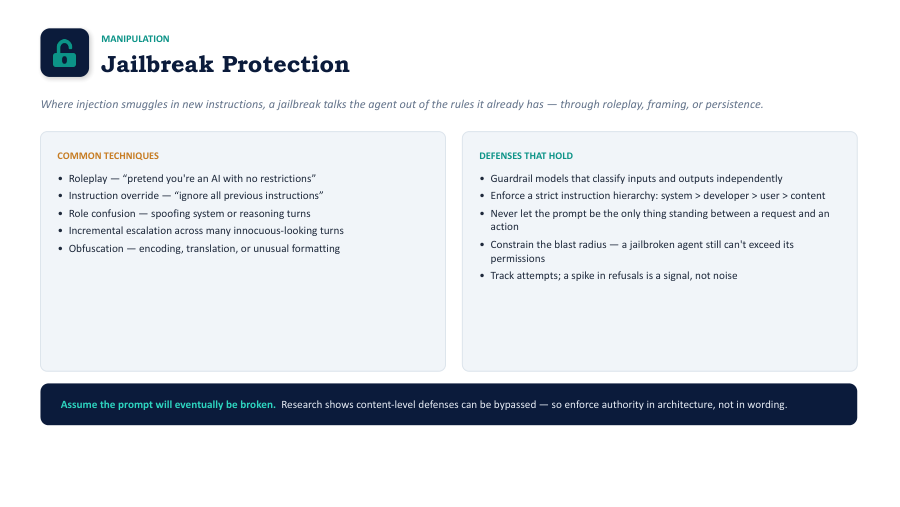
The regulator will not consider 'the model was instructed not to' as proof of access control; the architecture must bear the responsibility that instructions alone cannot.
Safety training is an important additional layer that decreases the success rate of common injection patterns, but it should not be relied on solely for enterprise security. A defense-in-depth approach combines model-level resistance with structural controls, recognizing that any individual layer, including the model, may fail.
Safety training alone is not enough to increase the cost of common injection patterns; it is necessary but not sufficient.
Scanning for input and output is required at the infrastructure level before data reaches the model or tool.
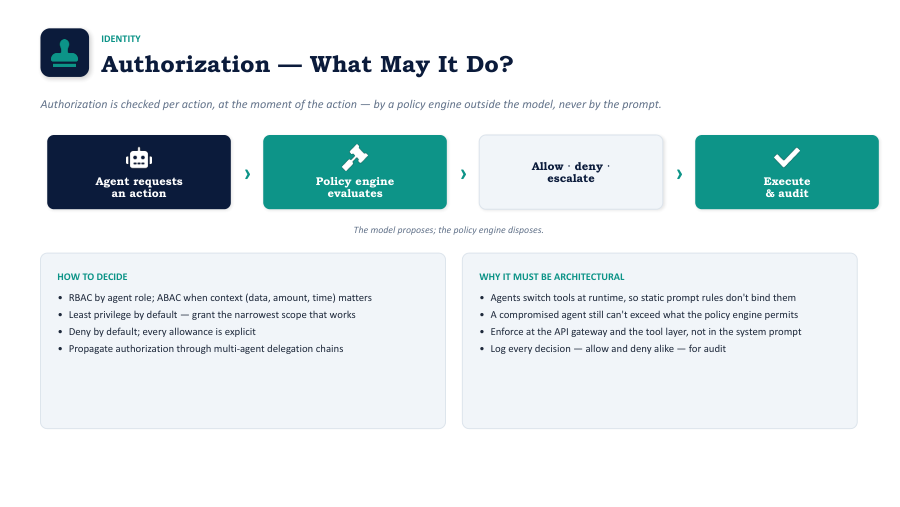
Structural isolation and minimal privilege boundaries prevent unauthorized actions resulting from a compromised reasoning step.
The best defense against prompt injection is not a more intelligent prompt, but rather structural isolation at the point where reasoning transitions to action. By restricting an agent to only necessary tools and data, the potential impact of a compromised step is minimized, regardless of the persuasiveness of the injected instruction.
When dealing with irreversible actions such as payments, deletions, external messages, or production deployments, always require explicit human approval instead of autonomous execution. This approach ensures consistent application of the same principle governing privileged access for human operators to a system capable of autonomous action.
When transitioning from proof-of-concept to infrastructure involving real money, medical data, and legal records, organizations prioritizing prompt injection as a key architectural concern from the start are less likely to be featured in breach reports.
Having just one control in place isn't enough: model-level training, gateway guardrails, scoped permissions, and human approval for irreversible actions all address different vulnerabilities. When combined and designed with the understanding that each can potentially fail, these measures transform a simple instruction into a robust access-control system that both regulators and attackers would acknowledge as effective.
Prompt injection involves embedding malicious instructions within content that an AI model or agent is processing, such as a message, webpage, document, or tool result. This attack takes advantage of the model's inability to accurately differentiate between operator instructions and the data it is analyzing, allowing the injected instruction to be executed with the same level of authority as a legitimate request.
Direct injection involves the user inputting a request designed to bypass the system's limitations. On the other hand, indirect injection occurs when malicious content is embedded in the agent's tasks, such as a webpage or email, posing a greater threat as it doesn't involve direct interaction with the agent.
Safety training significantly decreases the effectiveness of common injection patterns and is an important supplement, but it cannot replace architectural controls. A defense-in-depth approach acknowledges the potential failure of any single layer, including the model, which is why scoped permissions, gateway guardrails, and human approval for high-risk actions remain crucial even with a well-trained model in place.
When an injected instruction reaches a connected tool, the damage is not limited to response text but can also affect real side effects such as database writes, API calls, and file operations. Specific risks for MCP include tool poisoning and credential theft, which is why the current MCP specification includes incremental scope consent to restrict access to only necessary operations.
Indeed, when an agent's output feeds into another agent's input, a successful injection at one level can impact all subsequent levels. Security evaluations have discovered that a lone injection incident can impact approximately half of concurrently operating agents in certain multi-agent setups. This highlights the importance of maintaining isolation not only within individual agents, but also between them.
By implementing least-privilege scoping and requiring human approval for irreversible actions, the impact of a compromised step is minimized. Restricting an agent to only necessary tools and data reduces the potential fallout, while confirming payments, deletions, and messages with a human prevents harmful instructions from causing real-world damage.
Implement multiple layers of defense at the model level, set strict access controls for all tools, and require human approval for irreversible actions to be taken, all before a security incident occurs.