An immediate revision is sent out. The canary appears to be in good shape for forty minutes. Half a day later, a corporate customer submits a ticket regarding a sub-path that was never tested by the regression suite. Deploying an agent isn't just a simple process - it involves passing through a series of checkpoints to ensure the candidate is truly prepared.
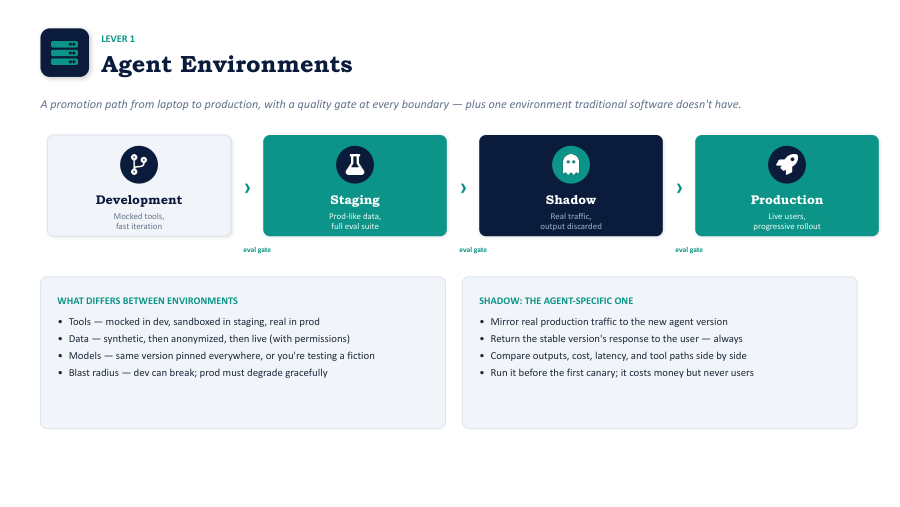
Agent deployment Deploying a new agent version involves careful precision to ensure the stability of the existing production system. Since each request may prompt a different tool sequence, deployments must be monitored to prevent silent degradation of system performance while maintaining reliable responses. four-stage gate : shadow (validate against real traffic with no user exposure), canary (a small live cohort sees it), percentage (gradual ramp with automated rollback triggers), and full The rollout progresses through various stages, each addressing a unique question. Skipping a stage doesn't just increase risk; it eliminates the sole check that could detect a particular type of failure.
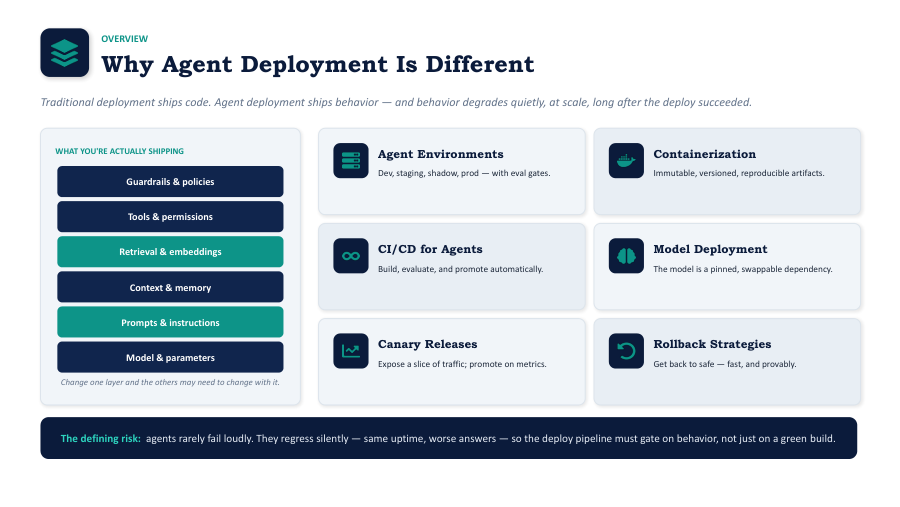
When deploying standard software, version codes must be synchronized with agent deployments, which consist of tightly coupled artifacts including code, data, and model or prompt weights. Any modification to these components can potentially disrupt production without any noticeable impact on system performance.
Conventional CI/CD pipelines focus on detecting compilation errors and failed unit tests, missing the subtle tool-call schema breakage on a sub-route caused by a prompt edit. A staged rollout, with thorough evaluation at each stage, aims to address this gap.
Skipping a stage not only increases risk overall but also eliminates the essential verification that the stage is designed to provide.
Routing determines the path for each request, while a distinct evaluation stack determines if the candidate qualifies to advance to the next stage. The scoring templates used to evaluate pull requests in CI are also used to assess the live traffic of the canary, ensuring that any regressions are identified consistently.
Does the candidate demonstrate reasonable behavior when faced with actual traffic data without exposing user information?
Is a small group of users seeing genuine responses just as effective when real users are involved?
As volume and diversity increase, does quality remain consistent with the gradual ramp and automated gates?
Finish cutover. Keep monitoring and rollback readiness active, even after the ramp up.
Shadow deployment involves replicating real production requests to the candidate version, evaluating the responses, and keeping them hidden from users. This cost-effective method is often overlooked by teams who jump from offline evaluations to live canaries, missing out on the crucial phase where candidate tuning occurs.
One common error is viewing shadow testing as a one-time verification before canary deployment instead of an ongoing procedure. As production distribution changes gradually, a rubric can only detect these shifts if shadow traffic is consistently monitored, not just once prior to a particular release.
In contrast to shadow testing, a canary's feedback is only received by a small live group, typically 5 to 10 percent of traffic. This necessitates monitoring of quality, cost, latency, safety, and task outcomes on a per-cohort basis rather than just in total. To be considered successful, the candidate must demonstrate its effectiveness compared to the existing version with active user involvement, rather than just showing promise in a shadow sample.
The classic failure scenario: average stability remains high at 0.91 throughout most of the system, but a single impacted branch is operating at a lower 0.62. The overall picture appeared satisfactory due to the use of averages instead of percentiles, leading to the oversight of the incorrect metric by the monitoring system.
Blue-green Maintains two identical production environments simultaneously. The inactive environment is updated with the new version, rigorously tested in isolation, and only switches traffic once verified : rollback is as easy as reverting to the untouched environment.
A/B testing It rigorously compares two versions using business metrics, not just model accuracy, to determine which performs better for users, separate from the safety evaluation done by shadow and canary testing.
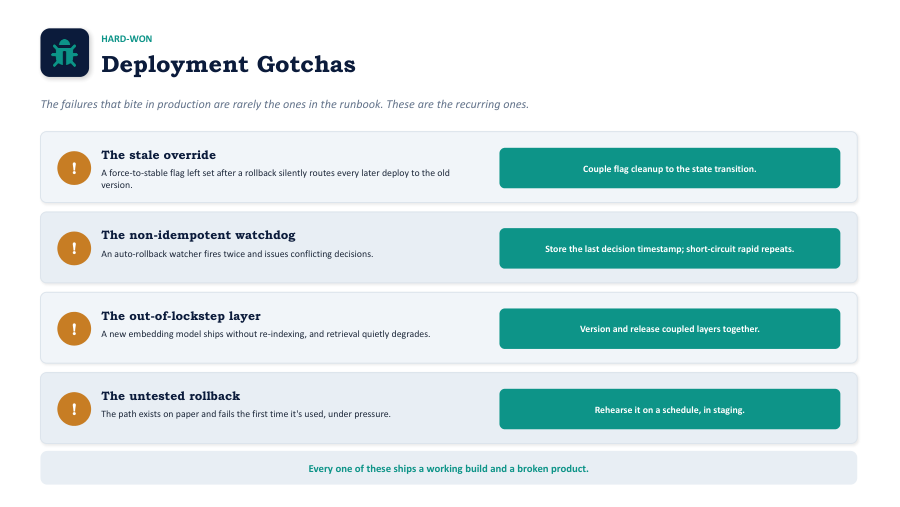
All of them result in a rollout that appears successful on the dashboard until it unexpectedly fails.
These failure modes are not exotic, but rather the specific and recurring gaps that a seemingly complete rollout process still quietly harbors.
A quick update could necessitate a shift in retrieval tactics. Implementing a fresh embedding model may call for a complete reindexing of the database. The purpose of release orchestration is to ensure that any changes in one layer prompt automatic testing and deployment of its dependencies, preventing them from falling out of sync until caught in production.
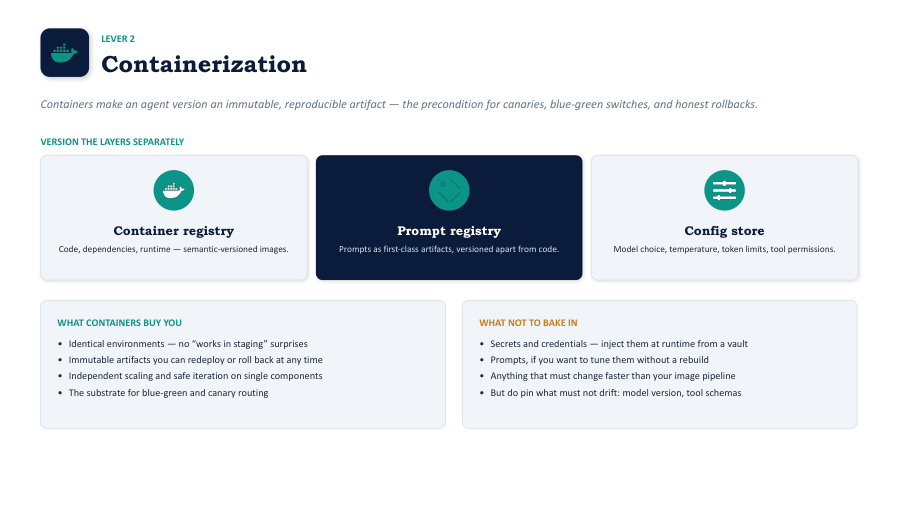
The fundamental approach here involves treating prompts and configurations as code, ensuring they are version-controlled, reviewed, and integrated into the same CI pipeline as the rest of the stack, rather than directly editing a live prompt and hoping for consistency.
Safe deployment includes guardrails at the input, output, and action levels, along with immutable logging, enabling full traceability of production decisions back to the precise version of the stack responsible - not just a rough release time frame, but the specific commit, model version, and training run.
The model lineage must consist of the training data hash and code SHA associated with every deployed version, with deployment events recorded in an unchangeable audit trail. Access control measures should prevent developers from directly pushing to a production namespace, mirroring the discipline seen in traditional infrastructure but adapted for a stack that undergoes frequent changes.
Successful organizations will not be defined by having the most intelligent individual model, but rather by their ability to effectively orchestrate the deployment and development of agents in a safe manner, aligning with their other products and following the same release schedule and evidence standards.
The key factor that distinguishes a rollout process that appears finished from one that truly is: a tried and tested rollback plan, not just a written one. While documentation outlines the expected steps, a practiced rollback validates its effectiveness, including cache flushing.
Shadow deployment replicates actual production traffic to evaluate a candidate version's responses discreetly, while canary deployment exposes the candidate's responses to a small group of live users for direct evaluation of quality, cost, and safety metrics by cohort.
A standard deployment only versions code, while an agent deployment versions code, data, and model weights simultaneously. Any changes to these can silently degrade quality as the system continues to respond without triggering traditional CI/CD error detection.
In a canary rollout, the overall quality metric may appear to be in good shape, but a particular sub-route or segment could be experiencing significant issues that are masked by the average. To address this, focusing on percentiles and failure clusters within the traffic is essential, rather than solely relying on the aggregate mean.
Frequently, a semantic or response cache continues to provide incorrect answers from the cached data, even after traffic has shifted back to the original version, due to the TTL not expiring. To ensure a successful rollback, it is crucial to include a cache flush in the procedure, rather than solely relying on a routing change.
This entails ensuring that all interconnected layers remain in harmony when one is altered, such as making a quick adjustment that necessitates a different approach to retrieval, or implementing a new embedding model that demands re-indexing a database. Instead of deploying individual layers and hoping for compatibility, it views the entire stack as a unified release rather than multiple separate entities.
At the very least, ensure that shadow validation is done before the initial canary release, have automated metric gates and rollback criteria for canary steps, keep a warm fallback environment for 24 hours after promotion, test the rollback process instead of just writing it down, and track each deployment back to a specific git commit, model version, and training run.
Complete the entire four-stage gate before the next prompt or model change is launched, and practice the rollback : including cache flush : before it is required in a real scenario.