Understanding Three Categories of AI-Driven Entities
As AI technology advances, three distinct categories of AI-driven entities have emerged, each serving different purposes and meeting different user needs. Understanding the differences between AI Assistants, Digital Humans, and Robots is crucial for selecting the right technology for specific applications. These categories differ fundamentally in their appearance, functionality, interaction patterns, and appropriate use cases.
The Three Categories at a Glance
💬 AI Assistant
A software application designed to help users by performing tasks, providing information, and offering recommendations through text or voice interaction.
- Primarily task-oriented and functional
- No visual appearance or minimal simplistic representation
- Text or voice interaction
- Lacks advanced emotional intelligence
- Limited social interaction capabilities
👤 Digital Human
An AI-driven virtual entity designed to mimic human appearance, behavior, and interaction as closely as possible through realistic avatars.
- Visually realistic or semi-realistic appearance
- Uses graphics and animation techniques
- Multi-modal interaction (text, voice, facial expressions, body language)
- High emotional intelligence and context awareness
- Immersive and emotionally engaging
🤖 Robot
A physical entity designed to interact with the physical world through movement, sensors, and actuators while communicating with humans.
- Physical existence in the real world
- Can range from industrial machines to humanoid robots
- Perform physical tasks and actions
- Equipped with sensors and actuators
- Multi-modal communication capabilities
01. AI Assistant : Virtual Assistant or Digital Assistant
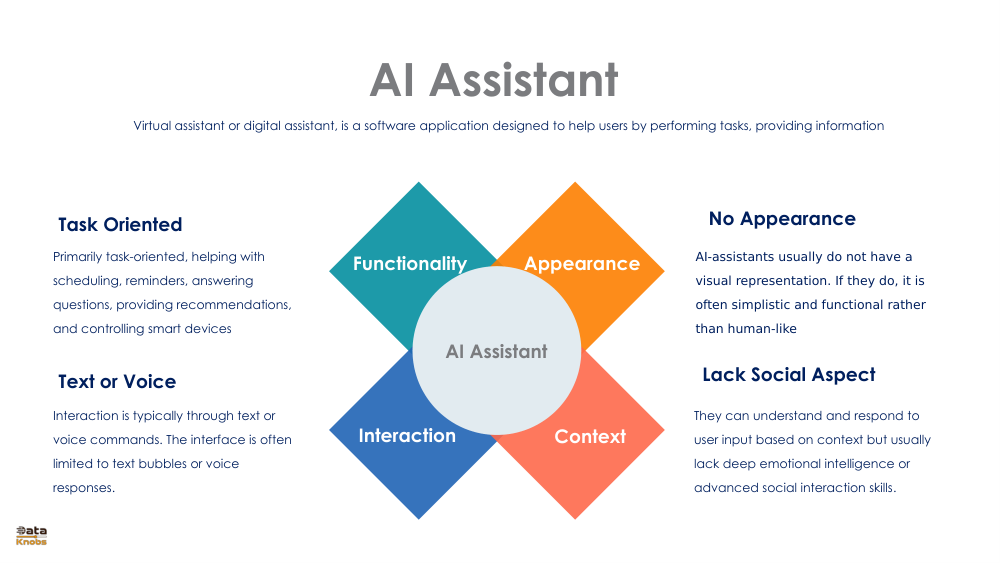
AI Assistants are software applications designed to help users by performing tasks, providing information, and offering recommendations. They are the most widely deployed form of AI interaction today, found in smartphones, smart home devices, customer service platforms, and enterprise applications.
Key Characteristics
🎯 Functionality : Task Oriented
AI Assistants are primarily designed for task completion and information delivery. Their core purpose is to be efficient, helpful, and responsive to user requests.
- Scheduling and reminders: Manage calendars and set alerts
- Information retrieval: Answer questions across domains
- Recommendations: Suggest products, content, actions based on user preferences
- Smart device control: Manage IoT devices through voice or text
- Administrative tasks: Email management, note-taking, research
- Customer service: Provide support and resolve issues
👁️ Appearance : No Visual Representation
AI Assistants typically lack any visual representation. If they do include visual elements, these are usually simple, functional, and non-human-like.
- No avatar or virtual presence required
- Some may use icons or simple animations
- Focus is on the quality of responses, not aesthetics
- Minimal visual design overhead
🗣️ Interaction : Text or Voice
AI Assistants interact with users through straightforward channels: text input/output or voice commands and responses.
- Text-based chat interfaces with text bubbles
- Voice commands and verbal responses
- Simple, direct communication patterns
- No nonverbal cues like gestures or facial expressions
🧠 Context Awareness : Limited Social Intelligence
AI Assistants understand and respond to user input based on context, but typically lack deep emotional intelligence or advanced social interaction skills.
- Can track conversation history within a session
- Understand explicit user preferences
- Limited ability to detect emotional subtext
- Focus on content accuracy over emotional connection
Popular Examples
Siri (Apple)
Voice assistant integrated into iOS, macOS, and Apple Watch. Handles scheduling, weather queries, app control, and Siri Shortcuts automation.
Google Assistant
Multi-platform voice assistant available on Android, Google Home, and smart devices. Specializes in search, information retrieval, and smart home control.
Alexa (Amazon)
Voice-first assistant focused on smart home control, shopping, and entertainment. Available on Echo devices and integrated into many IoT products.
ChatGPT
Conversational AI assistant providing in-depth responses, content creation, analysis, and problem-solving across diverse domains.
Advantages and Disadvantages
✓ Advantages
- Fast response times
- Low computational overhead
- Easy to deploy and scale
- No need for visual rendering
- Cost-effective to develop and maintain
- Quick and direct task completion
- Works on diverse devices
✗ Disadvantages
- Limited emotional engagement
- No human-like presence
- Can seem impersonal or cold
- Difficult for relationship-building
- Limited nonverbal communication
- May feel robotic or transactional
Technology Stack
Core Technologies
Natural Language Processing (NLP): Understanding and generating human language. Machine Learning: Learning from interactions to improve responses. Knowledge Bases: Databases of information for retrieval. Intent Recognition: Understanding what users want to accomplish. Text-to-Speech/Speech-to-Text: For voice interaction capabilities.
Use Case Applications
Consumer Applications
- Personal productivity (calendar, reminders, notes)
- Smart home control
- Shopping and recommendations
- Entertainment and media control
- Navigation and travel planning
Enterprise Applications
- Customer service chatbots
- Employee support systems
- Internal knowledge management
- HR and benefits assistance
- Sales and lead qualification
02. Digital Human : Virtual Human or Digital Avatar
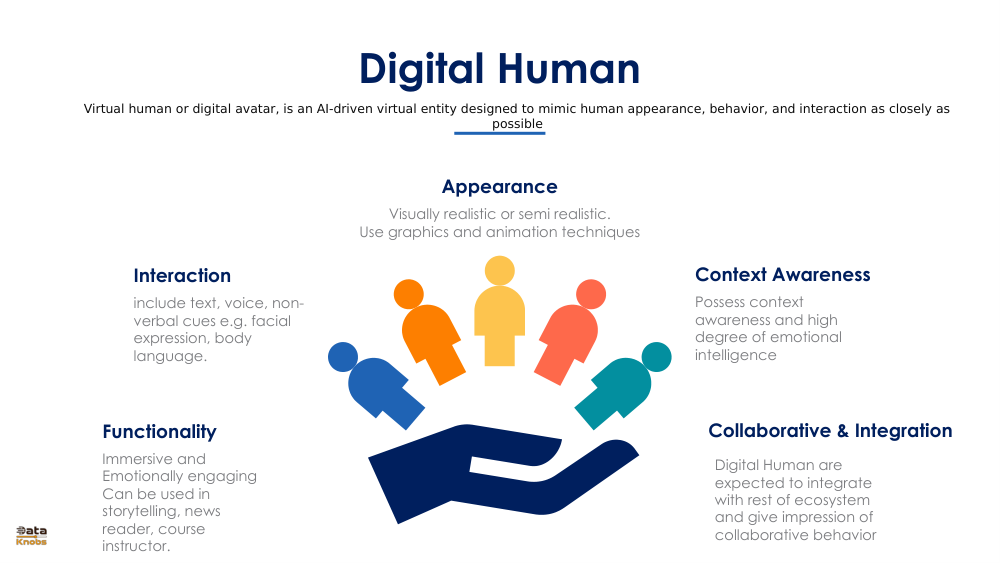
Digital Humans, also called virtual humans or digital avatars, are AI-driven virtual entities designed to mimic human appearance, behavior, and interaction as closely as possible. They represent a significant leap in engagement and presence compared to traditional AI Assistants, combining sophisticated AI with visual realism.
Key Characteristics
👤 Appearance : Visually Realistic
Digital Humans have visually realistic or semi-realistic human-like appearance, created using advanced graphics and animation techniques.
- Computer-generated human faces and bodies
- Realistic skin, hair, clothing, and accessories
- Ranging from photorealistic to stylized representations
- Uses 3D modeling and rendering techniques
- Animation brings the avatar to life
🎬 Functionality : Immersive and Emotionally Engaging
Digital Humans go beyond task completion to create emotional connections and immersive experiences. They can be used for storytelling, education, entertainment, and engagement.
- News reader avatars delivering broadcasts
- Course instructors delivering online education
- Brand ambassadors for marketing campaigns
- Virtual receptionists and concierge services
- Narrative-driven experiences and storytelling
💬 Interaction : Multi-Modal Communication
Digital Humans interact using multiple communication channels beyond text and voice, incorporating human-like nonverbal cues.
- Facial expressions: Smiles, frowns, expressions matching emotion
- Body language: Gestures, posture, movement
- Eye contact: Looking at camera/user for engagement
- Hand gestures: Pointing, emphasizing, illustrating
- Voice with prosody: Tone, emphasis, intonation variations
🧠 Context Awareness : High Emotional Intelligence
Digital Humans possess context awareness and a high degree of emotional intelligence, understanding and responding to user emotional states.
- Understand implicit emotional subtext
- Respond with appropriate emotional context
- Adapt behavior based on user mood
- Build rapport and emotional connection
- Remember user history and preferences
🤝 Integration : Collaborative Behavior
Digital Humans are designed to integrate with other systems and present collaborative behavior, working seamlessly as part of larger ecosystems.
- Coordinate with other systems and data sources
- Present as part of a larger team or organization
- Show understanding of organizational context
- Maintain consistency with brand and values
Real-World Examples
University Virtual Lecturers
Digital humans serving as course instructors in online education platforms, delivering lectures with engaging presentation styles and emotional responsiveness to student questions.
News Reader Avatars
AI-generated news anchors presenting broadcast journalism with realistic appearance, emotion, and delivery matching human presenters.
Brand Ambassadors
Digital humans representing brands in marketing campaigns, social media, and customer interaction, providing consistent, engaging brand representation.
Virtual Receptionists
Digital humans greeting and assisting visitors in virtual or mixed reality environments, providing human-like hospitality and direction.
Advantages and Disadvantages
✓ Advantages
- High user engagement and attention
- Emotional connection and rapport
- More memorable interactions
- Nonverbal communication adds richness
- Better for relationship-building
- Enhanced storytelling capability
- Humanizes brand and organization
✗ Disadvantages
- Higher computational cost
- Complex to develop and maintain
- Risk of "uncanny valley" effect
- Longer response times
- Requires significant rendering power
- More difficult to scale
- Higher development costs
Technology Stack
Advanced Technologies Required
3D Graphics Rendering: Real-time rendering of realistic human forms. Facial Animation: Mapping emotions to facial expressions. Motion Capture: Recording human movements for realism. Advanced NLP: More sophisticated language understanding. Emotion Recognition: Detecting user emotional states. Lip Sync Technology: Synchronizing speech with mouth movements.
Use Case Applications
Entertainment & Media
- News broadcasting and journalism
- Documentary narration
- Entertainment and gaming
- Social media influencers
- Virtual concert performers
Business & Education
- Online education and training
- Corporate training programs
- Marketing and brand representation
- Customer experience centers
- Virtual event hosting
03. Robot : Physical Entity for Real-World Interaction
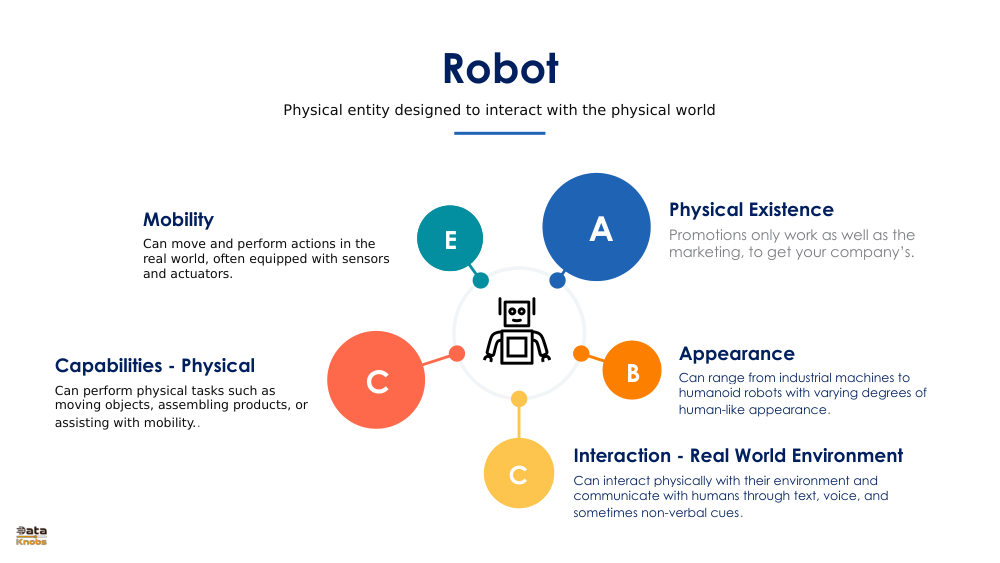
Robots are physical entities designed to interact with the physical world. Unlike AI Assistants and Digital Humans, which exist as software, robots have tangible existence with mechanical components, sensors, and actuators that allow them to perceive and manipulate their environment.
Key Characteristics
🏗️ Physical Existence
Robots have tangible physical form in the real world, not just digital representation. This physical presence enables direct interaction with the environment.
- Mechanical structure with joints and limbs
- Power systems (battery, electric, hydraulic)
- Mounting and installation requirements
- Physical footprint and space considerations
- Durability and maintenance needs
🚀 Mobility : Movement and Real-World Action
Robots can move and perform actions in the real world, often equipped with sophisticated sensors and actuators.
- Locomotion: Walking, rolling, flying, swimming
- Manipulation: Arms and hands to grasp and move objects
- Navigation: Autonomous movement through environments
- Obstacle avoidance using sensor data
- Real-time adaptation to physical environment
🎭 Appearance : Diverse Forms
Robot appearance ranges dramatically based on function, from purely industrial machines to humanoid robots with human-like features.
- Industrial robots: Functional mechanical arms and structures
- Mobile robots: Wheeled or tracked platforms
- Humanoid robots: Bipedal or human-like forms
- Specialized robots: Designed for specific tasks
- Varying degrees of human-likeness by design choice
⚙️ Capabilities : Physical Task Performance
Robots can perform physical tasks that software cannot, directly manipulating the physical world.
- Moving and manipulating objects
- Assembling and manufacturing products
- Lifting and transporting heavy items
- Surgical or precision tasks
- Mobility assistance for humans
- Hazardous environment operations
💬 Interaction : Real World Environment
Robots interact physically with their environment and communicate with humans through multiple modalities.
- Physical interaction: Manipulation of objects and spaces
- Text communication: Display screens and interfaces
- Voice: Speech recognition and generation
- Nonverbal cues: Gestures, LEDs, movement patterns
- Sensor feedback: Understanding and responding to environment
Robot Types and Examples
Industrial Robots
Robotic arms used in manufacturing for welding, assembly, painting, and material handling. Precision-engineered for repetitive, high-volume tasks.
Mobile Robots
Autonomous mobile robots used for delivery, cleaning, inspection, and logistics. Navigate environments using sensors and path planning algorithms.
Humanoid Robots
Robots designed to resemble human form and movement. Examples include Boston Dynamics' Atlas, Tesla's Optimus, and Honda's ASIMO.
Service Robots
Designed to interact with humans and provide services such as cleaning, hospitality, healthcare assistance, and companionship.
Collaborative Robots (Cobots)
Designed to work alongside humans in shared spaces, with safety features and intuitive programming interfaces.
Advantages and Disadvantages
✓ Advantages
- Can perform physical tasks
- Real-world presence and tangibility
- Direct environmental manipulation
- Can work in hazardous conditions
- 24/7 operation capability
- No fatigue or human limitations
- Precise, repeatable performance
✗ Disadvantages
- High initial cost and infrastructure
- Complex maintenance and repairs
- Limited flexibility and reprogramming
- Safety concerns and liability
- Requires physical space and installation
- Limited AI capabilities compared to software
- Difficult to scale and deploy
Technology Stack
Mechanical and Software Technologies
Mechanical Engineering: Mechanical design, actuators, and control systems. Sensor Technology: Vision, LiDAR, ultrasonic, tactile sensors. Motion Planning: Path planning and obstacle avoidance algorithms. Control Systems: Real-time control and feedback loops. Power Systems: Battery management and energy efficiency.
Use Case Applications
Manufacturing & Industry
- Assembly line automation
- Welding and fabrication
- Material handling and logistics
- Quality inspection
- Packaging and sorting
Healthcare & Services
- Surgical assistance
- Patient mobility assistance
- Cleaning and sanitation
- Delivery and logistics
- Security and surveillance
Comprehensive Comparison Matrix
The following comparison matrix highlights the key differences across multiple dimensions. This helps organizations select the appropriate technology for their specific use cases and requirements.
| Dimension | AI Assistant | Digital Human | Robot |
|---|---|---|---|
| Primary Form | Software application | Virtual entity with visual representation | Physical mechanical entity |
| Appearance | No appearance or minimal icons | Realistic or semi-realistic human form | Industrial to humanoid forms |
| Primary Purpose | Task completion and information | Engagement and experience | Physical actions and manipulation |
| Interaction Mode | Text/Voice commands | Multi-modal (text, voice, gestures, expressions) | Physical + text/voice communication |
| Emotional Intelligence | Limited | High with deep context awareness | Limited, task-focused |
| Deployment | Any device with internet connection | Requires graphics processing and display | Physical space and infrastructure |
| Development Cost | Low to moderate | High (graphics, animation, AI) | Very high (mechanical, sensors, integration) |
| Scalability | Highly scalable | Moderately scalable with graphics optimizations | Difficult to scale physically |
| Response Time | Fast (seconds) | Moderate (few seconds with rendering) | Variable based on physical actions |
| Physical Capability | None (software-only) | None (virtual-only) | Direct physical manipulation |
| User Engagement | Transactional | Relational and emotional | Functional and physical |
| Best For | Productivity, information, support | Education, storytelling, brand engagement | Manufacturing, physical tasks, logistics |
Choosing the Right Technology
Selecting between AI Assistants, Digital Humans, and Robots depends on your specific needs, use case, budget, and operational requirements. This guide helps navigate the decision.
Decision Framework
Choose AI Assistant When:
✓ Primary need is information retrieval or task automation
✓ Budget is limited
✓ Rapid deployment is critical
✓ Scalability to millions of users is needed
✓ Device compatibility is important
✓ Focus is efficiency and productivity
✓ Examples: Customer service chatbots, voice assistants, personal productivity apps
Choose Digital Human When:
✓ User engagement and emotional connection matters
✓ Storytelling or narrative is important
✓ Brand presence and humanization desired
✓ Education or training is the goal
✓ Investment in quality presentation is justified
✓ Graphics and animation capability available
✓ Examples: Online educators, news readers, brand ambassadors, virtual tour guides
Choose Robot When:
✓ Physical tasks must be performed
✓ Direct environmental manipulation needed
✓ Manufacturing or logistics is involved
✓ Physical presence in real world required
✓ Significant investment in infrastructure justified
✓ Long-term ROI from physical automation clear
✓ Examples: Manufacturing assembly, warehouse automation, surgical assistance, delivery services
Cost-Benefit Analysis
Initial Investment
- AI Assistant: $50K–$500K
- Digital Human: $500K–$5M
- Robot: $100K–$10M+
Ongoing Costs
- AI Assistant: Low per user
- Digital Human: Moderate per interaction
- Robot: High with maintenance
The Future : Convergence and Integration
The future will likely see increasing integration of these three technologies, with hybrid systems combining the strengths of AI Assistants, Digital Humans, and Robots.
🚀 Emerging Trends
1. Hybrid Systems: AI Assistants controlling physical robots and displayed as Digital Humans. A single intelligent system leveraging advantages of all three forms.
2. AI-Driven Avatars: Digital Humans becoming more autonomous and sophisticated, powered by advanced AI reasoning and decision-making.
3. Embodied AI: Robots becoming increasingly intelligent and autonomous, with more sophisticated decision-making and human-like interaction.
4. Metaverse Integration: Digital Humans as virtual presence in metaverse environments, controlled by sophisticated AI systems.
5. Social Robots: Robots with digital human-like appearance and interaction patterns, combining physical presence with emotional engagement.
Key Insight for Organizations
Rather than viewing these as competing technologies, forward-thinking organizations are adopting a portfolio approach. Deploy AI Assistants for efficiency, Digital Humans for engagement, and Robots for physical tasks. The most sophisticated solutions will integrate all three, creating seamless experiences that leverage each technology's strengths while compensating for weaknesses.
Summary: Three Forms of AI-Driven Entities
AI Assistants are the present of practical AI deployment : efficient, scalable, and focused on productivity and task completion. They power the vast majority of AI interactions today, from smartphones to enterprise systems.
Digital Humans represent the bridge between software and humanity : bringing emotional intelligence, visual presence, and engagement to digital interactions. They excel at storytelling, education, and building connections.
Robots are the physical manifestation of AI : bringing intelligence into the real world to perform tasks, move objects, and directly impact physical environments. They drive automation and efficiency in manufacturing, logistics, and healthcare.