Generative AI for Audience Intelligence | Slides and Notes
SLIDE1
SLIDE1
        
SLIDE2
SLIDE2
        
SLIDE3
SLIDE3


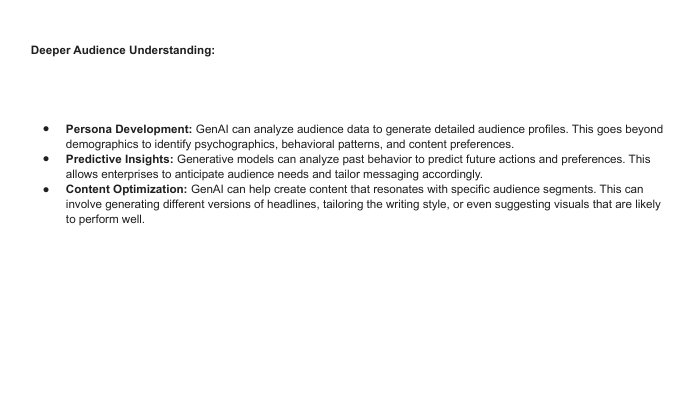
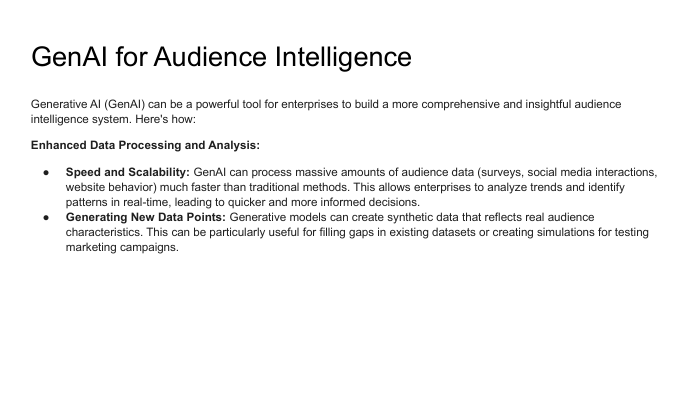
Generative AI can significantly enhance audience intelligence by leveraging advanced data analysis, pattern recognition, and content generation capabilities. Here's how it can be used to enrich user data and provide better signals for audience intelligence:


1. Data Enrichment

Generative AI can process and synthesize information from various sources, improving the quality and depth of user profiles.

  • Personalization Insights: By analyzing user-generated content (e.g., reviews, comments, social media posts), generative AI can infer interests, preferences, and behaviors that may not be explicitly stated.
  • Behavioral Trends: Generative models can analyze patterns in user interactions (e.g., browsing habits, clicks, purchases) and predict future behaviors or interests.
  • Unstructured Data Analysis: It can transform unstructured data, such as text, images, or videos, into structured insights, making the data actionable.

2. Synthesizing Audience Personas

Using generative AI, companies can create detailed audience personas based on patterns in demographic, psychographic, and behavioral data.

  • Cluster Identification: Segment audiences into micro-groups using clustering algorithms and generative AI to create synthetic personas that reflect the attributes of each cluster.
  • Emotion and Sentiment Analysis: Analyze sentiment from user feedback, reviews, or social media, revealing deeper emotional drivers that influence behavior.

3. Predictive Analytics for Audience Signals

Generative AI models can predict and simulate future audience behavior, providing actionable signals.

  • Content Consumption Predictions: Analyze what type of content resonates with which segments and recommend optimal times for engagement.
  • Customer Journey Mapping: Generate predictive pathways of a user’s journey to understand drop-off points and optimize conversion strategies.

4. Generating Insights from Sparse Data

Generative AI can infer missing data points or simulate scenarios when there is limited data.

  • Data Augmentation: Generate synthetic data based on existing patterns to enrich datasets for smaller user groups or low-traffic segments.
  • Anomaly Detection: Identify outliers in audience behavior that may signal emerging trends or potential issues.

5. Real-Time Insights

Generative AI can process data in real-time, offering timely and relevant insights into audience behavior.

  • Trend Spotting: Quickly identify trending topics, preferences, or shifts in user sentiment.
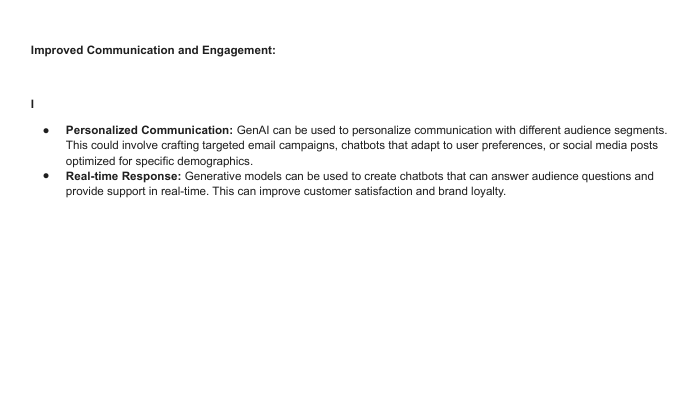
  • Dynamic Personalization: Tailor messages, offers, or recommendations instantly based on real-time audience responses.

6. Multi-Channel Signal Integration

Generative AI can unify data across multiple platforms and touchpoints to provide a comprehensive audience view.

  • Cross-Platform Consistency: Combine social media, email, website interactions, and offline data to create unified user profiles.
  • Journey Optimization: Understand the interconnectedness of touchpoints to optimize audience engagement strategies across channels.

How Companies Can Use These Capabilities

A. Improving Audience Segmentation

  • Leverage AI to group audiences more accurately based on enriched data, beyond traditional demographics.
  • Use generative AI to model audience behavior under different scenarios, such as launching new campaigns or products.

B. Enhancing Personalization

  • Deliver hyper-personalized recommendations by identifying unique patterns in user data.
  • Enable real-time content adaptation based on user engagement signals.

C. Predicting Lifetime Value

  • Use enriched data to model customer lifetime value (CLV) and tailor engagement strategies to maximize retention and value.

D. Informing Product Development

  • Analyze user feedback at scale to identify unmet needs or areas for improvement, helping shape product roadmaps.

E. Strengthening Marketing Effectiveness

  • Generate content tailored for specific audience segments using generative AI.
  • Refine targeting strategies by identifying key behavioral signals that predict conversion likelihood.

Conclusion

Generative AI transforms audience intelligence by synthesizing large, diverse datasets into actionable insights, enabling deeper personalization and smarter decision-making. By enriching user data and extracting better signals, companies can create more meaningful interactions, improve engagement, and drive business outcomes.


Dataknobs Blog

Showcase: 10 Production Use Cases

10 Use Cases Built By Dataknobs

Dataknobs delivers real, shipped outcomes across finance, healthcare, real estate, e‑commerce, and more—powered by GenAI, Agentic workflows, and classic ML. Explore detailed walk‑throughs of projects like Earnings Call Insights, E‑commerce Analytics with GenAI, Financial Planner AI, Kreatebots, Kreate Websites, Kreate CMS, Travel Agent Website, and Real Estate Agent tools.

Data Product Approach

Why Build Data Products

Companies should build data products because they transform raw data into actionable, reusable assets that directly drive business outcomes. Instead of treating data as a byproduct of operations, a data product approach emphasizes usability, governance, and value creation. Ultimately, they turn data from a cost center into a growth engine, unlocking compounding value across every function of the enterprise.

AI Agent for Business Analysis

Analyze reports, dashboard and determine To-do

Our structured‑data analysis agent connects to CSVs, SQL, and APIs; auto‑detects schemas; and standardizes formats. It finds trends, anomalies, correlations, and revenue opportunities using statistics, heuristics, and LLM reasoning. The output is crisp: prioritized insights and an action‑ready To‑Do list for operators and analysts.

AI Agent Tutorial

Agent AI Tutorial

Dive into slides and a hands‑on guide to agentic systems—perception, planning, memory, and action. Learn how agents coordinate tools, adapt via feedback, and make decisions in dynamic environments for automation, assistants, and robotics.

Build Data Products

How Dataknobs help in building data products

GenAI and Agentic AI accelerate data‑product development: generate synthetic data, enrich datasets, summarize and reason over large corpora, and automate reporting. Use them to detect anomalies, surface drivers, and power predictive models—while keeping humans in the loop for control and safety.

KreateHub

Create New knowledge with Prompt library

KreateHub turns prompts into reusable knowledge assets—experiment, track variants, and compose chains that transform raw data into decisions. It’s your workspace for rapid iteration, governance, and measurable impact.

Build Budget Plan for GenAI

CIO Guide to create GenAI Budget for 2025

A pragmatic playbook for CIOs/CTOs: scope the stack, forecast usage, model costs, and sequence investments across infra, safety, and business use cases. Apply the framework to IT first, then scale to enterprise functions.

RAG for Unstructured & Structured Data

RAG Use Cases and Implementation

Explore practical RAG patterns: unstructured corpora, tabular/SQL retrieval, and guardrails for accuracy and compliance. Implementation notes included.

Why knobs matter

Knobs are levers using which you manage output

The Drivetrain approach frames product building in four steps; “knobs” are the controllable inputs that move outcomes. Design clear metrics, expose the right levers, and iterate—control leads to compounding impact.

Our Products

KreateBots

  • Ready-to-use front-end—configure in minutes
  • Admin dashboard for full chatbot control
  • Integrated prompt management system
  • Personalization and memory modules
  • Conversation tracking and analytics
  • Continuous feedback learning loop
  • Deploy across GCP, Azure, or AWS
  • Add Retrieval-Augmented Generation (RAG) in seconds
  • Auto-generate FAQs for user queries
  • KreateWebsites

  • Build SEO-optimized sites powered by LLMs
  • Host on Azure, GCP, or AWS
  • Intelligent AI website designer
  • Agent-assisted website generation
  • End-to-end content automation
  • Content management for AI-driven websites
  • Available as SaaS or managed solution
  • Listed on Azure Marketplace
  • Kreate CMS

  • Purpose-built CMS for AI content pipelines
  • Track provenance for AI vs human edits
  • Monitor lineage and version history
  • Identify all pages using specific content
  • Remove or update AI-generated assets safely
  • Generate Slides

  • Instant slide decks from natural language prompts
  • Convert slides into interactive webpages
  • Optimize presentation pages for SEO
  • Content Compass

  • Auto-generate articles and blogs
  • Create and embed matching visuals
  • Link related topics for SEO ranking
  • AI-driven topic and content recommendations