"Managing Risks in LLMs: Safer AI Applications Explained"
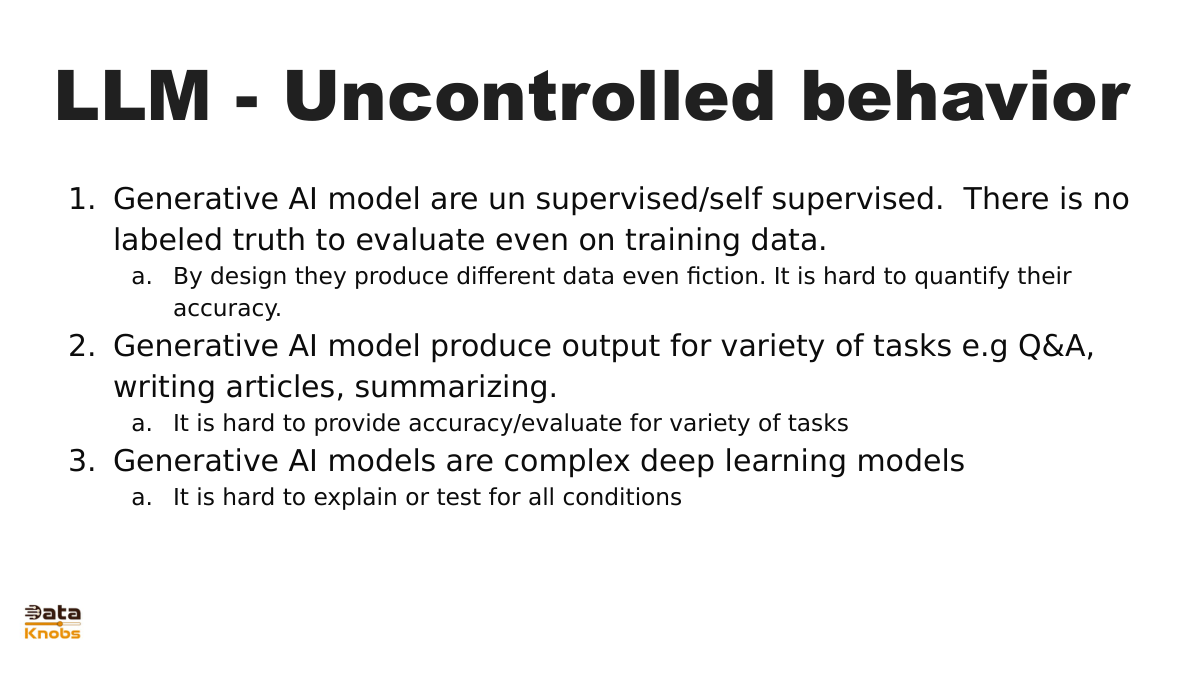
SLIDE48
SLIDE48


Section Description
Introduction
Large Language Models (LLMs) like GPT-3, GPT-4, and beyond have revolutionized applications in various domains, from natural language generation to conversational AI. However, they can also exhibit uncontrolled behavior in the form of inappropriate, biased, or nonsensical outputs. This article explores the risks posed by uncontrolled behavior in LLMs and strategies to design applications to mitigate these risks effectively.
Understanding Uncontrolled Behavior
LLMs are incredibly powerful, but their probabilistic nature can lead to unpredictable and unintended outcomes. Examples of uncontrolled behavior include:
  • Producing biased or offensive language based on training data.
  • Hallucinating facts or generating false information.
  • Generating responses that do not align with the context of the query.
These behaviors arise from the vast and often imperfect datasets used in training and the inherent difficulty in ensuring contextual relevance.
Concerns with Uncontrolled Outcomes
The implications of uncontrolled outputs from LLMs can be severe, particularly in sensitive domains:
  • Ethical Risks: Biased or offensive outputs can harm users or propagate stereotypes.
  • Misinformation: Incorrect outputs can spread false information, particularly in educational or healthcare applications.
  • Brand Reputation: Uncontrolled behavior can damage the credibility of companies deploying LLM-powered applications.
These risks underscore the importance of designing LLM integrations with caution.
Strategies for Mitigating Risks
Developers and organizations can take the following steps to minimize the potential for uncontrolled outputs in LLM-powered applications:
  1. Prompt Engineering: Design precise prompts to guide the model's behavior and reduce ambiguity in responses.
  2. Fine-Tuning: Train the model on domain-specific data to improve relevance and reduce bias.
  3. Output Filtering: Use post-processing techniques to sanitize outputs and remove inappropriate content.
  4. User Feedback Mechanisms: Allow users to flag inappropriate responses, helping to refine the application further.
  5. Contextual Constraints: Implement strict rules or use external databases to ensure the model stays within the desired scope.
Designing Responsible LLM Applications
To create applications that safeguard against uncontrolled LLM outputs, consider the following design principles:
  • AI Monitoring: Integrate monitoring tools that flag potentially harmful outputs in real-time.
  • Human-in-the-Loop: Include a human review process for critical applications like content moderation or customer support.
  • Transparency: Inform users when they are interacting with an AI model and provide disclaimers regarding its limitations.
  • Testing and Validation: Subject the application to rigorous testing before deployment to identify edge cases prone to uncontrolled behavior.
  • Ethical Guidelines: Adhere to ethical AI guidelines and industry standards to ensure responsible use.
These practices help


11-common-terms    14-assistant-agent-features    15-features-chatbot-assistants    16-evaluation-metrics    17-ai-assistant-evaluation-me    18-metric-for-each-response    19-technical-metrics    2-llm-topics-use-cases    2-topics-slides    20-search-metrics   

Dataknobs Blog

Showcase: 10 Production Use Cases

10 Use Cases Built By Dataknobs

Dataknobs delivers real, shipped outcomes across finance, healthcare, real estate, e‑commerce, and more—powered by GenAI, Agentic workflows, and classic ML. Explore detailed walk‑throughs of projects like Earnings Call Insights, E‑commerce Analytics with GenAI, Financial Planner AI, Kreatebots, Kreate Websites, Kreate CMS, Travel Agent Website, and Real Estate Agent tools.

Data Product Approach

Why Build Data Products

Companies should build data products because they transform raw data into actionable, reusable assets that directly drive business outcomes. Instead of treating data as a byproduct of operations, a data product approach emphasizes usability, governance, and value creation. Ultimately, they turn data from a cost center into a growth engine, unlocking compounding value across every function of the enterprise.

AI Agent for Business Analysis

Analyze reports, dashboard and determine To-do

Our structured‑data analysis agent connects to CSVs, SQL, and APIs; auto‑detects schemas; and standardizes formats. It finds trends, anomalies, correlations, and revenue opportunities using statistics, heuristics, and LLM reasoning. The output is crisp: prioritized insights and an action‑ready To‑Do list for operators and analysts.

AI Agent Tutorial

Agent AI Tutorial

Dive into slides and a hands‑on guide to agentic systems—perception, planning, memory, and action. Learn how agents coordinate tools, adapt via feedback, and make decisions in dynamic environments for automation, assistants, and robotics.

Build Data Products

How Dataknobs help in building data products

GenAI and Agentic AI accelerate data‑product development: generate synthetic data, enrich datasets, summarize and reason over large corpora, and automate reporting. Use them to detect anomalies, surface drivers, and power predictive models—while keeping humans in the loop for control and safety.

KreateHub

Create New knowledge with Prompt library

KreateHub turns prompts into reusable knowledge assets—experiment, track variants, and compose chains that transform raw data into decisions. It’s your workspace for rapid iteration, governance, and measurable impact.

Build Budget Plan for GenAI

CIO Guide to create GenAI Budget for 2025

A pragmatic playbook for CIOs/CTOs: scope the stack, forecast usage, model costs, and sequence investments across infra, safety, and business use cases. Apply the framework to IT first, then scale to enterprise functions.

RAG for Unstructured & Structured Data

RAG Use Cases and Implementation

Explore practical RAG patterns: unstructured corpora, tabular/SQL retrieval, and guardrails for accuracy and compliance. Implementation notes included.

Why knobs matter

Knobs are levers using which you manage output

The Drivetrain approach frames product building in four steps; “knobs” are the controllable inputs that move outcomes. Design clear metrics, expose the right levers, and iterate—control leads to compounding impact.

Our Products

KreateBots

  • Ready-to-use front-end—configure in minutes
  • Admin dashboard for full chatbot control
  • Integrated prompt management system
  • Personalization and memory modules
  • Conversation tracking and analytics
  • Continuous feedback learning loop
  • Deploy across GCP, Azure, or AWS
  • Add Retrieval-Augmented Generation (RAG) in seconds
  • Auto-generate FAQs for user queries
  • KreateWebsites

  • Build SEO-optimized sites powered by LLMs
  • Host on Azure, GCP, or AWS
  • Intelligent AI website designer
  • Agent-assisted website generation
  • End-to-end content automation
  • Content management for AI-driven websites
  • Available as SaaS or managed solution
  • Listed on Azure Marketplace
  • Kreate CMS

  • Purpose-built CMS for AI content pipelines
  • Track provenance for AI vs human edits
  • Monitor lineage and version history
  • Identify all pages using specific content
  • Remove or update AI-generated assets safely
  • Generate Slides

  • Instant slide decks from natural language prompts
  • Convert slides into interactive webpages
  • Optimize presentation pages for SEO
  • Content Compass

  • Auto-generate articles and blogs
  • Create and embed matching visuals
  • Link related topics for SEO ranking
  • AI-driven topic and content recommendations