Metrics for AI Assistants and Bot | Slides
assistant-bot-metrics


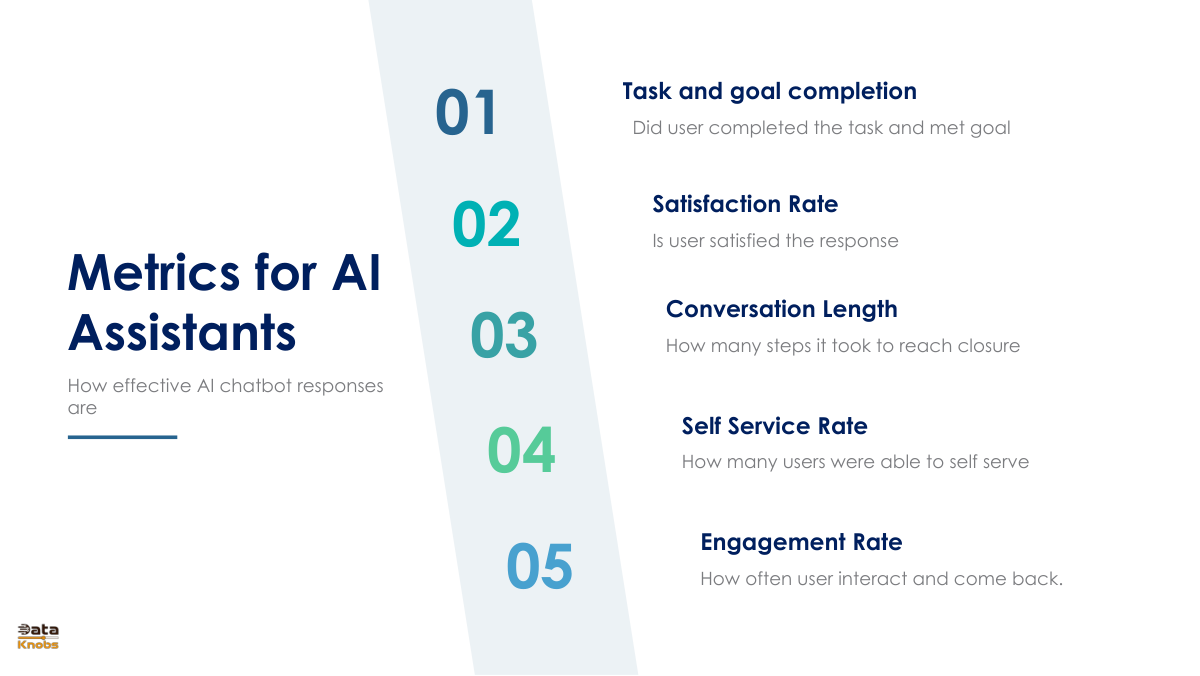
AI assistants are weaving themselves into the fabric of our lives, handling tasks, answering questions, and even predicting our needs. But with a growing sea of options, how do we truly know which assistant reigns supreme? While the surface may shine with flashy features, a deeper evaluation is crucial. Dataknobs offers a multi-pronged approach to AI assistant evaluation, using a diverse set of metrics that go beyond technical specs. Let's delve into these metrics and understand how they paint a comprehensive picture of an assistant's true capabilities.

1. Unveiling the Engine: Technical Prowess

The foundation of any AI assistant is its technical muscle. Dataknobs sheds light on these core functionalities:

  • Accuracy: The heart of the matter. This metric dissects how often the assistant grasps the user's intent (what they want) and accurately responds. It can be further broken down into intent accuracy (understanding the user's goal) and slot accuracy (extracting specific details like dates or locations).
  • Latency: Response time is king. Latency measures how swiftly the assistant processes a request and delivers a response. A speedy response keeps the interaction smooth and frustration-free.
  • Speech Recognition: Can the assistant understand you? This metric assesses how well the assistant deciphers spoken language, factoring in accents and background noise. Crystal clear communication is essential.
  • Natural Language Generation: Imagine an assistant that speaks gibberish! This metric evaluates the assistant's ability to formulate clear, grammatically correct, and natural-sounding responses.

2. Task-Specific Metrics: Going Beyond the Basics

Technical prowess is just one piece of the puzzle. Dataknobs dives deeper with task-specific metrics:

  • Task Completion Rate: Did the assistant get the job done? This metric measures the percentage of times the assistant successfully accomplishes a user's request, like booking a flight or reminding them to pick up milk.
  • Success Rate by Task Type: Not all tasks are created equal. This metric analyzes how well the assistant performs on different types of tasks (e.g., information retrieval vs. making appointments) to identify areas of strength and weakness.
  • Number of Steps Taken & Dialog Length: Less is often more. These metrics measure the number of interactions needed and the length of conversation required to complete a task. A lower number indicates a more efficient assistant.

3. The Human Factor: User Satisfaction

Technology serves humanity. Dataknobs recognizes the importance of user perception through these metrics:

  • Net Promoter Score (NPS): A widely used metric that measures user loyalty and their willingness to recommend the assistant to others. A high NPS indicates a happy user base.
  • Customer Satisfaction (CSAT): Cutting straight to the chase, CSAT surveys users directly to gauge their satisfaction with the assistant's performance and ease of use.
  • Number of Help Requests: A high volume of help requests might indicate a confusing or difficult-to-use assistant.
  • User Feedback Analysis: Numbers tell part of the story. Analyzing user feedback, both positive and negative, reveals specific pain points and areas for improvement.

4. A Holistic View: Beyond the Core

Dataknobs acknowledges that AI assistants exist within a broader ecosystem. Here are some additional metrics they consider:

  • Effort Saved: Time is precious. This metric measures the time and effort users save by using the AI assistant compared to completing tasks themselves.
  • Functionality: Versatility matters. This metric evaluates the range of tasks the assistant can perform, considering its adaptability to different user needs.
  • Privacy and Security: Trust is paramount. This metric assesses how well the assistant safeguards user data and ensures user privacy.

By employing a multi-metric approach, Dataknobs provides a well-rounded evaluation of AI assistants. This empowers users to make informed decisions and choose the assistant that best aligns with their needs and expectations. So, the next time you're considering an AI assistant, look beyond the marketing hype and delve into the world of evaluation metrics. After all, a truly intelligent assistant should not only be technically sound but also understand and cater to its human users.

100K-tokens    Agenda    Ai-assistant-architecture    Ai-assistant-building-blocks    Ai-assistant-custom-model    Ai-assistant-evaluation-metric    Ai-assistant-finetune-model    Ai-assistant-on-your-data    Ai-assistant-tech-stack    Ai-assistant-wrapper   

Dataknobs Blog

Showcase: 10 Production Use Cases

10 Use Cases Built By Dataknobs

Dataknobs delivers real, shipped outcomes across finance, healthcare, real estate, e‑commerce, and more—powered by GenAI, Agentic workflows, and classic ML. Explore detailed walk‑throughs of projects like Earnings Call Insights, E‑commerce Analytics with GenAI, Financial Planner AI, Kreatebots, Kreate Websites, Kreate CMS, Travel Agent Website, and Real Estate Agent tools.

Data Product Approach

Why Build Data Products

Companies should build data products because they transform raw data into actionable, reusable assets that directly drive business outcomes. Instead of treating data as a byproduct of operations, a data product approach emphasizes usability, governance, and value creation. Ultimately, they turn data from a cost center into a growth engine, unlocking compounding value across every function of the enterprise.

AI Agent for Business Analysis

Analyze reports, dashboard and determine To-do

Our structured‑data analysis agent connects to CSVs, SQL, and APIs; auto‑detects schemas; and standardizes formats. It finds trends, anomalies, correlations, and revenue opportunities using statistics, heuristics, and LLM reasoning. The output is crisp: prioritized insights and an action‑ready To‑Do list for operators and analysts.

AI Agent Tutorial

Agent AI Tutorial

Dive into slides and a hands‑on guide to agentic systems—perception, planning, memory, and action. Learn how agents coordinate tools, adapt via feedback, and make decisions in dynamic environments for automation, assistants, and robotics.

Build Data Products

How Dataknobs help in building data products

GenAI and Agentic AI accelerate data‑product development: generate synthetic data, enrich datasets, summarize and reason over large corpora, and automate reporting. Use them to detect anomalies, surface drivers, and power predictive models—while keeping humans in the loop for control and safety.

KreateHub

Create New knowledge with Prompt library

KreateHub turns prompts into reusable knowledge assets—experiment, track variants, and compose chains that transform raw data into decisions. It’s your workspace for rapid iteration, governance, and measurable impact.

Build Budget Plan for GenAI

CIO Guide to create GenAI Budget for 2025

A pragmatic playbook for CIOs/CTOs: scope the stack, forecast usage, model costs, and sequence investments across infra, safety, and business use cases. Apply the framework to IT first, then scale to enterprise functions.

RAG for Unstructured & Structured Data

RAG Use Cases and Implementation

Explore practical RAG patterns: unstructured corpora, tabular/SQL retrieval, and guardrails for accuracy and compliance. Implementation notes included.

Why knobs matter

Knobs are levers using which you manage output

The Drivetrain approach frames product building in four steps; “knobs” are the controllable inputs that move outcomes. Design clear metrics, expose the right levers, and iterate—control leads to compounding impact.

Our Products

KreateBots

  • Ready-to-use front-end—configure in minutes
  • Admin dashboard for full chatbot control
  • Integrated prompt management system
  • Personalization and memory modules
  • Conversation tracking and analytics
  • Continuous feedback learning loop
  • Deploy across GCP, Azure, or AWS
  • Add Retrieval-Augmented Generation (RAG) in seconds
  • Auto-generate FAQs for user queries
  • KreateWebsites

  • Build SEO-optimized sites powered by LLMs
  • Host on Azure, GCP, or AWS
  • Intelligent AI website designer
  • Agent-assisted website generation
  • End-to-end content automation
  • Content management for AI-driven websites
  • Available as SaaS or managed solution
  • Listed on Azure Marketplace
  • Kreate CMS

  • Purpose-built CMS for AI content pipelines
  • Track provenance for AI vs human edits
  • Monitor lineage and version history
  • Identify all pages using specific content
  • Remove or update AI-generated assets safely
  • Generate Slides

  • Instant slide decks from natural language prompts
  • Convert slides into interactive webpages
  • Optimize presentation pages for SEO
  • Content Compass

  • Auto-generate articles and blogs
  • Create and embed matching visuals
  • Link related topics for SEO ranking
  • AI-driven topic and content recommendations