Generative AI Technical Terms
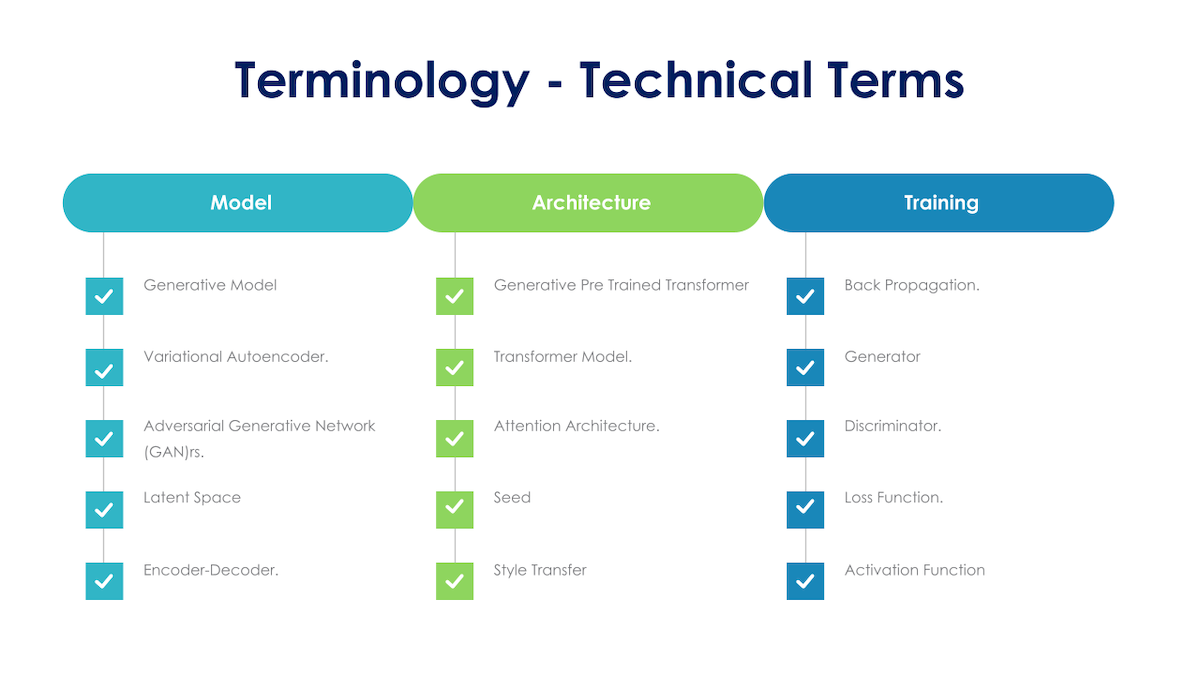
TECHNOLOGY TERMS GENAI


Generative AI: Shaping the Future of Content Creation

Generative AI (GAI) has emerged as a powerful subfield of artificial intelligence, with the ability to create entirely new data, be it text, code, images, or even music. This essay explores the core concepts behind GAI, its technical underpinnings, and its potential impact on various technical fields.

Understanding Generative Models:

At the heart of GAI lie generative models, a class of algorithms trained on massive datasets to learn the statistical patterns underlying a particular data type. Key terms in this context include:

Loss Function: This function measures the discrepancy between the model's generated output and the real data it's trained on. Popular loss functions include mean squared error (MSE) for continuous data and cross-entropy for discrete data.

Optimizer: This algorithm iteratively updates the model's internal parameters to minimize the loss function, effectively "teaching" the model to replicate the underlying data distribution. Common optimizers include stochastic gradient descent (SGD) and Adam.

Latent Space: In certain GAI architectures, a latent space is employed. This is a lower-dimensional representation of the input data, allowing for manipulation and generation of novel outputs.

Popular GAI Techniques:

Several prominent techniques power the world of GAI. These include:

Generative Adversarial Networks (GANs): GANs pit two neural networks against each other – a generator that creates new data, and a discriminator that tries to distinguish real data from the generated one. This adversarial training fosters continuous improvement in both networks, leading to increasingly realistic outputs.

Variational Autoencoders (VAEs): VAEs encode the input data into a compressed latent space, allowing for manipulation and reconstruction. They are particularly useful for tasks like anomaly detection and data compression.

Transformers: These deep learning architectures excel at learning long-range dependencies in sequential data. Transformer-based models are at the forefront of text-to-text generation and code generation.

Impact of Generative AI:

GAI holds immense potential across various technical domains:

Software Development: AI-powered code generation can automate repetitive coding tasks, accelerate development cycles, and even assist with bug detection and refactoring.

Content Creation: GAI can generate realistic images, videos, and music, revolutionizing the creative industries. However, concerns around copyright and potential misuse require careful consideration.

Drug Discovery: Generative models can be employed to design new molecules with desired properties, accelerating the drug discovery process. Data Augmentation: GAI can create synthetic data to augment existing datasets, improving the performance of machine learning models, especially in scenarios with limited real data.

Challenges and Considerations:

Despite its promise, GAI faces several challenges:

Bias: Biases present in the training data can be reflected in the generated outputs. Mitigating bias through careful data selection and model design is crucial.

Interpretability: Understanding the reasoning behind GAI outputs can be difficult. Explainable AI (XAI) techniques are critical for building trust and ensuring responsible use.

Safety and Security: Malicious actors could potentially exploit GAI to generate deepfakes or manipulate data for nefarious purposes. Robust security measures are necessary to address these concerns.


Adoption-framework    Ai-assistant-lifecycle    Ai-finance    Algorithms    Challenges-on-prem-generative    Considerations    Detail-notes    Digital-human    Elephant-and-monkey-generated    Elephant-monkey-story   

Dataknobs Blog

Showcase: 10 Production Use Cases

10 Use Cases Built By Dataknobs

Dataknobs delivers real, shipped outcomes across finance, healthcare, real estate, e‑commerce, and more—powered by GenAI, Agentic workflows, and classic ML. Explore detailed walk‑throughs of projects like Earnings Call Insights, E‑commerce Analytics with GenAI, Financial Planner AI, Kreatebots, Kreate Websites, Kreate CMS, Travel Agent Website, and Real Estate Agent tools.

Data Product Approach

Why Build Data Products

Companies should build data products because they transform raw data into actionable, reusable assets that directly drive business outcomes. Instead of treating data as a byproduct of operations, a data product approach emphasizes usability, governance, and value creation. Ultimately, they turn data from a cost center into a growth engine, unlocking compounding value across every function of the enterprise.

AI Agent for Business Analysis

Analyze reports, dashboard and determine To-do

Our structured‑data analysis agent connects to CSVs, SQL, and APIs; auto‑detects schemas; and standardizes formats. It finds trends, anomalies, correlations, and revenue opportunities using statistics, heuristics, and LLM reasoning. The output is crisp: prioritized insights and an action‑ready To‑Do list for operators and analysts.

AI Agent Tutorial

Agent AI Tutorial

Dive into slides and a hands‑on guide to agentic systems—perception, planning, memory, and action. Learn how agents coordinate tools, adapt via feedback, and make decisions in dynamic environments for automation, assistants, and robotics.

Build Data Products

How Dataknobs help in building data products

GenAI and Agentic AI accelerate data‑product development: generate synthetic data, enrich datasets, summarize and reason over large corpora, and automate reporting. Use them to detect anomalies, surface drivers, and power predictive models—while keeping humans in the loop for control and safety.

KreateHub

Create New knowledge with Prompt library

KreateHub turns prompts into reusable knowledge assets—experiment, track variants, and compose chains that transform raw data into decisions. It’s your workspace for rapid iteration, governance, and measurable impact.

Build Budget Plan for GenAI

CIO Guide to create GenAI Budget for 2025

A pragmatic playbook for CIOs/CTOs: scope the stack, forecast usage, model costs, and sequence investments across infra, safety, and business use cases. Apply the framework to IT first, then scale to enterprise functions.

RAG for Unstructured & Structured Data

RAG Use Cases and Implementation

Explore practical RAG patterns: unstructured corpora, tabular/SQL retrieval, and guardrails for accuracy and compliance. Implementation notes included.

Why knobs matter

Knobs are levers using which you manage output

The Drivetrain approach frames product building in four steps; “knobs” are the controllable inputs that move outcomes. Design clear metrics, expose the right levers, and iterate—control leads to compounding impact.

Our Products

KreateBots

  • Ready-to-use front-end—configure in minutes
  • Admin dashboard for full chatbot control
  • Integrated prompt management system
  • Personalization and memory modules
  • Conversation tracking and analytics
  • Continuous feedback learning loop
  • Deploy across GCP, Azure, or AWS
  • Add Retrieval-Augmented Generation (RAG) in seconds
  • Auto-generate FAQs for user queries
  • KreateWebsites

  • Build SEO-optimized sites powered by LLMs
  • Host on Azure, GCP, or AWS
  • Intelligent AI website designer
  • Agent-assisted website generation
  • End-to-end content automation
  • Content management for AI-driven websites
  • Available as SaaS or managed solution
  • Listed on Azure Marketplace
  • Kreate CMS

  • Purpose-built CMS for AI content pipelines
  • Track provenance for AI vs human edits
  • Monitor lineage and version history
  • Identify all pages using specific content
  • Remove or update AI-generated assets safely
  • Generate Slides

  • Instant slide decks from natural language prompts
  • Convert slides into interactive webpages
  • Optimize presentation pages for SEO
  • Content Compass

  • Auto-generate articles and blogs
  • Create and embed matching visuals
  • Link related topics for SEO ranking
  • AI-driven topic and content recommendations