In order to create a successful data product, it is essential to conduct experiments on two separate fronts at the same time: confirming the Technical Validity of the data, and proving the Market Validity for the user.
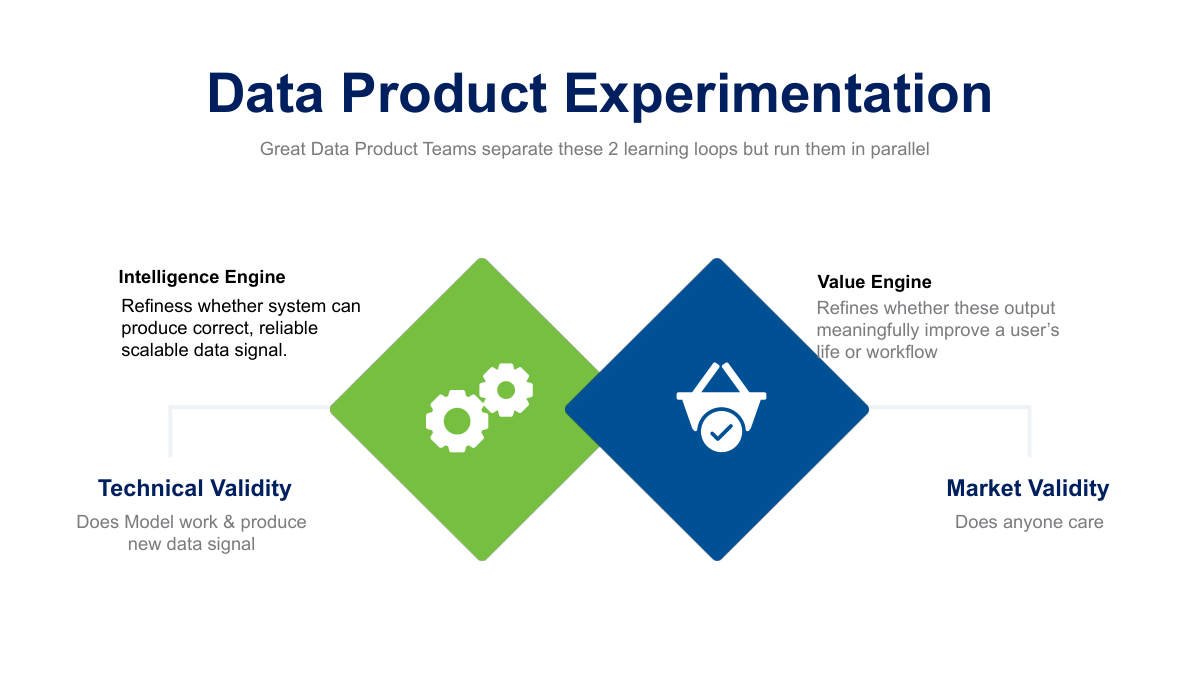
For a data product to succeed, it must have a balanced operation between two separate loops of experimentation: one focused on the accuracy of the mathematics, and the other on meeting the needs of the business.
This engine answers the question: "Does the algorithm actually work?" It emphasizes the importance of data science rigor, pipeline engineering, and statistical precision.
Evaluating precision, recall, RMSE, and other statistical metrics to verify the accuracy of the model's predictions.
Exploring methods for managing missing data, detecting outliers, and ensuring the pipeline maintains scalability while meeting SLA requirements.
Utilizing shadow models or champion/challenger setups to empirically demonstrate the superiority of a new algorithm over the previous one.
This engine answers the question: "Do users actually care?" The main areas of focus include product management, user experience, adoption, and achieving significant business outcomes.
Monitoring API requests, tracking daily active users on dashboards, and executing downstream queries on the data product.
Exploring different ways to deliver information (such as integrating insights into Salesforce or sending a daily email report).
Linking the utilization of the data product directly to business results such as higher conversion rates or lower operational expenses.
Improving the Intelligence Engine does not necessarily translate to improving the Value Engine, making building Data Products a complex challenge.
Improving an algorithm's accuracy from 92% to 94% can be a significant achievement for a Data Scientist. Technical win). Yet, should this increase in complexity result in a 3-second API latency, users may opt to abandon the tool altogether (a significant loss). Market failure).
Ensure that Technical R&D (Intelligence Engine) is always guided by the needs of User Adoption (Value Engine). Flawless calculations are worthless if they result in a negative user experience.
Don't separate your Data Scientists from your business users. Instead, master running coordinated technical and market experiments to speed up the value of your data.